- Start Your Free Consultation
- (866) 557-4343
A criminal record in Lubbock can follow you long after an arrest or conviction, showing up on the background checks that shape jobs, housing, professional licenses, and your standing in the community. Whether you were arrested but never convicted, completed deferred adjudication, or were acquitted, an expunction or order of nondisclosure can help you move forward with a clean slate. As your Lubbock expungement lawyer, we help people across Lubbock County work through Texas expunction and nondisclosure law to seal or destroy records and get them out of public view.
Our firm focuses on clearing records for clients up against background checks, license denials, and hiring barriers, expunction petitions, nondisclosure orders, and record-sealing for both misdemeanor and felony cases across Lubbock and the surrounding South Plains. Every case starts with a careful review of the arrest records, court dispositions, waiting periods, and eligibility under Texas law, and we work directly with the Lubbock County courts, the Texas Department of Public Safety, and law enforcement to pursue the relief you’re entitled to.
If you’re ready to look at your options for clearing your record in Lubbock, we offer confidential consultations to assess your eligibility, walk you through the process, and build a plan for your situation, including the real difference between expunction and nondisclosure, the timeline, and the steps to petition the court.


Board Certified
Only 1% of Attorney's in TX are Board Certified in Criminal Law

Phones Answered 24/7

5-Star
Google Ratings
over 500
11,500+ Cases Handled

We Fight for Dismissals and Never Back Down from Trial
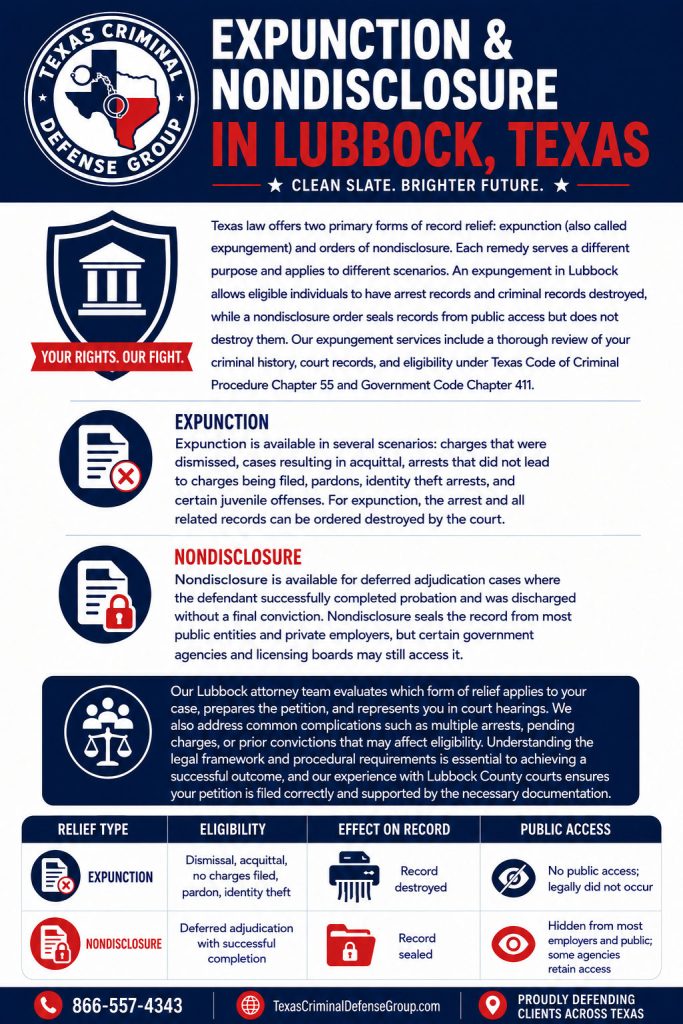
Texas law offers two main forms of record relief: expunction (also called expungement) and orders of nondisclosure. They do different things: an expungement in Lubbock destroys the arrest and criminal records, while a nondisclosure order seals them from public access without destroying them. Our expungement services start with a full review of your criminal history, court records, and eligibility under Texas Code of Criminal Procedure Chapter 55A and Texas Government Code Chapter 411.
Expunction is available in several situations: charges that were dismissed, cases ending in acquittal, arrests that never led to charges, pardons, identity-theft arrests, and certain juvenile offenses. With an expunction, the court can order the arrest and all related records destroyed. Nondisclosure is for deferred-adjudication cases where the defendant completed probation and was discharged without a final conviction; it seals the record from most public entities and private employers, though some government agencies and licensing boards can still see it.
Our Lubbock team figures out which form of relief fits your case, prepares the petition, and represents you at any hearing, and we handle the complications that come up, like multiple arrests, pending charges, or prior convictions that affect eligibility. Getting the legal framework and the procedure right is what makes the difference, and our experience in the Lubbock County courts keeps your petition filed correctly and backed by the right documentation.
| Relief Type | Eligibility | Effect on Record | Public Access | Where Filed in Lubbock |
|---|---|---|---|---|
| Expunction | Dismissal, acquittal, no charges filed, pardon, identity theft | Record destroyed | No public access; legally did not occur | Lubbock County District Court |
| Nondisclosure | Deferred adjudication with successful completion | Record sealed | Hidden from most employers and public; some agencies retain access | Court that handled your case |
Whether you qualify for expunction depends on how your case ended and how much time has passed since the arrest. Common qualifying scenarios include charges dismissed by the prosecutor or court, a not-guilty verdict at trial, arrests that never turned into formal charges, and mistaken-identity or identity-theft situations. Our lawyer in Lubbock reviews the arrest reports, court documents, and disposition records to see whether you meet the statutory criteria for expunction under Texas Code of Criminal Procedure Article 55.01.
If you were arrested for a Class C misdemeanor and the charge was dismissed, you may qualify for expunction immediately or after a short waiting period. For Class A and B misdemeanors, a waiting period can apply depending on why the case was dismissed, and felony cases have their own waiting periods and rules. One important limit: if you were convicted of any criminal offense within five years before the arrest, you may be ineligible for expunction. We run a full background and criminal-history review to flag any barriers and advise you on timing and strategy.
If you completed deferred-adjudication probation for a misdemeanor or felony in Lubbock County, you may be eligible for an order of nondisclosure. Deferred adjudication is community supervision where the judge holds off on a finding of guilt and dismisses the case on successful completion, but the arrest and court records stay public until you get the nondisclosure order. We file nondisclosure petitions and represent clients in hearings before Lubbock County judges.
Texas sets the nondisclosure waiting period by offense: some are eligible immediately on discharge, others require a two-year, five-year, or longer wait, and certain crimes, family violence offenses, sexual offenses, and registration offenses, are generally ineligible. Our Lubbock legal services include a detailed eligibility assessment, preparation of the petition, and advocacy in court to show that nondisclosure serves the interest of justice and will not compromise public safety.
Expunction law in Texas runs primarily through Chapter 55 of the Texas Code of Criminal Procedure, which sets the grounds for expunction, the filing and service procedures, the petitioner’s rights, and the obligations of law enforcement and government agencies. Under Article 55.01, you’re entitled to expunction if the charges were dismissed or quashed, you were acquitted, you were convicted and later pardoned or found innocent, or the arrest resulted from identity theft.
Texas imposes waiting periods on certain expunctions based on the offense level and how the case was resolved. A felony arrest that ended in dismissal generally requires a wait before you can file, while a misdemeanor dismissal may carry a shorter one. Because these timelines can hold up a job offer or another time-sensitive plan, talking to an expungement attorney in Lubbock early is worth it.
If no charges were filed after your arrest, you may have to wait a statutory period, often 180 days for Class C misdemeanors, two years for Class A and B misdemeanors, and three years for felonies, before petitioning for expunction. Acquittals and dismissals after trial or by prosecutorial discretion usually carry different waiting periods, or none. We track these deadlines and file the moment you’re eligible, so your arrest record spends the least time possible in front of employers and licensing agencies.

Helping Good People Through Tough Times
Texas expungement and nondisclosure law runs primarily through Chapter 55 of the Texas Code of Criminal Procedure for expunctions and Subchapter E-1 of Chapter 411 of the Texas Government Code for orders of nondisclosure. Those statutes set the eligibility criteria, the procedure, and the effect of each type of relief, and getting them right is what keeps a petition from being denied or delayed.
Article 55.01 of the Texas Code of Criminal Procedure spells out when a person is entitled to expunction, acquittals, dismissals, pardons, and certain juvenile offenses. Article 55.02 covers the petition process, notice requirements, and hearing procedures. Article 55.03 handles expunctions for people who complete pretrial intervention or veterans treatment court programs.
Orders of nondisclosure run through Section 411.0725 and related provisions, which set the waiting periods and eligibility by offense type and whether the case involved deferred adjudication. Certain misdemeanors can qualify for immediate nondisclosure on discharge from deferred adjudication, while others take two or five years, and felonies and certain violent or sexual offenses may be excluded entirely.
Not every record can be cleared. Texas law specifically keeps some offenses out of record relief, most sex offenses, family violence offenses, and offenses involving injury to children or the elderly. Even with a completed deferred adjudication or a dismissal, those generally can’t be sealed or expunged, on public-safety and victim-protection grounds.
And if you were convicted, or placed on regular community supervision rather than deferred adjudication, you aren’t eligible for expungement or nondisclosure unless the conviction was later overturned or you were pardoned. A criminal defense attorney in Lubbock can review the specific facts and any legal developments to see what remedies are actually on the table.
A Texas expungement order only reaches records held by Texas state and local agencies. It doesn’t automatically pull information from federal databases like the FBI’s, or from records held by other states, so if your arrest generated federal records, you may need a separate federal expungement proceeding, which follows different rules.
The same goes for records in other states, which are governed by that state’s sealing or expungement law. A Lubbock expungement lawyer can coordinate with attorneys elsewhere to deal with out-of-state records and advise you on the limits of a Texas order when your records span multiple jurisdictions.
| Legal Provision | Scope | Key Requirements |
|---|---|---|
| Texas Code of Criminal Procedure Chapter 55A | Expunction eligibility conditions | Acquittal, dismissal, no charges filed, pardon, identity theft, or qualifying statutory circumstances |
| Texas Code of Criminal Procedure Chapter 55A | Expunction petition procedures | Detailed petition, identifying information, notice to agencies, and court hearing if an objection is filed |
| Texas Government Code Section 411.0725 | Nondisclosure for deferred adjudication | Successful completion of deferred adjudication, applicable waiting period, and eligible offense type |
| Texas Code of Criminal Procedure Chapter 55A | Expunction for qualifying diversion, specialty court, and dismissed cases | Completion of eligible program, dismissal of charges, or another qualifying expunction basis under Chapter 55A |
What Our
Clients Are Saying?
With Over 500 5-Star Reviews TCGD Have a Track Record of Client
Clients usually ask about cost and timeline. The cost typically covers attorney fees, court filing fees, and fees for certified copies and service of process, and the attorney fee depends on the complexity, the number of charges, and whether a contested hearing is needed, we lay it out plainly at the consultation.
The timeline depends on the court’s docket, how quickly law enforcement responds, and whether the district attorney objects. Uncontested cases often run three to six months from filing to final order; contested cases or ones needing a hearing take longer. We keep you posted at each stage and push to move it along wherever we can.
Some clients qualify for immediate expunction or nondisclosure; others have to wait out a statutory period. A nondisclosure petition for certain deferred-adjudication misdemeanors can be filed immediately on discharge, while others require a two-year wait. We calculate the applicable period from the offense and the discharge date, and file as soon as you’re eligible.