- Start Your Free Consultation
- (866) 557-4343
When you face drug charges in Dallas, the consequences can disrupt every aspect of your life. A drug conviction can result in jail time, substantial fines, a permanent criminal record, and the loss of professional licenses. Whether you’re dealing with possession charges, distribution allegations, or manufacturing accusations, securing experienced legal representation is essential to protecting your future. A Dallas drug lawyer understands Texas controlled substance laws, local court procedures, and the prosecution strategies used in Dallas County. The right criminal defense lawyer can challenge evidence, negotiate with prosecutors, and build a defense strategy tailored to the specific facts of your case.


Board Certified
Only 1% of Attorney's in TX are Board Certified in Criminal Law

Phones Answered 24/7

5-Star
Google Ratings
over 500
11,500+ Cases Handled

We Fight for Dismissals and Never Back Down from Trial
| Penalty Group | Common Substances | Possession Classification | Key Legal Considerations | Potential Consequences |
|---|---|---|---|---|
| Penalty Group 1 | Cocaine, methamphetamine, heroin, opiates, GHB | State jail felony to first-degree felony | Harshest penalties; less than 1 gram may qualify as state jail felony | 180 days to life in prison, fines up to $250,000 |
| Penalty Group 1-A | LSD and certain hallucinogens | State jail felony to first-degree felony | Measured in abuse units rather than weight | 180 days to life in prison, fines up to $250,000 |
| Penalty Group 2 | Ecstasy (MDMA), PCP, mescaline, mushrooms | State jail felony to first-degree felony | Similar structure to Group 1 with slightly lower penalties | 180 days to life in prison, fines up to $50,000-$250,000 |
| Penalty Group 3 | Valium, Xanax, Ritalin, anabolic steroids | Class A misdemeanor to second-degree felony | Prescription medications with abuse potential | Up to 1 year to 20 years, fines up to $10,000 |
| Penalty Group 4 | Compounds with limited narcotic content | Class B misdemeanor to first-degree felony | Lower penalties; often probation-eligible | Up to 180 days to life in prison, fines vary |
| Marijuana (Cannabis) | Cannabis, hashish, concentrates, edibles, THC | Class B misdemeanor to felony | Separate classification with distinct penalty structure | Up to 180 days to life in prison depending on weight |
Texas law classifies controlled substances into penalty groups that determine the severity of charges and potential sentences. The Texas Health and Safety Code divides drugs into Penalty Groups 1, 1-A, 2, 3, and 4, with Group 1 including substances like cocaine, methamphetamine, and heroin. Weed occupies its own category with specific weight thresholds. A Dallas criminal lawyer who focuses on drug offenses understands how prosecutors apply these classifications and how the amount of a controlled substance affects whether you face state jail felony charges or first-degree felony charges. Even possession of a small amount of certain drugs can trigger felony prosecution, while larger quantities may lead to intent-to-distribute charges.
The weight of the controlled substance plays a critical role in sentencing under the Texas Penal Code. For example, possession of less than one gram of cocaine is a state jail felony, while possession of 400 grams or more can result in a first-degree felony with a potential life sentence. A lawyer in Dallas with experience in drug cases understands how to challenge the state’s evidence regarding weight, purity, and usable quantity. Prosecutors must prove every element of the offense beyond a reasonable doubt, and a skilled criminal defense lawyer will scrutinize lab reports, chain of custody documentation, and testing procedures to identify weaknesses in the state’s case.

Elite Drug Defense
Top-rated attorneys in Texas
Drug cases in Dallas County are prosecuted by the Dallas County District Attorney’s Office, which handles thousands of felony drug offenses each year. Misdemeanor drug charges are typically prosecuted in county criminal courts, while felony drug charges move through the district courts. The court you appear in, the judge assigned to your case, and the prosecutor handling your file can all influence the strategy your Dallas drug attorney employs. Local prosecutors in Dallas have specific policies regarding plea negotiations, diversion programs, and sentencing recommendations that vary from other Texas counties.
Dallas County offers pretrial diversion programs for eligible defendants, including first-time offenders facing possession charges. These programs can involve drug education classes, community service, and regular drug testing in exchange for dismissal of charges upon successful completion. However, eligibility requirements are strict, and prosecutors retain discretion over who qualifies. A criminal defense lawyer in Dallas can advocate for your participation in these programs and present mitigating factors that support alternative sentencing. When diversion is not an option, your attorney must be prepared to challenge the evidence at trial and pursue acquittal or reduced charges.
Possession charges are the most common drug offenses in Dallas. Texas law defines possession as knowingly or intentionally possessing a controlled substance without a valid prescription. Prosecutors must prove that you knew the substance was present and that you exercised control over it. This requirement creates opportunities for defense. If drugs were found in a shared vehicle, apartment, or public space, your attorney can argue that you lacked knowledge or control. If police conducted an unlawful search, any evidence obtained may be inadmissible. A lawyer in Texas who handles drug possession cases will examine the circumstances of your arrest, review police reports, and interview witnesses to build a defense strategy focused on reasonable doubt.
Your constitutional rights are the foundation of any defense strategy. The Fourth Amendment protects you from unreasonable searches and seizures, and the Fifth Amendment protects you from self-incrimination. If police question you without providing Miranda warnings or continue interrogation after you invoke your right to counsel, any statements you made may be inadmissible. A Texas criminal lawyer will review audio and video recordings, witness statements, and police reports to identify violations of your rights. Protecting these rights is not just about legal technicalities—it’s about ensuring that law enforcement respects the constitutional limits on their power.
Another common defense strategy involves challenging the chain of custody for drug evidence. From the moment of seizure to the time of trial, the controlled substance must be properly documented, stored, and tested. Any break in the chain of custody raises questions about whether the substance presented in court is the same substance seized from you. Crime labs must follow strict protocols, and a drug defense lawyer can subpoena lab records, request independent testing, and cross-examine lab technicians to identify errors or contamination. Even minor discrepancies in documentation can create reasonable doubt.
Many drug cases rely on information from confidential informants. A defense lawyer in Dallas will challenge the reliability and credibility of informant testimony, examine whether the informant had a motive to lie, and review law enforcement procedures for handling informants. Courts require police to corroborate informant statements before relying on them to establish probable cause for a warrant or arrest. If the informant’s information is unverified or contradicted by other evidence, your attorney can argue that the search or arrest was unlawful.
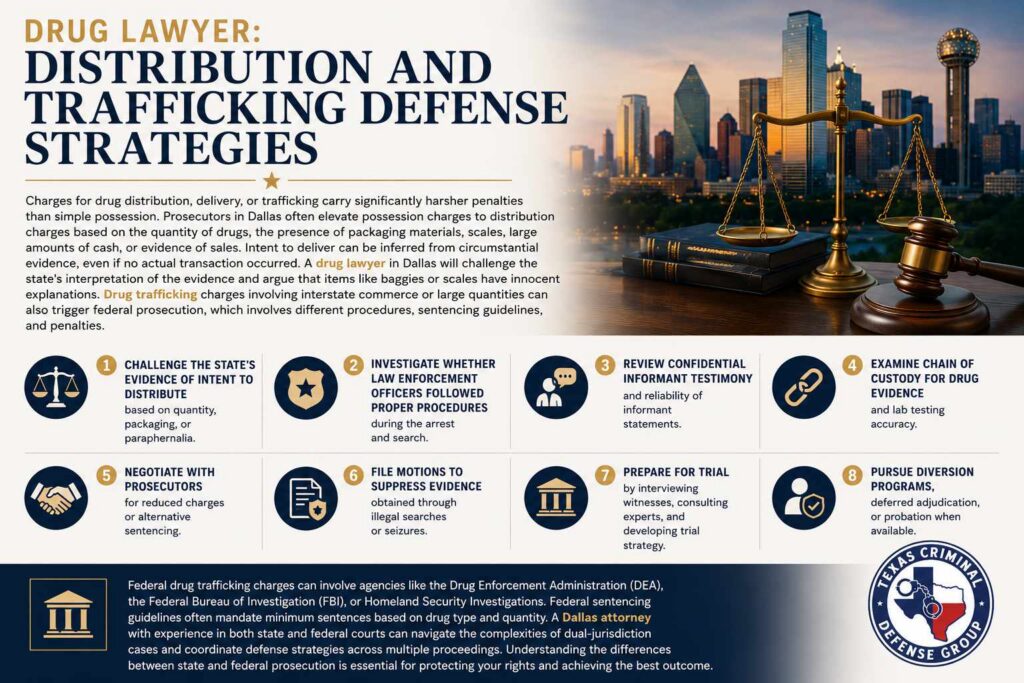
Charges for drug distribution, delivery, or trafficking carry significantly harsher penalties than simple possession. Prosecutors in Dallas often elevate possession charges to distribution charges based on the quantity of drugs, the presence of packaging materials, scales, large amounts of cash, or evidence of sales. Intent to deliver can be inferred from circumstantial evidence, even if no actual transaction occurred. A drug lawyer in Dallas will challenge the state’s interpretation of the evidence and argue that items like baggies or scales have innocent explanations. Drug trafficking charges involving interstate commerce or large quantities can also trigger federal prosecution, which involves different procedures, sentencing guidelines, and penalties.
Federal drug trafficking charges can involve agencies like the Drug Enforcement Administration (DEA), the Federal Bureau of Investigation (FBI), or Homeland Security Investigations. Federal sentencing guidelines often mandate minimum sentences based on drug type and quantity. A Dallas attorney with experience in both state and federal courts can navigate the complexities of dual-jurisdiction cases and coordinate defense strategies across multiple proceedings. Understanding the differences between state and federal prosecution is essential for protecting your rights and achieving the best outcome.
We Defend You Like Family
Helping Good People Through Tough Times
A drug conviction creates long-term consequences beyond jail time and fines. A criminal record can disqualify you from employment opportunities, professional license, student loans, and public housing. Immigration consequences can include deportation for non-citizens. Your ability to own a weapon may be permanently restricted. A conviction can also be used to enhance future charges if you are arrested again. A law firm in Dallas that focuses on criminal defense understands these collateral consequences and will fight to avoid a conviction or minimize the damage through expungement, nondisclosure orders, or record sealing when available under Texas law.
Expungement allows you to have your arrest record destroyed, as if the arrest never occurred. Nondisclosure orders restrict access to your criminal record for most employers and landlords, though law enforcement and certain licensing agencies retain access. Eligibility for expungement or nondisclosure depends on the outcome of your case and your criminal history. If charges are dismissed, you are acquitted, or you successfully complete deferred adjudication, you may qualify for relief. A criminal defense lawyer can guide you through the petition process and advocate for your right to a clean slate.
Dallas County has been at the forefront of criminal justice reform efforts in Texas. The District Attorney’s Office has implemented policies focused on diversion, treatment, and reducing incarceration for low-level drug offenses for things like marijuana or weed. However, these policies do not apply to all defendants or all drug charges. Serious offenses like trafficking, manufacturing, and distribution are still aggressively prosecuted. A criminal defense lawyer in Dallas must understand the current policies and how they apply to your specific case. What works for one defendant may not be available to another, and your attorney must tailor the defense strategy to your unique circumstances.
Understanding the political and policy landscape in Dallas is part of effective representation. Changes in administration, shifts in public opinion, and developments in drug policy can all influence prosecution decisions, even things like CBD and THC derivatives can be controversial . Your attorney should be engaged with these issues and able to leverage them in your favor when appropriate. A lawyer who is active in the local legal community, who knows the players, and who stays current with policy changes can provide a level of representation that goes beyond legal knowledge alone. The prosecutor assigned to your case, the criminal attorney strategies they employ, and the criminal law standards they apply all affect case outcomes.
Sentencing for drug convictions in Dallas depends on the offense level, your criminal history, and aggravating or mitigating factors. Texas law allows for probation in many drug cases, even for felony offenses, if the defendant is eligible and the judge agrees. Community supervision can include conditions like drug treatment, counseling, regular drug testing, community service, and curfews. A criminal defense lawyer in Dallas will present evidence of your character, employment history, family support, and willingness to participate in treatment to persuade the court that probation is appropriate. When incarceration is unavoidable, your attorney will advocate for the shortest possible sentence and argue against enhancements.
| Offense Level | Typical Sentence Range | Probation Eligibility | Mitigating Factors |
|---|---|---|---|
| Class B Misdemeanor | Up to 180 days in jail, fine up to $2,000 | Often eligible | First-time offense, small quantity, no prior record |
| Class A Misdemeanor | Up to 1 year in jail, fine up to $4,000 | Often eligible | Lack of criminal history, employment, family ties |
| State Jail Felony | 180 days to 2 years in state jail | May be eligible | First offense, agreement to treatment, restitution |
| Third-Degree Felony | 2 to 10 years in prison | Possible with negotiation | Cooperation, lack of violence, successful treatment history |
| Second-Degree Felony | 2 to 20 years in prison | Difficult but possible | Strong mitigation, exceptional circumstances |
| First-Degree Felony | 5 to 99 years or life in prison | Rarely available | Substantial assistance to prosecution, extraordinary mitigation |
Repeat offenders face enhanced penalties under Texas habitual offender statutes. If you have prior felony convictions, the state can seek enhanced punishment that increases the minimum and maximum sentences. A lawyer in Dallas who understands enhancement statutes can challenge the use of prior convictions, argue for concurrent sentences, or negotiate for a lower charge that avoids enhancement. The difference between a standard sentence and an enhanced sentence can be measured in decades, making skilled legal representation critical.
What Our
Clients Are Saying?
With Over 500 5-Star Reviews TCGD Have a Track Record of Client


From the moment of arrest, your constitutional rights are at stake. Law enforcement officers must advise you of your Miranda rights before conducting custodial interrogation. If officers fail to provide these warnings, any statements you make may be suppressed. You also have the right to remain silent and the right to an attorney. Exercising these rights cannot be used against you at trial.
Many defendants make the mistake of speaking to police without an attorney present, believing they can talk their way out of trouble. In reality, anything you say can and will be used against you. Even seemingly innocent statements can be twisted to support the prosecution’s theory of the case. A criminal defense lawyer in Dallas will advise you to invoke your right to silence and your right to counsel immediately upon arrest. This protects you from self-incrimination and ensures that your attorney can begin building your defense without damaging admissions.
After arrest, defendants are typically taken before a magistrate for a bail hearing. The court will consider factors such as the severity of the charge, the defendant’s criminal history, ties to the community, and flight risk when setting bail. In drug trafficking cases or cases involving large quantities of controlled substances, bail may be set very high or denied altogether. Your attorney can present evidence at the bail hearing to argue for a reasonable bond amount or for release on personal recognizance.
If bail is set at an amount you cannot afford, your Dallas drug attorney can file a motion for bond reduction and present evidence of your employment, family ties, and community roots. In some cases, electronic monitoring or other conditions can be imposed to allow release while ensuring you appear for future court dates. Securing release on bail is important because it allows you to work
We begin by gathering all available evidence, including police reports, witness statements, video footage, lab reports, and any physical evidence. We interview witnesses, visit the scene of the alleged crime, and consult with expert witnesses when necessary. The goal is to identify weaknesses in the prosecution’s case and build a compelling defense narrative.
Many criminal cases in Dallas County are won or lost on pretrial motions. If law enforcement conducted an illegal search, obtained a confession without proper Miranda warnings, or violated your constitutional rights, we file motions to suppress that evidence. Without key evidence, the prosecution may be forced to reduce charges or dismiss the case entirely.
Not every case goes to trial. When the evidence is strong or when a plea agreement serves the client’s best interests, we negotiate with Dallas County prosecutors to secure reduced charges, deferred adjudication, or alternative sentencing options. Programs such as drug court, veterans court, or mental health diversion can help clients avoid conviction and address underlying issues.
If your case goes to trial, our criminal lawyers are prepared to present a vigorous defense. We cross-examine witnesses, challenge the state’s evidence, present defense witnesses, and argue legal points to the judge and jury. Our goal is to create reasonable doubt and secure an acquittal.