- Start Your Free Consultation
- (866) 557-4343
Protect Your Freedom and Future With a Dallas Intoxication Manslaughter Defense Team Prepared to Challenge Causation, Toxicology, and Crash Evidence
Get Experienced Felony Defense From Attorneys Who Understand Blood Testing, Accident Reconstruction, and Dallas County Court Procedures
Take Immediate Action With Trial-Ready Defense Lawyers Focused on Reducing Charges, Challenging the State’s Case, and Pursuing the Best Possible Outcome
Facing an intoxication manslaughter charge in Dallas represents one of the most serious criminal accusations in Texas law. This second-degree felony carries consequences that extend far beyond potential imprisonment—impacting your professional license, employment prospects, constitutional rights, and personal reputation for decades. When prosecutors allege that intoxication caused the death of another person, the investigation typically involves accident reconstruction experts, toxicology analysis, witness testimony, and complex causation arguments that require immediate strategic defense work.
An intoxication manslaughter case unfolds differently than standard DWI prosecution because the state must establish not only that you operated a vehicle while intoxicated, but also that your intoxicated operation directly caused another person’s death. This causation element creates substantial defense opportunities when multiple factors contributed to the fatal car accident. Blood alcohol concentration testing procedures, accident reconstruction methodology, witness perception accuracy, medical causation opinions, and constitutional search issues all become critical battlegrounds where early investigation and expert consultation can preserve exculpatory evidence before it disappears.
The Dallas County criminal justice system processes intoxication manslaughter cases through specialized felony courts where prosecutors pursue maximum sentences and civil liability runs parallel to criminal exposure. Insurance companies investigate independently, civil wrongful death claims develop simultaneously, media attention complicates jury pool concerns, and family members of the deceased often attend court proceedings. This multi-front legal crisis demands coordinated defense strategy that addresses criminal exposure while protecting against collateral consequences that can prove equally devastating.


Board Certified
Only 1% of Attorney's in TX are Board Certified in Criminal Law

Phones Answered 24/7

5-Star
Google Ratings
over 500
11,500+ Cases Handled

We Fight for Dismissals and Never Back Down from Trial

Elite Defense
Top-rated attorneys in Texas
Who We Are
A criminal charge of any type has the ability to send an accused individual's life into complete upheaval.
Texas Penal Code Section 49.08 defines intoxication manslaughter as causing the death of another person by accident or mistake while operating a motor vehicle in a public place, operating an aircraft, watercraft, or amusement ride, or assembling a mobile amusement ride while intoxicated. The statutory framework requires prosecutors to prove beyond reasonable doubt that the defendant was intoxicated and that this intoxication caused the death through reckless conduct creating substantial and unjustifiable risk.
Intoxication under Texas law means lacking normal use of mental or physical faculties due to introduction of alcohol, a controlled substance, a drug, a dangerous drug, or any combination of those substances, or having a blood alcohol concentration of 0.08 or more. This dual definition creates two prosecution pathways: per se intoxication based solely on blood alcohol concentration measurements, or impairment-based intoxication established through officer observations, field sobriety test performance, driving conduct, and circumstantial evidence of diminished faculties.

Unwavering commitment to protecting your rights.

Handling complex cases across all Texas courts.
| Legal Element | Prosecution Burden | Common Defense Strategies |
|---|---|---|
| Operation of Vehicle | Evidence defendant controlled vehicle in public place | Challenge witness identification, dispute control or operation |
| Intoxication | Blood alcohol concentration ≥0.08 or loss of normal mental/physical faculties | Contest blood test accuracy, challenge field sobriety administration, question collection procedures |
| Death by Accident | Victim died as result of the incident | Examine medical causation, investigate pre-existing conditions |
| Causation | Intoxication was proximate cause of death | Identify alternative causes: weather, road defects, other drivers, mechanical failure |
The definition of intoxication under Texas law encompasses two distinct standards. The first is per se intoxication, established when a defendant’s blood alcohol concentration meets or exceeds 0.08 grams per 100 milliliters of blood. The second standard applies when a person lacks the normal use of mental or physical faculties by reason of the introduction of alcohol, a controlled substance, a drug, a dangerous drug, a combination of two or more of those substances, or any other substance into the body. This broader definition allows prosecutors to pursue charges even when blood alcohol levels fall below the statutory threshold, relying instead on witness observations, field sobriety test results, and expert testimony about impairment. A skilled Dallas criminal defense attorney scrutinizes the evidence supporting either theory of intoxication, often finding weaknesses in the state’s case related to testing protocols, witness credibility, or alternative explanations for observed behavior.
Causation represents the most contested element in many intoxication manslaughter prosecutions. Texas law requires proof that the defendant’s intoxication was a proximate cause of the death—meaning it was a substantial factor in bringing about the death and that the death was a foreseeable result of the intoxicated operation. This standard does not require the intoxication to be the sole cause; other contributing factors may exist. However, when accident reconstruction reveals significant alternative causes such as another driver running a red light, defective traffic signals, poor road design, or the victim’s failure to wear a seatbelt, a Texas manslaughter attorney can argue that the intoxication was not a substantial factor or that the death was not a foreseeable consequence of the defendant’s conduct. Expert testimony from accident reconstruction specialists, toxicologists, and biomechanical engineers often proves crucial in challenging the prosecution’s causation theory.
Helping Good People Through Tough Times
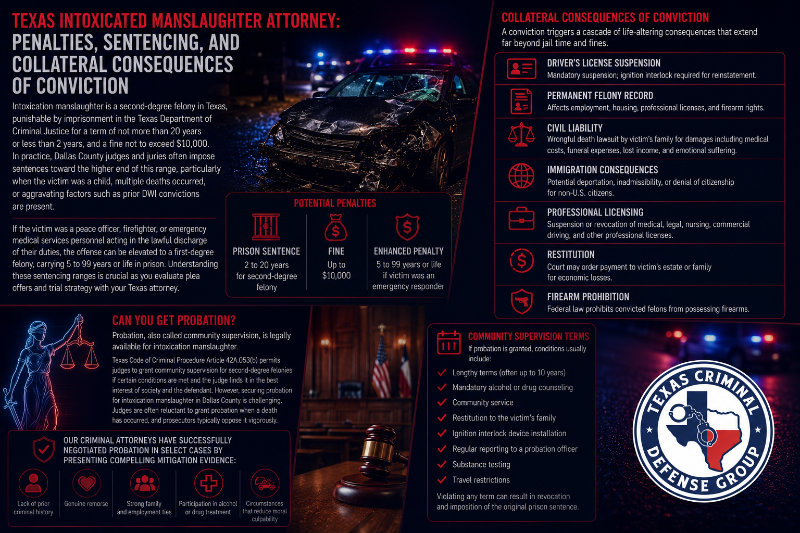
Beyond incarceration and fines, a conviction triggers a cascade of collateral consequences. Your driver’s license will be suspended . You will have a permanent felony conviction on your criminal record, affecting employment, professional licensing, housing, and educational opportunities. Federal law prohibits convicted felons from possessing firearms . Immigration consequences can include deportation or denial of naturalization for non-citizens. If you are a licensed professional, including a doctor, nurse, lawyer, teacher, commercial driver, your license may be revoked or suspended. Civil liability is also a certainty: the family of the deceased will almost certainly file a wrongful death lawsuit seeking damages for medical expenses, funeral costs, loss of companionship, and pain and suffering. While our firm focuses on criminal defense, we coordinate with civil attorneys to manage the overlap and protect your interests in both arenas.
Probation, also called community supervision , is legally available for intoxication manslaughter. Texas Code of Criminal Procedure Article 42A.053(b) permits judges to grant community supervision for second-degree felonies if certain conditions are met and the judge finds it in the best interest of society and the defendant. However, securing probation for intoxication manslaughter in Dallas County is challenging. Judges are often reluctant to grant probation when a death has occurred, and prosecutors typically oppose it vigorously. Nonetheless, our criminal attorneys have successfully negotiated probation in select cases by presenting compelling mitigation evidence: lack of prior criminal history, genuine remorse, participation in alcohol or drug treatment, strong family and employment ties, and circumstances of the accident that reduce moral culpability. When probation is granted, conditions usually include lengthy terms, often the maximum 10 years, mandatory alcohol or drug counseling, community service, restitution to the victim’s family, ignition interlock device installation, and regular reporting to a probation officer. Violating any term can result in revocation and imposition of the original prison sentence.
What Our
Clients Are Saying?
With Over 500 5-Star Reviews TCGD Have a Track Record of Client
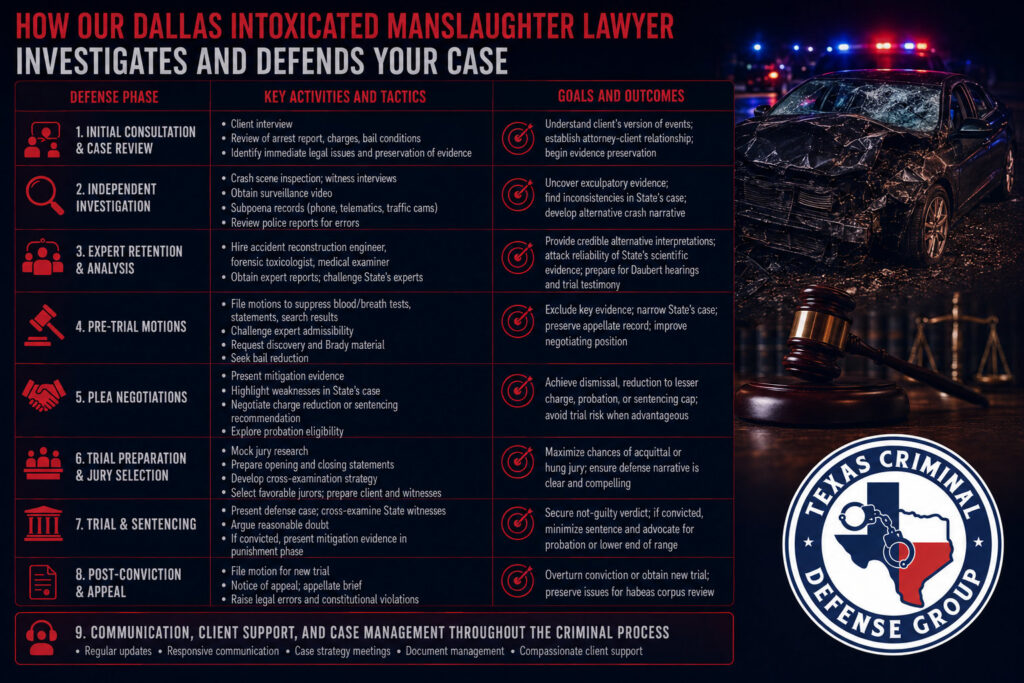
Effective defense against intoxication manslaughter charges begins immediately after arrest. The hours and days following a fatal accident represent the most critical period for evidence preservation, witness interviews, and constitutional challenge preparation. Law enforcement agencies dedicate substantial resources to these investigations, deploying crash reconstruction specialists, forensic toxicologists, and experienced prosecutors who build cases methodically. A manslaughter defense attorney must match this intensity with equally thorough investigation, expert consultation, and aggressive pre-trial motion practice.
Our defense approach addresses every stage of the prosecution’s case, from the initial traffic stop or accident response through blood sample analysis and causation theories. We retain independent accident reconstruction experts who examine skid marks, vehicle damage patterns, point of impact, and environmental factors that may have contributed to the crash. Mechanical engineers evaluate whether vehicle defects—brake failures, tire blowouts, steering malfunctions—played a role in causing the collision. Toxicologists review blood test procedures, examining whether the sample was properly collected, stored at appropriate temperatures, and analyzed using calibrated equipment with documented quality control measures.
Blood test results form the cornerstone of many intoxication manslaughter prosecutions, but these results are only as reliable as the collection, storage, and analysis procedures used to generate them. Texas Transportation Code and Texas Department of Public Safety regulations establish strict protocols for blood sample collection following DWI arrests and fatal accidents. Samples must be collected by qualified medical personnel, preserved with appropriate anticoagulants and preservatives, stored in sealed containers, and maintained in refrigerated conditions to prevent fermentation and sample degradation. Chain of custody documentation must account for every person who handled the sample from collection through analysis.
Defense lawyer teams file motions to suppress blood test results when evidence reveals procedural violations, improper storage, or laboratory errors. Excluding blood evidence forces prosecutors to rely on subjective observations of intoxication—slurred speech, bloodshot eyes, odor of alcohol, unsteady gait—which are less persuasive and easier to challenge through alternative explanations such as shock, injury, fatigue, or medical conditions. Even when blood results remain admissible, effective cross-examination of the state’s toxicology expert can expose limitations in the testing methodology and create doubt about the accuracy of reported BAC levels.
The prosecution must prove that your intoxicated operation of a vehicle caused the victim’s death. This causation requirement creates significant defense opportunities in cases involving complex traffic scenarios, multiple vehicles, adverse weather conditions, or evidence suggesting the victim’s own actions contributed to the crash. Independent accident reconstruction experts analyze physical evidence at the crash scene, vehicle damage, road surface characteristics, sight distance limitations, and data from vehicle event recorders to develop alternative theories of causation.
Modern vehicles contain event data recorders—similar to airplane black boxes—that capture information about vehicle speed, brake application, throttle position, steering input, and seatbelt use in the seconds before a crash. Downloading and analyzing this data can reveal whether the defendant was speeding, whether brakes were applied before impact, and whether mechanical systems were functioning properly. This objective data often contradicts witness estimates of speed or police assumptions about how the crash occurred. When event recorder data shows the defendant was traveling at or below the speed limit and applied brakes appropriately, it undermines the prosecution’s theory that intoxication caused impaired driving that led to the death.
Road design defects, inadequate signage, broken traffic signals, poor lighting, and dangerous intersections represent additional causation defenses. Municipal traffic engineers maintain records of accident history at specific intersections, and a pattern of previous crashes at the same location suggests design problems rather than driver impairment as the primary cause. Construction zones with confusing lane shifts, debris on roadways, potholes that cause loss of vehicle control, and hydroplaning conditions during rain all provide alternative explanations for why a crash occurred. A Dallas criminal defense attorney with experience in vehicular homicide cases investigates these factors systematically, often discovering evidence that police crash investigators overlooked or dismissed.
Intoxication manslaughter charges do not occur in a vacuum. Prosecutors in Dallas County often file additional or alternative charges arising from the same incident, including intoxication assault, criminally negligent homicide, manslaughter (non-intoxication), aggravated assault with a deadly weapon, DWI, and reckless driving. Understanding these related offenses is important because plea negotiations may involve reducing the charge to a lesser offense, and the defense strategy for each charge varies. Your Texas manslaughter attorney must be prepared to address all potential charges and leverage weaknesses in the State’s case to secure the best possible outcome.
Intoxication assault, defined in Texas Penal Code Section 49.07, occurs when a person operating a vehicle while intoxicated causes serious bodily injury to another. It is a third-degree felony, punishable by 2 to 10 years in prison and a fine up to $10,000. If intoxication manslaughter charges involve a crash with multiple victims, some of whom survived with injuries, the State may file both intoxication manslaughter for the deceased and intoxication assault for the survivors. Defense strategies overlap: challenging intoxication evidence, causation, and accident reconstruction. In some cases, we negotiate to resolve manslaughter charges as intoxication assault if causation of death is weak, substantially reducing the sentencing exposure.
Criminally negligent homicide, under Texas Penal Code Section 19.05, is a state jail felony involving causing death through criminal negligence, meaning the defendant ought to have been aware of a substantial and unjustifiable risk. If the State’s evidence of intoxication is weak or inadmissible, but evidence of risky driving exists, prosecutors might amend the charge to criminally negligent homicide. This carries 180 days to 2 years in a state jail facility and a fine up to $10,000, significantly less severe than intoxication manslaughter. Our criminal attorneys explore this option in cases where blood or breath test results are excluded or unreliable, making intoxication hard to prove but some level of culpability remains.
Manslaughter (non-intoxication), defined in Section 19.04, is a second-degree felony involving recklessly causing the death of another person. This charge can arise if the State believes your conduct was reckless but cannot prove intoxication beyond a reasonable doubt. Recklessness requires conscious disregard of a substantial and unjustifiable risk. Defenses focus on whether the risk was truly unjustifiable, whether you were aware of it, and whether your conduct was reckless as opposed to merely negligent or accidental. In some negotiations, the State may agree to a manslaughter charge instead of intoxication manslaughter if toxicology evidence is problematic, reducing the stigma and potentially the sentence, though the punishment range remains the same.
Aggravated assault with a deadly weapon charges can be filed when a vehicle is used in a manner that causes serious bodily injury. Under Texas law, a vehicle can constitute a deadly weapon if used in a way capable of causing death or serious injury. If the State pursues this theory, you face a first- or second-degree felony depending on the victim and circumstances. Our defense strategy challenges the deadly weapon designation by showing the vehicle was operated in an ordinary manner or that the injury resulted from an accident rather than intentional or reckless use of the vehicle as a weapon. We also highlight lack of intent or knowledge, which are required mental states for some assault theories.