- Start Your Free Consultation
- (866) 557-4343
A domestic violence charge in Lubbock County raises the stakes fast. A conviction can bring jail time, substantial fines, loss of firearm rights under the Lautenberg Amendment, employment fallout, and lasting damage to your reputation. At the Texas Criminal Defense Group, our Lubbock domestic violence attorneys know that family-violence allegations often grow out of exaggerated claims, misunderstandings, or false accusations made in the heat of a dispute, and we build an aggressive defense for clients across Lubbock, Texas to protect your rights, your freedom, and your future.
These cases span the whole range of the Texas Penal Code, from Class C misdemeanor assault to first-degree felony aggravated assault with a deadly weapon. Texas law defines family violence as an act against a family member, household member, or dating partner that causes bodily injury or assault, or a threat that puts the person in reasonable fear of imminent injury. We defend every kind of domestic assault charge in Lubbock County, from protective-order violations to serious felonies involving weapons or child victims, in the County Courts at Law and the district courts at the Lubbock County Courthouse.


Board Certified
Only 1% of Attorney's in TX are Board Certified in Criminal Law

Phones Answered 24/7

5-Star
Google Ratings
over 500
11,500+ Cases Handled

We Fight for Dismissals and Never Back Down from Trial
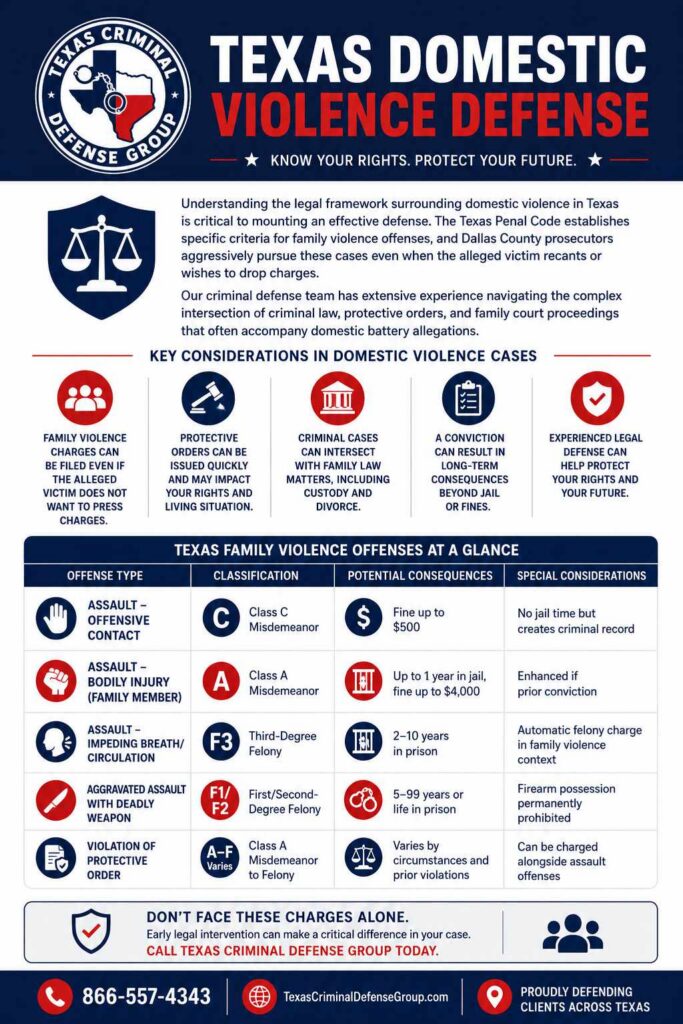
Texas law defines family violence as an act by a family or household member, or someone in a dating relationship, meant to cause physical harm, bodily injury, assault, or sexual assault, or a threat that puts the person in fear of imminent harm. It reaches spouses and former spouses, dating partners, parents and children, and other household members, so a charge labeled “domestic violence” in Lubbock can run anywhere from minor physical contact to aggravated assault involving serious bodily injury or a firearm.
Under the Texas Penal Code, assault causing bodily injury to a family member is typically a Class A misdemeanor, carrying up to one year in jail and a fine up to $4, 000. If the accused has a prior family-violence conviction, or if the alleged victim was choked or strangled, the charge can be elevated to a third-degree felony with a potential prison sentence of two to ten years. Aggravated assault, assault with a deadly weapon or assault causing serious bodily injury, is prosecuted as a first- or second-degree felony, with penalties ranging from five to 99 years in prison depending on the facts.
Domestic battery, often used interchangeably with domestic assault, can involve offensive or provocative contact even where no injury occurs. Stalking, continuous family violence, and violation of a protective order are additional offenses Lubbock County prosecutors pursue aggressively. Each carries collateral consequences, loss of child custody, ineligibility for certain professional licenses, deportation for non-citizens, and a lifetime ban on firearm possession under federal law.
| Offense Type | Classification | Potential Consequences | Special Considerations | Where It’s Heard in Lubbock |
|---|---|---|---|---|
| Assault – Offensive Contact | Class C Misdemeanor | Fine up to $500 | No jail time but creates criminal record | Justice or Municipal Court |
| Assault – Bodily Injury (Family Member) | Class A Misdemeanor | Up to 1 year in jail, fine up to $4, 000 | Enhanced if prior conviction | Lubbock County Court at Law |
| Assault – Impeding Breath/Circulation | Third-Degree Felony | 2-10 years in prison | Automatic felony charge in family violence context | 137th, 140th, or 364th District Court |
| Aggravated Assault with Deadly Weapon | First/Second-Degree Felony | 5-99 years or life in prison | Firearm possession permanently prohibited | 137th, 140th, or 364th District Court |
| Violation of Protective Order | Class A Misdemeanor to Felony | Varies by circumstances and prior violations | Can be charged alongside assault offenses | County Court at Law or District Court |
Helping Good People Through Tough Times
In Texas, domestic violence is defined as “family violence” under the Texas Penal Code, any act by a family or household member meant to cause physical harm, bodily injury, assault, or sexual assault against another member, including a threat that places someone in reasonable fear of imminent harm. Depending on the injury, whether a weapon was involved, and the accused’s criminal history, a family-violence charge can run from misdemeanor assault causing bodily injury to felony aggravated assault with a deadly weapon.
The Texas Penal Code reads “family member” broadly, it covers:
Because the definition is that wide, all sorts of relationships can trigger a family-violence charge in Lubbock County, even a minor argument between roommates or dating partners can turn into a criminal case with lasting consequences. A Lubbock criminal defense lawyer can evaluate the specific facts and test whether the state can actually prove family violence beyond a reasonable doubt.
When a domestic violence incident involves a firearm, knife, or other deadly weapon, Lubbock County prosecutors often elevate the charge to aggravated assault. Under Texas law, aggravated assault happens when a person causes serious bodily injury or uses or exhibits a deadly weapon during an assault, and against a family member it is typically charged as a first-degree or second-degree felony depending on the circumstances and the extent of injury.
The punishment is severe: five to 99 years in prison for a first-degree felony, two to 20 years for a second-degree felony, fines up to $10,000, permanent loss of firearm rights under federal and Texas law, and, in many cases, ineligibility for deferred adjudication. That exposure is why it matters to have a Lubbock assault lawyer who has actually defended felony family-violence cases. Our criminal attorneys dig into the facts, examine the police reports and witness statements, and challenge the state’s evidence to protect your rights and your freedom.
Not every domestic violence arrest ends in a conviction. Texas law gives you several defenses to assault and family-violence charges, and an experienced criminal defense attorney in Lubbock can put them to work against the prosecution’s case. The defenses that come up most often include:
| Defense Strategy | Description | When It Applies |
|---|---|---|
| Self-Defense | You used reasonable force to protect yourself from imminent harm | When the alleged victim was the initial aggressor or threatened you with harm |
| Defense of Others | You used reasonable force to protect a third party from harm | When you intervened to protect a child, family member, or other person |
| False Accusation | The alleged victim fabricated or exaggerated the allegations | When the accuser has a motive to lie (custody dispute, divorce, revenge) |
| Lack of Intent | The injury was accidental, not intentional, knowing, or reckless | When the contact or injury occurred by accident during a non-violent interaction |
| Insufficient Evidence | The state cannot prove the offense beyond a reasonable doubt | When there are no witnesses, no physical evidence, or conflicting statements |
| Violation of Constitutional Rights | Evidence was obtained through illegal search, seizure, or interrogation | When police violated your Fourth or Fifth Amendment rights during investigation |
Our Lubbock criminal lawyers go through the police reports, 911 recordings, witness statements, medical records, and physical evidence to build a strong legal defense. In many cases we can negotiate with prosecutors to reduce the charge, secure deferred adjudication, or get the case dismissed outright, and when trial is the right call, we have the courtroom experience to fight for a not-guilty verdict.
After a domestic violence arrest in Lubbock, the alleged victim often asks the Lubbock County courts for a protective order (sometimes called a restraining order), a court order barring the accused from contacting the alleged victim, going near their home or workplace, or possessing a firearm. Protective orders can be entered on an emergency basis, as temporary orders, or as final orders lasting up to two years.
Violating a protective order is its own criminal offense in Texas. A first violation is typically a Class A misdemeanor, punishable by up to one year in jail and a $4, 000 fine, and violations that involve assault, stalking, or other crimes, or that pile up, can be charged as felonies with prison time. Even unintended contact, like a text, a call, or a social-media message, can lead to arrest and new charges.
If you are served with a protective order in Lubbock County, talk to a Lubbock protective order lawyer right away. We can appear with you at the protective-order hearing, present your evidence, and fight to keep the order from being entered or to soften its terms, because these orders can upend your ability to see your children, stay in your home, or keep a job that requires a firearm or a security clearance.
Texas Criminal Defense
Knowing how a domestic-violence case moves through Lubbock County helps you prepare for what comes next. Most cases follow the same stages:
At every stage, an experienced Lubbock lawyer matters. Our criminal attorney team walks you through each step, protects your constitutional rights, and works for the best outcome available on your facts, with felony family-violence cases heard in the 137th, 140th, and 364th District Courts and misdemeanors in the County Courts at Law.
A family-violence conviction in Lubbock County brings both direct criminal penalties and long-term collateral consequences. Seeing the full picture is part of why a strong legal defense matters so much.

5 Star
google rating

Contact a violence lawyer immediately. Do not speak to police without an attorney present. Anything you say can be used against you in court. Your lawyer will advise you on how to protect your rights, what to expect during the legal process, and how to build the strongest possible defens
Knowing how a domestic-assault case moves through the Lubbock County criminal justice system helps you make good decisions at each stage. From the first arrest to final disposition, our Lubbock assault lawyer team guides you through every step, protecting your rights and building the strongest defense.
Most family-violence arrests in Lubbock start when police respond to a domestic-disturbance call. Texas law requires officers to make an arrest when they have probable cause that a domestic assault occurred, even if the alleged victim does not want to press charges. You will be taken to the Lubbock County Detention Center for booking, an emergency protective order may be issued, and bail will be set based on the severity of the charge and your record.
At arraignment, you are formally notified of the charges filed by the Lubbock Criminal District Attorney’s Office, and you enter a plea, guilty, not guilty, or no contest. We advise clients to plead not guilty at this stage to preserve every defense option and hold the state to proving each element beyond a reasonable doubt, and we start negotiating with prosecutors and investigating the allegations right away.
The pre-trial phase is where much of the work happens: motions to suppress illegally obtained evidence, motions to dismiss for insufficient evidence, and discovery for the police reports, witness statements, 911 recordings, body-camera footage, medical records, and forensic evidence. Our criminal attorneys leave no stone unturned looking for what supports your defense or exposes weaknesses in the state’s case.
Depending on the strength of the evidence and your history, we may negotiate with Lubbock County prosecutors for reduced charges, deferred adjudication, a pretrial-diversion program, or dismissal. Deferred adjudication lets eligible defendants complete probation and avoid a final conviction, though family-violence cases are often ineligible for expunction even after a clean completion, so we weigh carefully whether a plea or trial serves you better.
When a case goes to trial, our defense lawyers prepare thoroughly, subpoenaing witnesses, building cross-examination, consulting experts, and shaping the opening and closing. Jury selection is especially important in family-violence cases, where jurors often carry strong preconceptions about domestic-assault allegations, so we question prospective jurors closely to identify those who cannot weigh the evidence fairly.