- Start Your Free Consultation
- (866) 557-4343
A fraud allegation in Lubbock reaches far past a simple misunderstanding, it can threaten your freedom, professional licenses, financial assets, and reputation. Whether prosecutors allege credit card fraud, securities fraud, healthcare fraud, or another kind of deceptive conduct, you want a Lubbock fraud attorney who understands the technical elements of these crimes and how to build a complete defense. Fraud cases run on voluminous evidence, complex financial records, and aggressive prosecutors who treat white-collar crime as seriously as violent felonies, so the right fraud defense attorney works through every transaction, communication, and witness statement to find the weaknesses and protect your constitutional rights.
Texas fraud statutes cover a wide range of conduct, from theft by deception to sophisticated investment fraud schemes, and many allegations grow out of a business dispute, an accounting error, or a misunderstanding rather than intentional crime. A skilled Lubbock criminal attorney knows a civil breach of contract can be mischaracterized as criminal fraud, and that intent, knowing a representation was false and making it to obtain property or services, is a critical element the state must prove beyond a reasonable doubt. Without experienced legal representation, you risk a plea that carries incarceration, restitution, asset forfeiture, and a permanent record.


Board Certified
Only 1% of Attorney's in TX are Board Certified in Criminal Law

Phones Answered 24/7

5-Star
Google Ratings
over 500
11,500+ Cases Handled

We Fight for Dismissals and Never Back Down from Trial
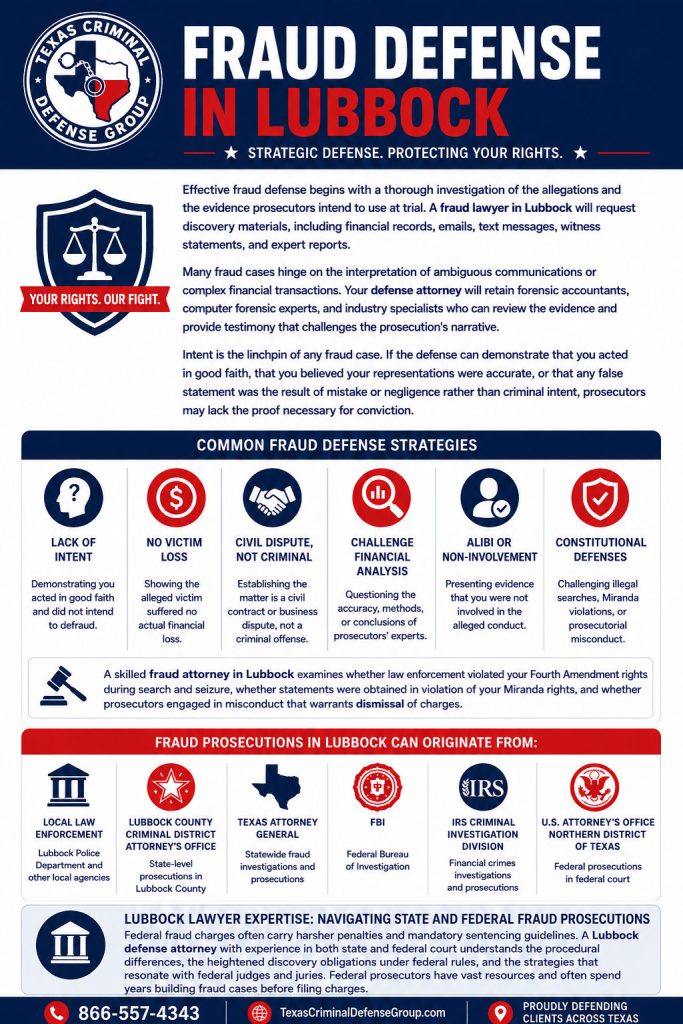
Effective fraud defense starts with a thorough investigation of the allegations and the evidence the state intends to use at trial. A fraud lawyer in Lubbock requests the discovery, financial records, emails, texts, witness statements, and expert reports, because many fraud cases turn on the reading of ambiguous communications or complex transactions. We retain forensic accountants, computer-forensic experts, and industry specialists to review it and testify against the state’s narrative. Intent is the linchpin: if we can show you acted in good faith, believed your representations were accurate, or that a false statement was a mistake or negligence rather than criminal intent, the state may lack the proof for a conviction.
Common defenses in these cases include a lack of intent, showing the alleged victim suffered no loss, establishing that the matter is a civil dispute rather than a crime, challenging the reliability of the state’s financial analysis, and presenting an alibi or evidence that you weren’t involved. We also examine whether law enforcement violated your Fourth Amendment rights in the search and seizure, whether statements were taken in violation of your Miranda rights, and whether prosecutorial misconduct warrants dismissal.
Fraud prosecutions in Lubbock can come from local law enforcement, the Lubbock Criminal District Attorney’s Office, the Texas Attorney General, or federal agencies including the FBI, IRS Criminal Investigation Division, and the U.S. Attorney’s Office for the Northern District of Texas, whose cases are heard in the Lubbock Division of the U.S. District Court for the Northern District of Texas. Federal fraud charges tend to carry harsher penalties and mandatory sentencing guidelines, so a Lubbock defense attorney who works in both state and federal court understands the procedural differences, the heightened federal discovery obligations, and the strategies that land with federal judges and juries, and federal prosecutors have vast resources and often spend years building a case before charging.
| Fraud Type | Common Allegations | Potential Penalties | Where It’s Prosecuted |
|---|---|---|---|
| Credit Card Fraud | Unauthorized use, skimming, identity theft | State jail felony to first-degree felony | Lubbock County District Court |
| Healthcare Fraud | False billing, kickbacks, Medicare fraud | Federal criminal charges, substantial fines, prison | Federal, N.D. Texas (Lubbock Division) |
| Securities Fraud | Investment schemes, misrepresentations, insider trading | Federal prison, disgorgement, civil penalties | Federal, N.D. Texas (Lubbock Division) |
| Insurance Fraud | Staged claims, inflated losses, false statements | Third-degree felony, restitution, license loss | Lubbock County District Court |
| Business Fraud | Embezzlement, falsified records, bribery | Felony charges, asset forfeiture, professional sanctions | Lubbock County District Court |
Texas law defines fraud broadly under the theft statute and other specific provisions. Fraud is intentionally obtaining property or services through deception, false representation, or failure to disclose material information, and the severity depends on the value involved. Theft by deception involving property under $2, 500 may be a misdemeanor, while a scheme exceeding $300, 000 can be a first-degree felony carrying five to ninety-nine years in prison. Wire fraud, mail fraud, and other federal offenses add another layer, since federal prosecutors can pursue charges in parallel with the state. In Lubbock County, misdemeanor fraud is handled in the County Courts at Law and felony fraud in the district courts, the 137th, 140th, and 364th District Courts at the Lubbock County Courthouse on Broadway.
Common fraud offenses prosecuted in Lubbock include credit card fraud, using another person’s card information without authorization; healthcare fraud, involving false billing, upcoding, or claims for services not rendered to Medicare, Medicaid, or private insurers; securities fraud, covering investment scams, insider trading, and misrepresentations to investors; insurance fraud, like staging accidents or inflating claims; and business fraud, including fraudulent financial statements, embezzlement, and vendor-kickback schemes, each requiring specialized knowledge of the industry rules, accounting practices, and technical standards the state has to meet.
Helping Good People Through Tough Times
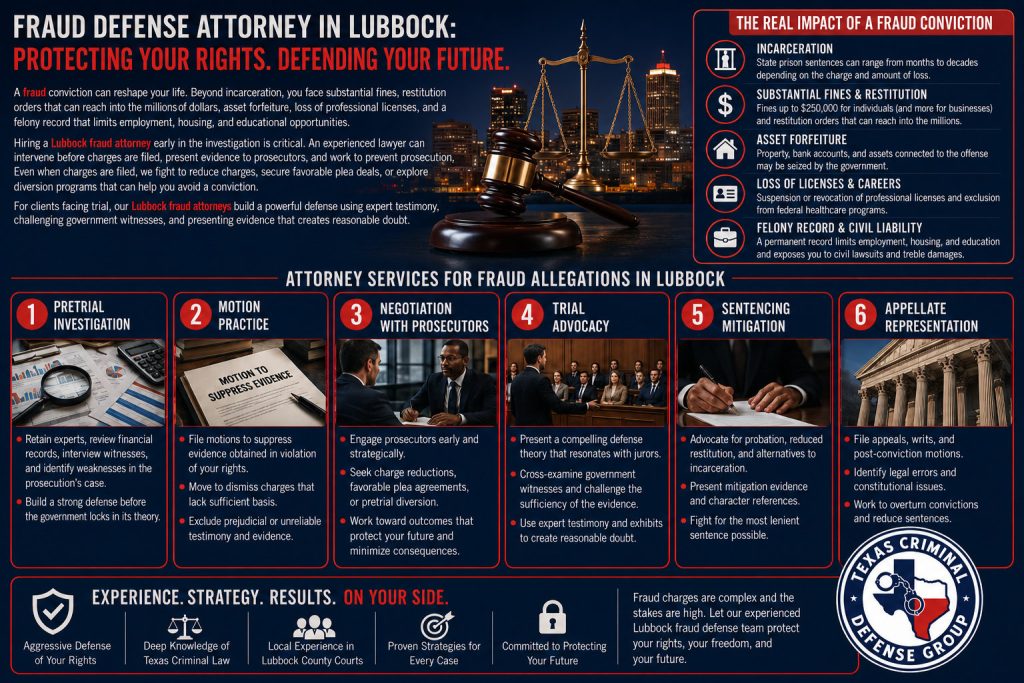
A fraud conviction can reshape your life. Beyond incarceration, you face heavy fines, restitution that can reach into the millions, asset forfeiture of property tied to the offense, loss of professional licenses, and a felony record that limits work, housing, and education. Many fraud defendants are professionals, doctors, accountants, financial advisors, business owners, whose livelihoods depend on their reputations and licenses, and a conviction can bring exclusion from federal healthcare programs, suspension or revocation of a state license, and civil suits seeking treble damages.
Getting a fraud defense attorney involved early is critical. In many cases an attorney can step in before charges are filed, presenting evidence that undermines the case and persuades prosecutors to decline it. Even after charges, a lawyer can negotiate reduced charges, a favorable plea deal, or pretrial diversion that avoids a conviction, and for clients headed to trial, an experienced Lubbock fraud attorney builds a persuasive case with expert testimony, cross-examination of government witnesses, and evidence that creates reasonable doubt.
A full fraud defense covers investigation, pretrial advocacy, motion practice, trial prep, and post-conviction relief. We run an independent investigation, interviewing witnesses, obtaining records, and finding exculpatory evidence, and in the pretrial phase we file motions to suppress illegally obtained evidence, dismiss charges that lack a basis, and compel the state to disclose Brady material (evidence favorable to the defense). At trial, we select the jury, deliver the opening and closing, run direct and cross-examination, and present a cohesive defense theory that lands with jurors.
With Over 500 5-Star Reviews TCGD Have a Track Record of Client
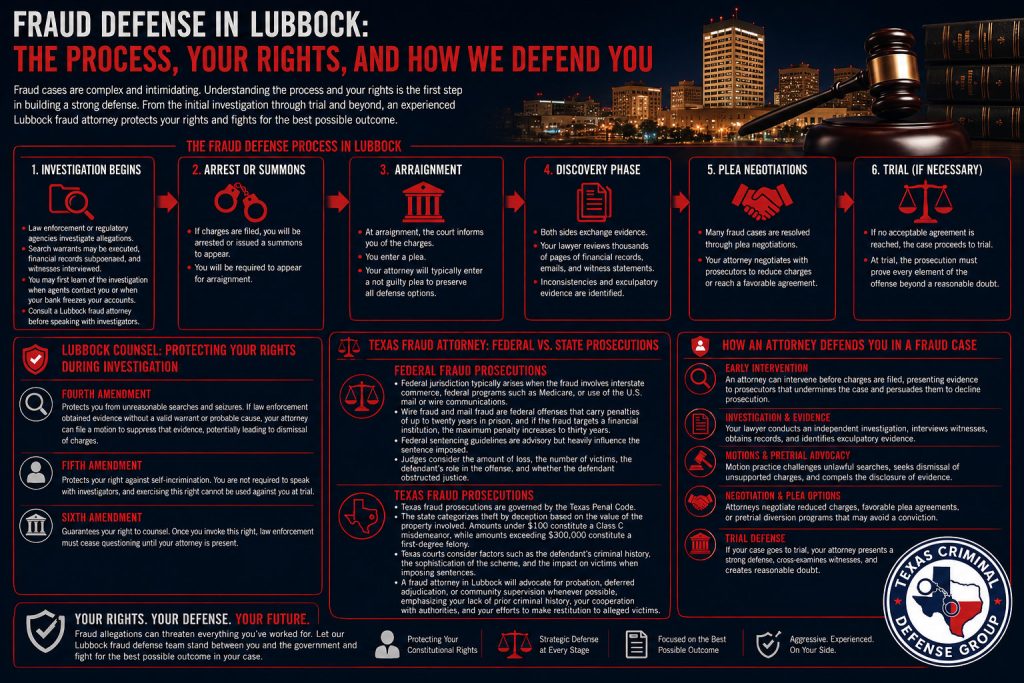
Fraud cases usually start with an investigation. Law enforcement or regulatory agencies may execute search warrants, subpoena financial records, and interview witnesses before filing. You might first learn of it when agents ask for an interview or your bank freezes your accounts, and at that point it’s critical to talk to a Lubbock fraud attorney before you talk to investigators, because anything you say can be used against you, and even an innocent explanation can be twisted to fit the state’s theory. Your attorney can deal with investigators on your behalf, protect your rights, and sometimes keep charges from being filed at all.
If charges are filed, you’ll be arrested or summoned to arraignment, where the court reads the charges and you enter a plea, usually not guilty, to preserve every option. Then comes discovery, where both sides exchange evidence and your lawyer works through thousands of pages of financial records, emails, and statements looking for inconsistencies and exculpatory evidence. Many fraud cases resolve in plea negotiations; if none is acceptable, the case goes to trial, where the state has to prove every element beyond a reasonable doubt.
Your constitutional rights stay in force through the whole investigation and prosecution. The Fourth Amendment protects you from unreasonable searches and seizures, if law enforcement got evidence without a valid warrant or probable cause, we can file a motion to suppress that could lead to dismissal. The Fifth Amendment protects you against self-incrimination; you don’t have to talk to investigators, and your silence can’t be used against you. The Sixth Amendment guarantees your right to counsel, and once you invoke it, questioning has to stop until your attorney is present.
Fraud can be prosecuted under Texas law, federal law, or both. Federal jurisdiction usually kicks in when the fraud involves interstate commerce, a federal program like Medicare, or use of the U.S. mail or wires. Wire fraud and mail fraud are federal offenses carrying up to twenty years in prison, thirty years if the fraud targets a financial institution, and federal sentencing guidelines, though advisory, heavily shape the sentence based on the loss amount, the number of victims, the defendant‘s role, and any obstruction. Federal cases out of Lubbock are handled in the Lubbock Division of the U.S. District Court for the Northern District of Texas.
Texas fraud prosecutions run through the Texas Penal Code, which grades theft by deception by the value involved, under $100 is a Class C misdemeanor, while more than $300, 000 is a first-degree felony. Texas courts weigh the defendant’s history, the sophistication of the scheme, and the impact on victims at sentencing, and a fraud attorney in Lubbock advocates for probation, deferred adjudication, or community supervision where possible, emphasizing a clean record, cooperation, and efforts at restitution to alleged victims.
The fraud lawyer you choose can decide the outcome. Look for an attorney with real experience defending fraud, trials and appeals, because it takes specialized knowledge of financial crimes, forensic accounting, and complex evidence. Ask about their track record of dismissals, acquittals, and favorable pleas, their familiarity with both state and federal court, the investigative resources they can bring, and their willingness to try the case if it comes to that.
Communication matters just as much. Your attorney should be accessible, responsive, and willing to explain the process, the charges, and your options, fraud cases can run months or years, so you need a lawyer who keeps you informed. Trust your instincts: if an attorney makes unrealistic promises, pressures you into quick decisions, or won’t answer your questions, keep looking. The right Lubbock fraud attorney gives honest assessments, lays out the risks and benefits of each strategy, and works with you toward the best outcome.
Bring any documents tied to your case, subpoenas, search warrants, charging documents, bail paperwork, and correspondence from law enforcement or prosecutors, and any financial records, contracts, or emails relevant to the allegations, or be ready to give your attorney access. Write down a timeline: when you first learned of the investigation, any interactions with law enforcement, and the names of potential witnesses. Be honest and thorough, your attorney can’t defend you well without the full picture, and attorney-client privilege protects what you share.
Fraud defense can be costly, since these cases often need extensive investigation, experts, and long trials. Most Lubbock fraud attorneys charge a flat fee through trial or an hourly rate for ongoing legal services. At the consultation, ask for a clear explanation of the fees, what’s included, and the extra costs for experts, investigators, or appeals, some attorneys offer payment plans or take credit cards. Cost is a factor, but it shouldn’t be the only one; the consequences of a fraud conviction are severe, and experienced representation can save you far more down the line.
Don’t answer questions or give a statement without an attorney present. Politely decline and contact a Lubbock fraud attorney right away, even if you’re innocent, anything you say can be misread or used against you, and your attorney can deal with investigators for you and protect your rights.
Yes. A skilled fraud defense attorney can file pretrial motions to dismiss when the state lacks sufficient evidence, when your rights were violated in the investigation, or when the alleged conduct isn’t a crime, and in some cases we present evidence to prosecutors that persuades them to decline or reduce charges before an indictment.
Fraud is a form of theft that obtains property or services through deception, false representation, or failure to disclose material information, the key element is using deceit to get the victim to part with property. Other theft offenses, like robbery or burglary, involve force, threat, or unlawful entry, while fraud requires proof of intent to deceive and defraud.
Healthcare fraud cases often turn on complex billing and medical coding, so a criminal defense lawyer retains medical-billing experts to review the charges and find the errors in the government’s analysis. Many health care fraud allegations come from billing mistakes, not intentional fraud, and your defense lawyer works to show the lack of criminal intent and challenge the prosecution’s case.