



What does a DWI lawyer do in Lubbock, TX?
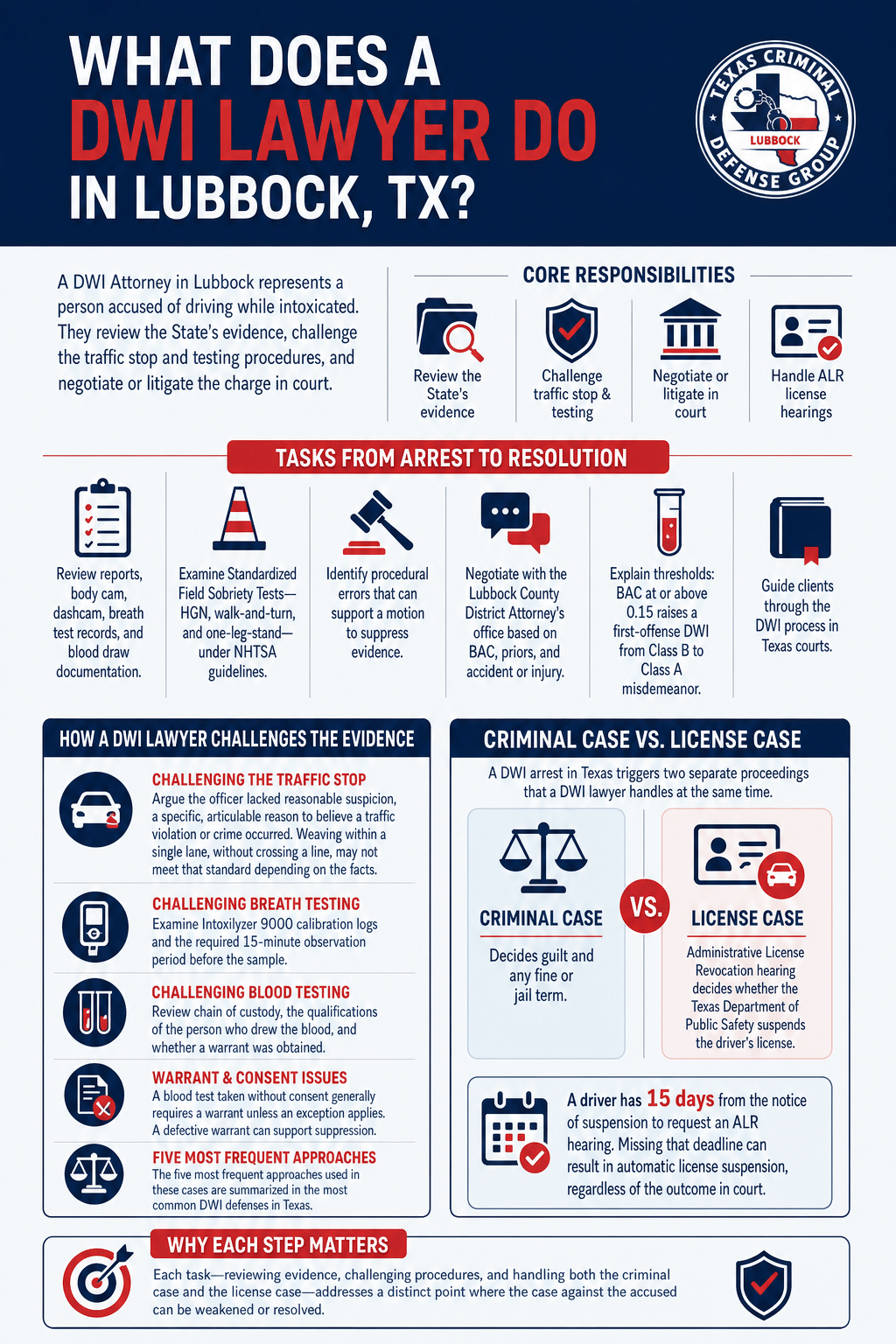
A DWI Attorney in Lubbock represents a person accused of driving while intoxicated, reviews the State’s evidence, assesses whether there are grounds to challenge the traffic stop or testing procedures, and may negotiate or litigate the charge in court. A DWI lawyer may file pretrial motions to suppress evidence, cross-examine an arresting officer, and represent the driver in a separate Administrative License Revocation hearing concerning a proposed administrative suspension, when those steps apply. The attorney evaluates whether the stop was supported by reasonable suspicion, whether field sobriety tests were administered correctly, and whether breath or blood testing followed proper procedure. Each of these tasks addresses a distinct issue that may affect how the evidence is evaluated or how the case proceeds.
What tasks does a DWI lawyer handle from arrest to resolution?
A DWI lawyer may review available materials such as the offense report, body-camera or dashboard footage, breath-testing records, and blood-draw documentation, as applicable, when evaluating strategy. A Lubbock DWI Attorney examines whether the Standardized Field Sobriety Tests, which include the horizontal gaze nystagmus, walk-and-turn, and one-leg-stand, were administered under the National Highway Traffic Safety Administration guidelines. An attorney looks for constitutional, statutory, or procedural violations that, depending on their nature, may support a motion to suppress, which asks the court to exclude evidence claimed to have been obtained unlawfully.
A DWI lawyer may also negotiate with the Lubbock County Criminal District Attorney’s Office, and those negotiations may be influenced by the alcohol concentration, qualifying prior convictions, accident or injury allegations, the strength of the evidence, and other case-specific facts. A blood test showing an alcohol concentration of 0.15 or more at the time of analysis can elevate a first-offense DWI from a Class B to a Class A misdemeanor under Texas law if the State proves that element, which changes the range of possible penalties. The attorney explains these thresholds so the accused understands what drives the charge level. General information can help explain the steps in the DWI process in Texas courts before a first setting.

How does a DWI lawyer challenge the evidence?
A DWI lawyer may challenge the traffic stop when the facts support an argument that the officer lacked reasonable suspicion, which generally requires specific, articulable facts and rational inferences that, under the totality of the circumstances, reasonably suggest a violation or criminal activity. A stop for weaving within a single lane, without crossing a line, may not meet that standard depending on the facts and the court. An attorney may challenge breath testing by examining available records and other evidence for compliance with 37 Texas Administrative Code § 19.53, including the requirement that the operator remain in the person’s continuous presence for at least 15 minutes immediately before the test.
Blood testing may be challenged by examining issues such as chain of custody, the qualifications of the person who drew the blood, laboratory procedures, and the legal basis for obtaining the sample. A law-enforcement-directed blood draw without valid consent generally requires a warrant unless a recognized exception applies, and a warrant defect may support a suppression motion depending on the facts and applicable law. DWI defense approaches may include challenges to the stop, field sobriety testing, breath testing, blood testing, or other evidence. Which approach fits a case depends on the testing method, the stop, and the officer’s documented conduct.
What is the difference between the criminal case and the license case?
A DWI arrest in Texas may lead to a criminal case and, when an Administrative License Revocation suspension is initiated, a separate administrative proceeding. The criminal case addresses whether the State can prove the charge and any resulting criminal penalties and may also produce conviction-based driver’s-license consequences, while the Administrative License Revocation hearing separately determines whether the Texas Department of Public Safety imposes the proposed administrative suspension. Under Texas law, DPS generally must receive a request for an ALR hearing within 15 days after the driver receives the notice of suspension; if no timely request is received, the administrative suspension generally takes effect without a hearing.
| Task the lawyer performs | What it decides or affects |
|---|---|
| Requesting the ALR hearing within 15 days | Whether the driver receives a hearing on the proposed administrative suspension |
| Filing a motion to suppress evidence obtained from the stop | Whether the court excludes particular evidence after considering the alleged illegality, its connection to the evidence, and any applicable exceptions |
| Reviewing available breath-test records and video | Whether there may be grounds to challenge the breath result Checking blood draw warrant and chain of custody Whether there may be grounds to challenge the blood result |
| Negotiating with the District Attorney | Whether a negotiated resolution may be available before trial |
| Advising on occupational license eligibility | Whether the driver may be eligible to seek limited driving privileges during a suspension |
An ordinary first-offense Class B DWI in Texas is punishable by 72 hours to 180 days in jail and a Penal Code fine of up to $2,000; other facts can change the classification, and an additional traffic fine may apply after conviction. A DWI offense enhanced by one qualifying prior DWI conviction is generally punishable in Texas by 30 days to one year in jail and a Penal Code fine of up to $4,000; an additional traffic fine may apply after conviction. Whether a charge reaches the felony level, such as a DWI charge enhanced by two qualifying prior intoxication-offense convictions or a charge of intoxication manslaughter, can substantially change the applicable procedures and potential consequences.
When should a person in Lubbock contact a DWI lawyer?
Texas law generally measures the 15-day ALR hearing-request period from service of the notice rather than from a court date; an attorney can explain how the deadline applies to a particular case. DWI cases arising in Lubbock County are generally filed in the Lubbock County Courts at Law for misdemeanors and the district courts for felonies, and the timeline for a first setting varies by court docket. An attorney reviews whether the arrest involved a breath refusal; a refusal does not itself authorize a blood draw, although the State may seek a warrant when the applicable legal requirements are met.
Case facts that may affect the charge classification or penalty range include an alcohol concentration of 0.15 or more at the time of analysis, a qualifying prior DWI conviction, or a child younger than 15 in the vehicle. An accident involving injury does not by itself elevate a DWI charge; intoxication assault is a separate offense that requires proof that, by reason of intoxication, the person caused serious bodily injury to another. Whether an occupational license is available depends on the driver’s record and the reason for the suspension, and the process differs from restoring a standard license.
What a DWI lawyer does in any specific Lubbock case depends on the testing method used, the documented conduct of the arresting officer, the driver’s prior record, and the facts of the stop. A Criminal Lawyer may review available offense reports, video, and testing records to assess which challenges might apply and what deadlines may be approaching. Every case involves different evidence, and the available options depend on those individual facts rather than a fixed formula.