



What happens if you can’t afford a lawyer in a criminal case in Lubbock, TX?
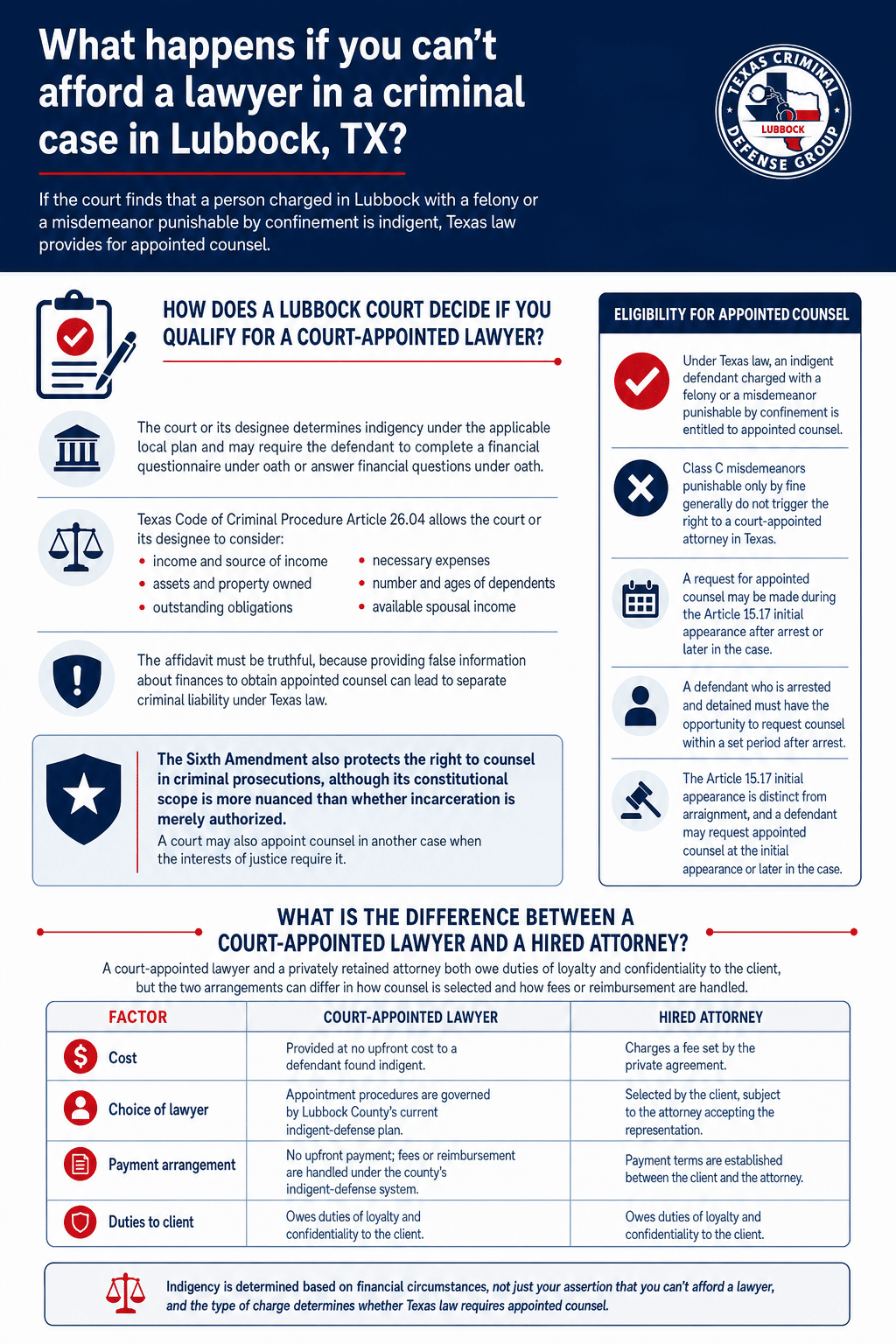
In a Texas state criminal case in Lubbock County, if the court finds that a person charged with a felony or a misdemeanor punishable by confinement is indigent, Texas law provides for appointed counsel; the Sixth Amendment also protects the right to counsel in criminal prosecutions, although its constitutional scope is more nuanced than whether incarceration is merely authorized. An indigent defendant charged with a felony or a misdemeanor punishable by confinement is entitled under Texas law to appointed counsel through the applicable Lubbock County indigent-defense process; a court may also appoint counsel in another case when the interests of justice require it. The court determines indigency under applicable standards by reviewing financial circumstances such as income, assets, obligations, necessary expenses, and dependents, rather than relying solely on a person’s assertion that counsel is unaffordable; indigency, the nature and stage of the proceeding, the charge, and applicable appointment rules determine whether counsel must be appointed.
How does a Lubbock court decide if you qualify for a court-appointed lawyer?
The court or its designee determines indigency under the applicable local plan and may require the defendant to complete a financial questionnaire under oath or answer financial questions under oath. Texas Code of Criminal Procedure Article 26.04 allows the court or its designee to consider the defendant’s income, source of income, assets, property owned, outstanding obligations, necessary expenses, number and ages of dependents, and available spousal income. Any sworn financial questionnaire or testimony must be truthful, because making a material false statement under oath with the intent to deceive and knowledge of the statement’s meaning may result in prosecution under Texas perjury law.
Eligibility for appointed counsel depends on both indigency and the type of charge. Under Texas law, an indigent defendant charged with a felony or a misdemeanor punishable by confinement is entitled to appointed counsel, while federal Sixth Amendment doctrine does not treat every offense authorizing incarceration identically. Class C misdemeanors punishable only by fine generally do not trigger the right to a court-appointed attorney in Texas.
A request for appointed counsel may be made during the Article 15.17 initial appearance after arrest or later in the case. A defendant who is arrested and detained must have the opportunity to request counsel within a set period after arrest, and the magistrate informs the person of the right to counsel during the initial appearance. The Article 15.17 initial appearance is distinct from arraignment, and a defendant may request appointed counsel at the initial appearance or later in the case.

What is the difference between a court-appointed lawyer and a hired attorney?
A court-appointed lawyer and a privately retained attorney both owe duties of loyalty and confidentiality to the client, but the two arrangements can differ in how counsel is selected and how fees or reimbursement are handled. How appointed counsel is selected is governed by Lubbock County’s current indigent-defense plan. A privately hired attorney is selected by the client, subject to the attorney accepting the representation.
| Factor | What it means for the defendant |
|---|---|
| Cost | A court-appointed lawyer does not require a privately negotiated retainer, but the court may order a defendant with financial resources to offset some or all appointed-counsel costs; a hired attorney’s fee is governed by the private agreement. |
| Choice of lawyer | Appointment procedures are governed by Lubbock County’s current indigent-defense plan; a defendant generally selects a privately retained attorney, subject to the attorney accepting the engagement. |
| Reimbursement | Texas Code of Criminal Procedure Article 26.05 requires the court to order a defendant to offset some or all appointed-counsel costs if the court determines that the defendant has financial resources enabling the defendant to do so. |
| Caseload | Caseloads vary among both appointed and privately retained attorneys. |
| Scope | The duration and scope of representation depend on the appointment order, applicable law, any court-approved withdrawal, and the private engagement agreement. |
The fact that counsel is appointed does not mean the representation is free of all future obligation. Under Article 26.05 of the Texas Code of Criminal Procedure, if a court finds that the defendant has financial resources to offset some or all of the costs of legal services, it must order payment; the statute permits payment during the proceedings or, if the defendant is convicted, as court costs.
What are the warning signs you may not actually qualify for appointed counsel?
The court makes an individualized indigency determination. The following factors may be relevant to that decision or to whether appointment is required:
- Income from steady employment may be considered under the applicable indigency standards. Assets and property may also be considered to the extent permitted by the applicable standards
- .
- A fine-only charge, such as a Class C misdemeanor, does not by itself create the confinement-based entitlement to appointed counsel, although a court may appoint counsel when the interests of justice require representation.
- Bail information may be considered only to the extent permitted by Texas Code of Criminal Procedure Article 26.04(m) and the applicable local indigency standards; posting or being able to post bail is not by itself determinative of indigency.
- A prior private representation does not by itself decide indigency; a later request for appointed counsel requires a current indigency determination and resolution of existing counsel’s status.
A person who does not qualify for appointed counsel and cannot immediately hire a lawyer may still have options. Some private attorneys may offer payment arrangements, and a defendant may ask the court for additional time to secure counsel, although the court decides whether to grant a continuance. Deadlines for pretrial motions and evidence review vary by case and may be set by statute, rule, or court order; an attorney can explain which deadlines apply to a specific Lubbock assault case. The role of evidence in a criminal case often shapes whether a charge can be challenged before trial.
What happens to your case while you are waiting for a lawyer in Lubbock?
Court dates and procedural deadlines may continue while a defendant seeks counsel, although a court generally may not conduct a critical stage requiring counsel unless counsel is present or the defendant validly waives the right. After an arrest in Lubbock County, the person generally appears before a magistrate, who gives the required warnings, including information about the right to counsel, and addresses bail or release as applicable. For an eligible defendant who requests appointed counsel, Texas Code of Criminal Procedure Article 1.051 requires the appointing authority to appoint counsel as soon as possible and within the statutory period applicable to the county. Failure to appear when personal attendance is required can result in a warrant; whether a defendant must personally attend a particular setting depends on the case and the court’s instructions.
Once counsel is in place, the attorney may review the State’s evidence, examine relevant law-enforcement conduct and testing procedures, and evaluate possible defenses based on the facts of the case. A person accused of a crime is presumed innocent unless and until proven guilty; at trial, the State must prove every element of the charged offense beyond a reasonable doubt. Some cases end in dismissal. Suppressed evidence, procedural rulings, or weaknesses in the proof may influence whether the prosecution seeks dismissal, while a court’s authority to dismiss depends on applicable law and the facts of the case.
Whether a Lubbock defendant qualifies for court-appointed counsel depends on the applicable indigency standards and whether the charge carries a right to appointed counsel; the court or its designee may use sworn financial information to make the indigency determination. Reimbursement obligations, the timing of the appointment, and the strength of any defense vary from one case to the next. A financial review by the court helps determine indigency, while the nature of the proceeding, the charge, a request for counsel, and applicable law determine whether appointed counsel is required; an attorney’s case evaluation informs legal strategy and possible next steps, not the court’s indigency determination.