- Start Your Free Consultation
- (866) 557-4343
Protect Your Reputation, Career, and Future With a Fort Worth Fraud Defense Team Ready to Challenge Complex Financial Allegations. Get experienced representation from attorneys who understand white collar crime, fraud investigations, and the technical evidence prosecutors rely on. Take immediate action with trial-ready defense lawyers focused on challenging intent, protecting your rights, and pursuing the best possible outcome.
When you face fraud allegations in Fort Worth, the stakes reach well past a simple misunderstanding. Fraud charges can threaten your freedom, your professional licenses, your financial assets, and your reputation across Tarrant County. Whether prosecutors allege credit card fraud, securities fraud, healthcare fraud, or another form of deceptive conduct, you need a Fort Worth fraud attorney who understands the technical elements of these crimes and knows how to build a full defense strategy. Fraud cases often involve voluminous evidence, dense financial records, and aggressive prosecutors who treat white collar crime with the same severity as violent felonies. The right fraud defense attorney examines every transaction, communication, and witness statement to expose weaknesses in the prosecution and protect your constitutional rights.
Texas fraud statutes cover a wide spectrum of conduct, from theft by deception to sophisticated investment fraud schemes. Many fraud allegations grow out of business disputes, accounting errors, or honest misunderstandings rather than intentional criminal behavior. A skilled Fort Worth criminal attorney recognizes that a civil breach of contract issue can be mischaracterized as criminal fraud, and that intent, meaning the knowledge that a representation was false and made to obtain property or services, is a critical element the state must prove beyond a reasonable doubt. Without experienced legal representation, you risk accepting plea offers that carry long-term consequences, including incarceration, restitution orders, asset forfeiture, and a permanent criminal record.


Board Certified
Only 1% of Attorney's in TX are Board Certified in Criminal Law

Phones Answered 24/7

5-Star
Google Ratings
over 500
11,500+ Cases Handled

We Fight for Dismissals and Never Back Down from Trial
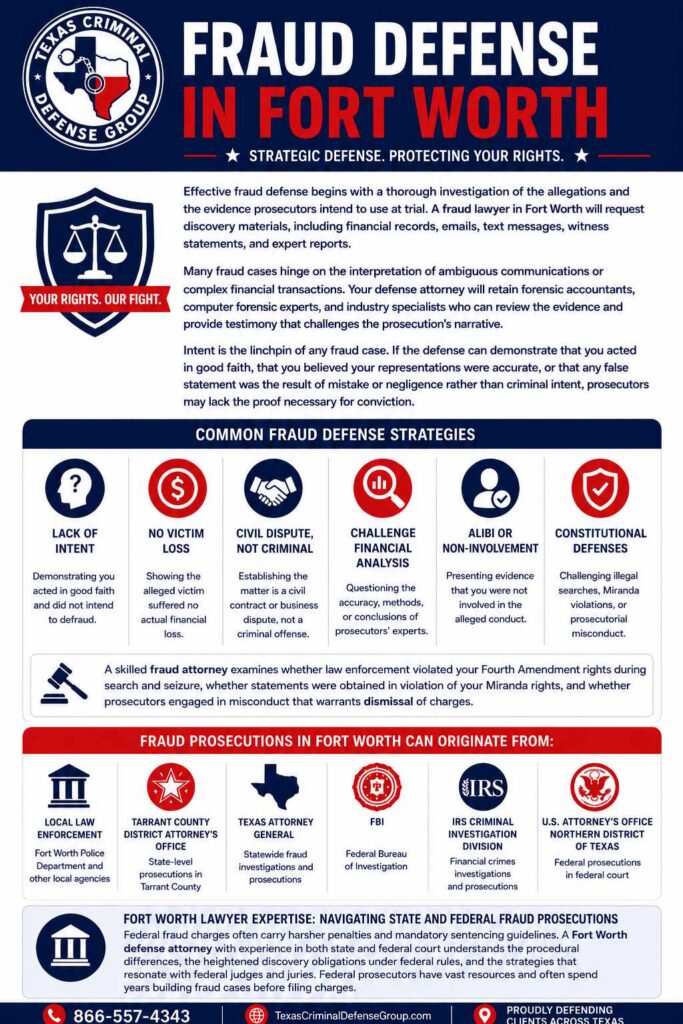
Effective fraud defense begins with a thorough investigation of the allegations and the evidence prosecutors intend to use at trial. A fraud lawyer in Fort Worth will request discovery materials, including financial records, emails, text messages, witness statements, and expert reports. Many fraud cases turn on how an ambiguous communication or a complex financial transaction gets read. Your defense attorney will retain forensic accountants, computer forensic experts, and industry specialists to review that material and offer testimony that challenges the prosecution narrative. Intent is the linchpin of any fraud case. If the defense can show that you acted in good faith, that you believed your representations were accurate, or that any false statement came from mistake or negligence rather than criminal intent, prosecutors may lack the proof they need for a conviction.
Common defense strategies in fraud legal services cases include showing a lack of intent, proving that the alleged victim suffered no loss, establishing that the matter was a civil dispute rather than a criminal one, attacking the reliability of the prosecution financial analysis, and presenting an alibi or evidence that you were not involved in the conduct. A skilled fraud attorney also looks at whether law enforcement violated your Fourth Amendment rights during search and seizure, whether statements were taken in violation of your Miranda rights, and whether prosecutors engaged in misconduct that warrants dismissal of the charges.
Fraud prosecutions in Fort Worth can originate from local law enforcement, the Tarrant County Criminal District Attorney’s Office, the Texas Attorney General, or federal agencies including the FBI, IRS Criminal Investigation Division, and the U.S. Attorney’s Office for the Northern District of Texas. State charges move through the Tim Curry Criminal Justice Center at 401 W. Belknap Street, where Tarrant County criminal cases are heard. Federal fraud charges often carry harsher penalties and mandatory sentencing guidelines. A Fort Worth defense attorney who works in both state and federal court understands the procedural differences, the heightened discovery obligations under federal rules, and the arguments that land with federal judges and juries. Federal prosecutors bring vast resources and often spend years building fraud cases before filing charges.
| Fraud Type | Common Allegations | Potential Penalties | Where It’s Heard in Fort Worth |
|---|---|---|---|
| Credit Card Fraud | Unauthorized use, skimming, identity theft | State jail felony to first-degree felony | Criminal District Court (Tim Curry Justice Center) |
| Healthcare Fraud | False billing, kickbacks, Medicare fraud | Federal criminal charges, substantial fines, prison | Criminal District Court (Tim Curry Justice Center) |
| Securities Fraud | Investment schemes, misrepresentations, insider trading | Federal prison, disgorgement, civil penalties | Criminal District Court (Tim Curry Justice Center) |
| Insurance Fraud | Staged claims, inflated losses, false statements | Third-degree felony, restitution, license loss | Criminal District Court (Tim Curry Justice Center) |
| Business Fraud | Embezzlement, falsified records, bribery | Felony charges, asset forfeiture, professional sanctions | Criminal District Court (Tim Curry Justice Center) |
Texas law defines fraud broadly under the theft statute and other specific provisions. Fraud occurs when a person intentionally obtains property or services through deception, false representation, or a failure to disclose material information. How severe the charge becomes depends on the value of the property or services at issue. Theft by deception involving property valued under $2,500 may be charged as a misdemeanor, while fraud schemes involving amounts exceeding $300,000 can result in first-degree felony charges carrying sentences of five to ninety-nine years in prison. Wire fraud, mail fraud, and other federal offenses add another layer of complexity, since federal prosecutors can pursue charges alongside state proceedings. Common fraud offenses prosecuted in Fort Worth include credit card fraud, where a defendant is accused of using another person’s credit or debit card information without authorization; healthcare fraud, involving allegations of false billing, upcoding, or claims for services not rendered to Medicare, Medicaid, or private insurers; securities fraud, covering investment scams, insider trading, and misrepresentations to investors; insurance fraud, such as staging accidents or inflating claims; and business fraud, including fraudulent financial statements, embezzlement, and vendor kickback schemes. Each category calls for specific knowledge of industry regulations, accounting practice, and the technical standards prosecutors must meet to secure a conviction.
Helping Good People Through Tough Times

A fraud conviction can reshape your life. Beyond incarceration, you face substantial fines, restitution orders that can climb into the millions of dollars, asset forfeiture of property connected to the offense, loss of professional licenses, and a felony record that limits employment, housing, and educational opportunities. Many fraud defendants are professionals, among them doctors, accountants, financial advisors, and business owners, whose livelihoods rest on their reputations and licenses. A conviction can bring exclusion from federal healthcare programs, suspension or revocation of state professional licenses, and civil lawsuits from alleged victims seeking treble damages.
Hiring a fraud defense attorney early in the investigation is critical. In many cases, an attorney can step in before charges are filed, presenting evidence to prosecutors that undercuts the case and persuades them to decline prosecution. Even after charges are filed, a lawyer can negotiate to reduce charges, secure favorable plea deal agreements, or arrange pretrial diversion that avoids a conviction altogether. For clients headed to trial, an experienced Fort Worth fraud attorney prepares a persuasive case that leans on expert testimony, cross-examines government witnesses, and presents evidence that creates reasonable doubt.
A full fraud defense includes investigation, pretrial advocacy, motion practice, trial preparation, and post-conviction relief. Your attorney will run an independent investigation, interviewing witnesses, gathering records, and identifying exculpatory evidence. During the pretrial phase, the lawyer files motions to suppress illegally obtained evidence, dismiss charges that lack a sufficient basis, and compel the prosecution to turn over Brady material, meaning evidence favorable to the defense. If the case reaches a Tarrant County courtroom for trial, your attorney selects a jury, delivers opening and closing statements, conducts direct and cross-examinations, and presents a coherent defense theory that resonates with jurors.
With Over 500 5-Star Reviews TCGD Have a Track Record of Client

Fraud cases usually begin with an investigation. Law enforcement or regulatory agencies may execute search warrants, subpoena financial records, and interview witnesses before any charges are filed. You may first learn of the investigation when agents contact you for an interview or when your bank tells you that your accounts have been frozen. At that point it is critical to consult a Fort Worth fraud attorney before speaking with investigators. Anything you say can be used against you, and even an innocent explanation can be twisted to fit the prosecution theory. Your attorney can communicate with investigators on your behalf, protect your rights, and in some cases keep charges from ever being filed.
If charges are filed, you will be arrested or issued a summons to appear for arraignment. In Tarrant County, that appearance takes place at the Tim Curry Criminal Justice Center on West Belknap Street, where the court informs you of the charges and you enter a plea. Your attorney will typically enter a not guilty plea to preserve every defense option. The discovery phase follows, during which both sides exchange evidence. Your lawyer reviews thousands of pages of financial records, emails, and witness statements, marking the inconsistencies and exculpatory evidence. Many fraud cases resolve through plea negotiations, but if no acceptable agreement is reached, the case proceeds to trial. At trial, the prosecution must prove every element of the offense beyond a reasonable doubt.
Your constitutional rights stay in force throughout the investigation and prosecution. The Fourth Amendment protects you from unreasonable searches and seizures. If law enforcement obtained evidence without a valid warrant or probable cause, your attorney can file a motion to suppress that evidence, which can lead to dismissal of the charges. The Fifth Amendment protects your right against self-incrimination. You are not required to speak with investigators, and exercising that right cannot be used against you at trial. The Sixth Amendment guarantees your right to counsel. Once you invoke it, law enforcement must stop questioning until your attorney is present.
Fraud cases can be prosecuted under Texas law, federal law, or both. Federal jurisdiction usually arises when the fraud involves interstate commerce, federal programs such as Medicare, or use of the U.S. mail or wire communications. Wire fraud and mail fraud are federal offenses that carry penalties of up to twenty years in prison, and if the fraud targets a financial institution, the maximum penalty rises to thirty years. Federal sentencing guidelines are advisory but weigh heavily on the sentence imposed. Judges consider the amount of loss, the number of victims, the defendant‘s role in the offense, and whether the defendant obstructed justice. Texas fraud prosecutions are governed by the Texas Penal Code. The state grades theft by deception based on the value of the property involved. Amounts under $100 constitute a Class C misdemeanor, while amounts exceeding $300,000 constitute a first-degree felony. Texas courts weigh factors such as the defendant’s criminal history, the sophistication of the scheme, and the impact on victims when imposing a sentence. A fraud attorney in Fort Worth will advocate for probation, deferred adjudication, or community supervision whenever possible, emphasizing your lack of prior criminal history, your cooperation with authorities, and your effort to make restitution to alleged victims.
Selecting the right fraud lawyer can decide the outcome of your case. Look for an attorney with substantial experience defending fraud cases, including trials and appeals. Fraud defense calls for specific knowledge of financial crimes, forensic accounting, and complex evidentiary issues. Your attorney should have a track record of strong outcomes, including dismissals, acquittals, and favorable plea agreements. Ask about the attorney’s familiarity with both state and federal court, the resources on hand to investigate your case, and the attorney’s willingness to take your case to trial if it comes to that.
Communication matters just as much. Your attorney should be accessible, responsive, and willing to explain the legal process, the charges you face, and the options in front of you. Fraud cases can run months or even years, so you need a lawyer who keeps you informed and involved at every stage. Trust your instincts. If an attorney makes unrealistic promises, pressures you into quick decisions, or dodges your questions, keep looking. The right Fort Worth fraud attorney will give honest assessments, explain the risks and benefits of each strategy, and work with you toward the best possible outcome.
When you meet with a fraud defense attorney, bring any documents tied to your case, including subpoenas, search warrants, charging documents, bail paperwork, and correspondence from law enforcement or prosecutors. If you have financial records, contracts, emails, or other materials relevant to the allegations, bring copies or be ready to give your attorney access. Write down a timeline of events, noting when you first learned of the investigation, any contact with law enforcement, and the names of potential witnesses. Be honest and thorough. Your attorney cannot provide effective representation without a full picture of the facts. Attorney-client privilege protects your communications.
Fraud defense can be expensive, since these cases often demand extensive investigation, expert witnesses, and lengthy trials. Most Fort Worth fraud attorneys charge a flat fee for representation through trial or an hourly rate for ongoing legal services. During your initial consultation, ask for a clear breakdown of fees, what services are included, and what additional costs you may face for experts, investigators, or appellate work. Some attorneys offer payment plans or accept credit cards. Cost is a factor, but it should not be the only one. The consequences of a fraud conviction are severe, and investing in experienced, capable representation can save you far more over time.
Do not answer questions or give statements without an attorney present. Politely decline to speak and contact a Fort Worth fraud attorney right away. Even if you believe you are innocent, anything you say can be misread or used against you. Your attorney can communicate with investigators on your behalf and protect your constitutional rights.
Yes. A skilled fraud defense attorney can file pretrial motions to dismiss charges when the prosecution lacks sufficient evidence, when your rights were violated during the investigation, or when the conduct alleged does not amount to a crime. In some cases, attorneys present evidence to prosecutors that persuades them to decline prosecution or reduce charges before an indictment is filed.
Fraud is a form of theft that involves obtaining property or services through deception, false representation, or a failure to disclose material information. The key element is the use of deceit to induce the victim to part with property. Other theft offenses, such as robbery or burglary, involve force, threat, or unlawful entry. Fraud prosecutions require proof of intent to deceive and defraud.
Healthcare fraud cases often involve complex billing practices and medical coding. A criminal defense lawyer will retain medical billing experts to review the charges and pinpoint errors in the government analysis. Many health care fraud allegations arise from billing mistakes, not intentional fraud. Your defense lawyer will show a lack of criminal intent and challenge the prosecution