- Start Your Free Consultation
- (866) 557-4343
Facing theft charges in Dallas County can threaten your freedom, your employment, and your future. Whether you’re accused of shoplifting, credit card fraud, identity theft, or burglary, the consequences of a conviction extend far beyond jail time and fines. A theft crime on your record can prevent you from securing housing, obtaining professional licenses, and finding meaningful employment. Our Dallas theft lawyers understand the stakes and work aggressively to protect your rights at every stage of the criminal justice process.
Theft offenses in Texas range from Class C misdemeanors for items valued under $100 to first-degree felonies when the property exceeds $300,000 or involves certain aggravating factors. The Texas Penal Code defines theft broadly, encompassing situations where someone unlawfully appropriates property with intent to deprive the owner. This definition covers shoplifting, employee theft, receiving stolen property, theft of services, and many other scenarios. Each case presents unique defense opportunities that an experienced criminal defense attorney can identify and leverage.
Our criminal defense lawyers have defended clients throughout Dallas, Dallas County, and the surrounding DFW area against all types of theft charges. We understand how prosecutors build their cases and know the weaknesses that can lead to reduced charges, dismissed cases, or favorable plea agreements. When you’re facing theft allegations, you need a Dallas theft attorney who will investigate thoroughly, challenge evidence aggressively, and fight for the best possible outcome in your case.


Board Certified
Only 1% of Attorney's in TX are Board Certified in Criminal Law

Phones Answered 24/7

5-Star
Google Ratings
over 500
11,500+ Cases Handled

We Fight for Dismissals and Never Back Down from Trial

| Theft Classification | Property Value | Offense Level | Maximum Jail/Prison | Maximum Fine |
|---|---|---|---|---|
| Class C Misdemeanor | Less than $100 | Lowest theft offense | No jail time | $500 |
| Class B Misdemeanor | $100 to $749 | Petty theft level | 180 days in jail | $2,000 |
| Class A Misdemeanor | $750 to $2,499 | High-level misdemeanor | 1 year in jail | $4,000 |
| State Jail Felony | $2,500 to $29,999 | Entry-level felony | 2 years in state jail | $10,000 |
| Third-Degree Felony | $30,000 to $149,999 | Mid-level felony | 10 years in prison | $10,000 |
| Second-Degree Felony | $150,000 to $299,999 | Serious felony | 20 years in prison | $10,000 |
| First-Degree Felony | $300,000 or more | Most serious theft | Life in prison | $10,000 |
Texas law categorizes theft crimes based primarily on the value of the property allegedly taken. The Texas Penal Code establishes clear thresholds that determine whether prosecutors charge a theft as a misdemeanor or felony. Understanding these classifications is essential because the penalties increase dramatically as the value of property rises. A theft attorney examines not just the alleged value but also whether prosecutors can prove that value beyond a reasonable doubt.
Theft charges can stem from various circumstances beyond simply taking merchandise from a store. You might face theft allegations for using someone’s credit card without permission, taking property you had permission to borrow but later refusing to return, or receiving property you knew or should have known was stolen. In Dallas County, prosecutors pursue these cases vigorously, and conviction rates remain high for defendants who attempt to navigate the criminal justice system without experienced legal representation.
The first consultation with a Dallas criminal defense lawyer provides an opportunity to understand your legal position and the strength of the prosecution’s case. During this meeting, your attorney will review the circumstances of your arrest, examine any evidence you have, and explain the charges you’re facing. This initial assessment helps identify potential defenses, procedural errors by law enforcement, and opportunities to challenge the state’s case.
Many people underestimate the importance of early legal intervention. Once you’ve been charged with theft in Dallas County, prosecutors begin building their case immediately. Witness statements solidify, surveillance footage gets preserved, and the narrative becomes harder to challenge as time passes. An experienced theft lawyer can begin investigating immediately, interviewing witnesses while memories remain fresh, and identifying exculpatory evidence before it disappears.
Helping Good People Through Tough Times
Felony theft charges in Dallas County carry prison sentences, substantial fines, and permanent felon status. These cases require aggressive defense representation from attorneys experienced in handling serious felonies. The stakes are too high to entrust your defense to an attorney who primarily handles misdemeanors or who lacks trial experience. Our criminal defense lawyers have tried felony cases before Dallas County juries and understand what it takes to achieve favorable outcomes in high-stakes litigation.
State jail felonies represent the entry level of felony theft, involving property valued between $2,500 and $29,999. While less serious than higher-degree felonies, state jail felony convictions still carry potential prison time and create permanent criminal records. Judges can impose sentences ranging from six months to two years in state jail facilities. First-time offenders may qualify for probation, but this requires convincing the judge that you’re suitable for community supervision.
Higher-value thefts result in more serious felony classifications with longer potential sentences. Third-degree felonies involve property worth $30,000 to $149,999 and carry two to ten years in prison. Second-degree felonies involve property worth $150,000 to $299,999 and carry two to twenty years. At these levels, prosecutors rarely agree to probation, and prison time becomes likely upon conviction. Effective defense requires challenging valuation evidence, questioning proof of ownership, and exploring whether lesser charges apply.
Certain aggravating factors can enhance theft charges to higher offense levels regardless of property value. These include theft of certain items like firearms or livestock, theft during declared disasters, theft from elderly victims, and theft involving government contracting fraud. Texas law specifies these enhancements, and prosecutors actively seek them because they dramatically increase penalties. Your Dallas theft lawyer must identify enhancement allegations early and develop strategies to challenge or mitigate them.
The impact of a theft conviction extends far beyond the criminal penalties imposed by the court. These collateral consequences can affect your life for years or even decades after the case concludes. Our theft defense lawyers help clients understand the full scope of potential consequences when evaluating plea offers and defense strategies.
Theft convictions signal dishonesty to employers and licensing boards. Many professions require disclosure of criminal history, and theft convictions can result in license denial, suspension, or revocation. Fields particularly affected include healthcare, finance, education, law, real estate, and any position requiring bonding or security clearance. Background checks reveal theft convictions, and many employers have policies against hiring individuals with theft-related offenses.
For non-citizens, theft convictions can trigger deportation, inadmissibility, or denial of naturalization. Crimes involving moral turpitude—which include most theft offenses—create serious immigration consequences. A criminal attorney in Dallas works with immigration counsel to evaluate whether alternative resolutions can avoid triggering adverse immigration consequences for non-citizen defendants.
Landlords frequently deny rental applications from individuals with theft convictions. Credit card companies, banks, and lenders view theft convictions as indicators of financial irresponsibility, potentially affecting loan applications and credit terms. Civil judgments for restitution can damage credit scores and remain on credit reports for years.
College admissions applications typically require disclosure of criminal convictions. Scholarship programs, financial aid, and admission to competitive programs may be denied based on theft convictions. Professional school programs in law, medicine, nursing, and other fields conduct character and fitness evaluations where theft convictions raise substantial concerns.
The actions you take immediately after theft accusations can significantly impact your case outcome. Hiring a Dallas theft lawyer before speaking with police or investigators protects your rights and prevents common mistakes that damage defense cases.
Police and investigators use sophisticated interrogation techniques designed to elicit incriminating statements. Even innocent explanations can be twisted or taken out of context. Defendants have an absolute right to remain silent and request an attorney. Our criminal lawyers ensure clients invoke these rights effectively and avoid making statements that prosecutors will later use against them.
Critical evidence can disappear quickly. Security footage may be recorded over, witnesses may become unavailable, and physical evidence can be lost or destroyed. Defense attorneys act immediately to identify and preserve favorable evidence, interview witnesses, photograph scenes, and document facts while memories remain fresh.
Quick action allows lawyers to challenge arrest warrants, search warrants, and probable cause determinations before cases progress. When law enforcement lacks sufficient evidence to establish probable cause, defense attorneys file motions to dismiss or suppress evidence, potentially ending prosecutions before formal charges are filed.
Understanding what to expect during the criminal justice process helps defendants make informed decisions and reduces anxiety about the unknown. A Texas theft attorney guides clients through each stage of proceedings.
| Stage | What Happens | Defense Attorney Role | Timeline |
|---|---|---|---|
| Arrest/Citation | Defendant taken into custody or issued citation | Advise on statement rights, arrange bail | Day 1 |
| Initial Appearance | Magistrate informs defendant of charges and rights | Present bond arguments, enter appearance | Within 48 hours of arrest |
| Discovery | Exchange of evidence between prosecution and defense | Obtain police reports, videos, witness statements | Ongoing throughout case |
| Pretrial Hearings | Motions to suppress, dismiss, or exclude evidence | File and argue motions challenging state’s case | Weeks to months after arraignment |
| Plea Negotiations | Discussions with prosecutor about case resolution | Negotiate for dismissal, reduction, or favorable terms | Throughout pretrial period |
| Trial | Presentation of evidence to judge or jury | Cross-examine witnesses, present defense evidence | Typically 6-12 months after charges filed |
| Sentencing | Court imposes punishment after conviction | Present mitigation evidence, argue for leniency | Immediately after verdict or separate hearing |
Not every theft case proceeds to trial. For first-time offenders or cases involving minimal property values, pretrial diversion programs may offer an alternative path. Dallas County offers several diversion options where defendants complete community service, pay restitution, and avoid formal conviction. A lawyer for theft charges evaluates whether you qualify for these programs and negotiates with prosecutors to secure admission when appropriate.
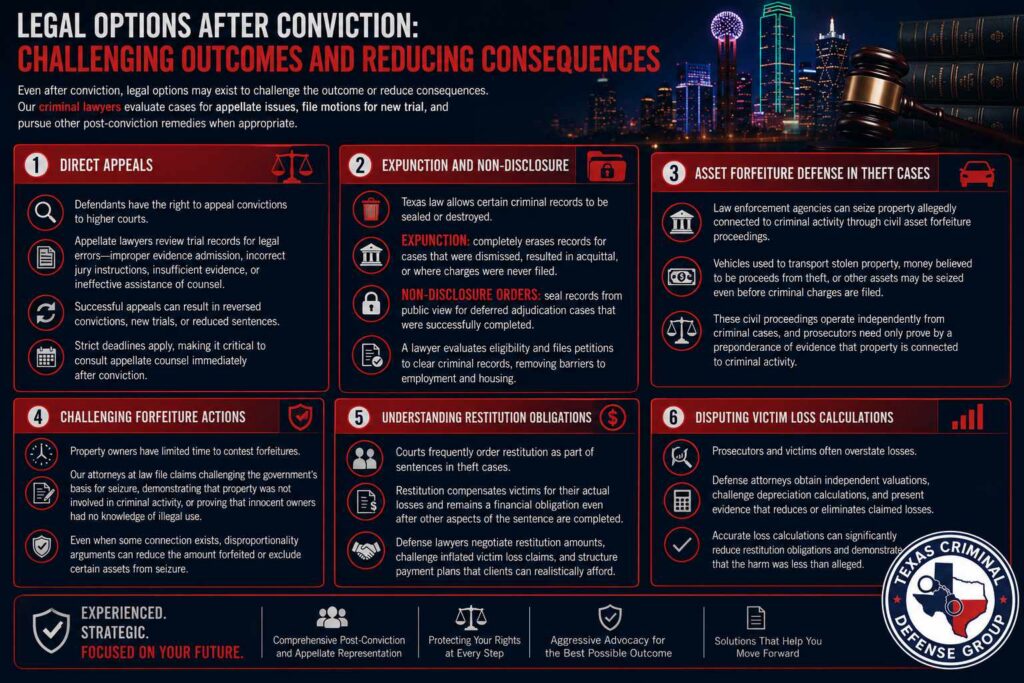
Even after conviction, legal options may exist to challenge the outcome or reduce consequences. Our criminal lawyers evaluate cases for appellate issues, file motions for new trial, and pursue other post-conviction remedies when appropriate.
Defendants have the right to appeal convictions to higher courts. Appellate lawyers review trial records for legal errors—improper evidence admission, incorrect jury instructions, insufficient evidence, or ineffective assistance of counsel. Successful appeals can result in reversed convictions, new trials, or reduced sentences. Strict deadlines apply, making it critical to consult appellate counsel immediately after conviction.
Texas law allows certain criminal records to be sealed or destroyed. Expunction completely erases records for cases that were dismissed, resulted in acquittal, or where charges were never filed. Non-disclosure orders seal records from public view for deferred adjudication cases that were successfully completed. A lawyer evaluates eligibility and files petitions to clear criminal records, removing barriers to employment and housing.
Law enforcement agencies can seize property allegedly connected to criminal activity through civil asset forfeiture proceedings. Vehicles used to transport stolen property, money believed to be proceeds from theft, or other assets may be seized even before criminal charges are filed. These civil proceedings operate independently from criminal cases, and prosecutors need only prove by a preponderance of evidence that property is connected to criminal activity.
Property owners have limited time to contest forfeitures. Our attorneys at law file claims challenging the government’s basis for seizure, demonstrating that property was not involved in criminal activity, or proving that innocent owners had no knowledge of illegal use. Even when some connection exists, disproportionality arguments can reduce the amount forfeited or exclude certain assets from seizure.
Courts frequently order restitution as part of sentences in theft cases. Restitution compensates victims for their actual losses and remains a financial obligation even after other aspects of the sentence are completed. Defense lawyers negotiate restitution amounts, challenge inflated victim loss claims, and structure payment plans that clients can realistically afford.
With Over 500 5-Star Reviews TCGD Have a Track Record of Client
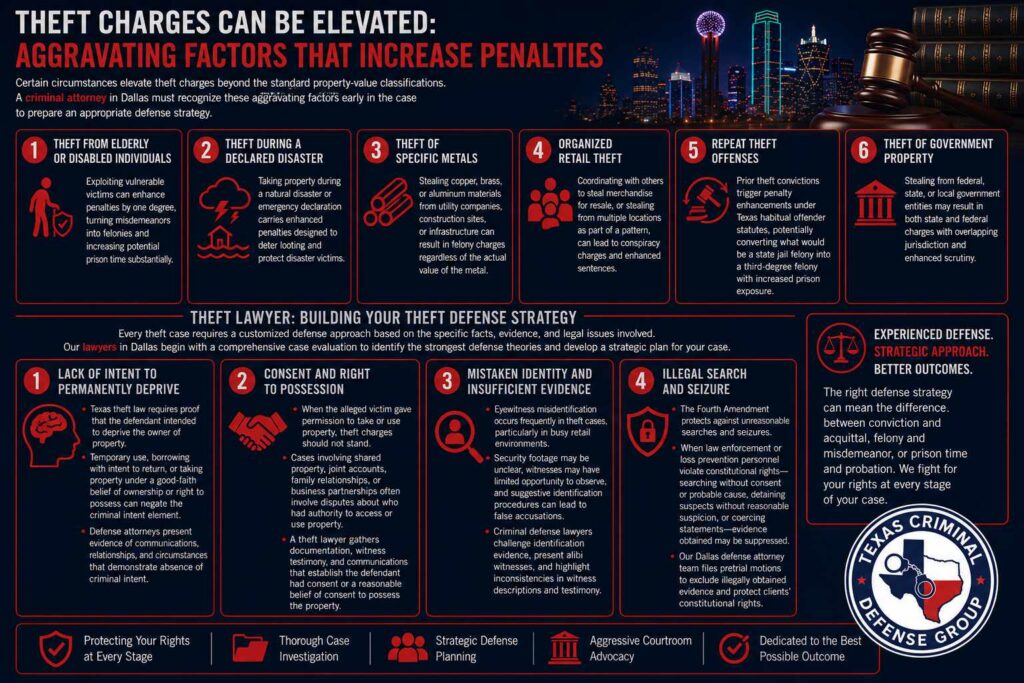
Certain circumstances elevate theft charges beyond the standard property-value classifications. A criminal attorney in Dallas must recognize these aggravating factors early in the case to prepare an appropriate defense strategy.
Every theft case requires a customized defense approach based on the specific facts, evidence, and legal issues involved. Our lawyers in Dallas begin with a comprehensive case evaluation to identify the strongest defense theories and develop a strategic plan for your case.
Texas theft law requires proof that the defendant intended to deprive the owner of property. Temporary use, borrowing with intent to return, or taking property under a good-faith belief of ownership or right to possess can negate the criminal intent element. Defense attorneys present evidence of communications, relationships, and circumstances that demonstrate absence of criminal intent.
When the alleged victim gave permission to take or use property, theft charges should not stand. Cases involving shared property, joint accounts, family relationships, or business partnerships often involve disputes about who had authority to access or use property. A theft lawyer gathers documentation, witness testimony, and communications that establish the defendant had consent or a reasonable belief of consent to possess the property.
Eyewitness misidentification occurs frequently in theft cases, particularly in busy retail environments. Security footage may be unclear, witnesses may have limited opportunity to observe, and suggestive identification procedures can lead to false accusations. Criminal defense lawyers challenge identification evidence, present alibi witnesses, and highlight inconsistencies in witness descriptions and testimony.
The Fourth Amendment protects against unreasonable searches and seizures. When law enforcement or loss prevention personnel violate constitutional rights—searching without consent or probable cause, detaining suspects without reasonable suspicion, or coercing statements—evidence obtained may be suppressed. Our Dallas defense attorney team files pretrial motions to exclude illegally obtained evidence and protect clients’ constitutional rights.