- Start Your Free Consultation
- (866) 557-4343
A driving while intoxicated charge in Lubbock County can put your driver’s license, your job, your freedom, and your future on the line at once, and the penalties reach well past fines and jail time. Texas prosecutors pursue these cases hard, and the stops often begin on I-27, Loop 289, or the Marsha Sharp Freeway, so skilled DWI defense matters from the moment of arrest.
At the Texas Criminal Defense Group, our Lubbock DWI attorneys defend cases built on alcohol, controlled substance, and cannabis impairment, prescription drug intoxication, and the chemical-testing and field sobriety evidence that drives most of these charges. Whether it’s a first offense or an enhanced charge from prior convictions, we pair a working knowledge of the Texas Penal Code with courtroom experience in the Lubbock County courts.
A DWI attorney who understands both the science and the procedure can find the weaknesses in the state’s evidence, from the reason for the initial traffic stop through breath or blood specimen collection, and use them to protect your rights, your record, and your license.


Board Certified
Only 1% of Attorney's in TX are Board Certified in Criminal Law

Phones Answered 24/7

5-Star
Google Ratings
over 500
11,500+ Cases Handled

We Fight for Dismissals and Never Back Down from Trial
Our Lubbock DWI practice covers the full spectrum of intoxication-related charges prosecuted in Lubbock County and across the surrounding South Plains, misdemeanor and felony DWI cases, administrative license revocation hearings, occupational license applications, and post-conviction relief. Every case gets a real investigation: dash-cam and body-cam footage, calibration records for the breath-testing instruments, blood-draw chain-of-custody, and officer training files.
We defend standard driving while intoxicated charges as well as enhanced and specialized intoxication offenses. Our DWI attorneys work the specifics of your arrest, the time and reason for the stop, how the standardized field sobriety tests were run, compliance with Texas Transportation Code Chapter 724 specimen procedures, and the accuracy of the chemical testing, to build targeted motions to suppress.
We also handle the charges that often ride along with a DWI arrest, possession of marijuana, possession of a controlled substance, unlawful carrying of a weapon, open-container violations, and warrants surfaced at booking into the Lubbock County Detention Center, and coordinate the defense across all of them so penalties don’t stack.
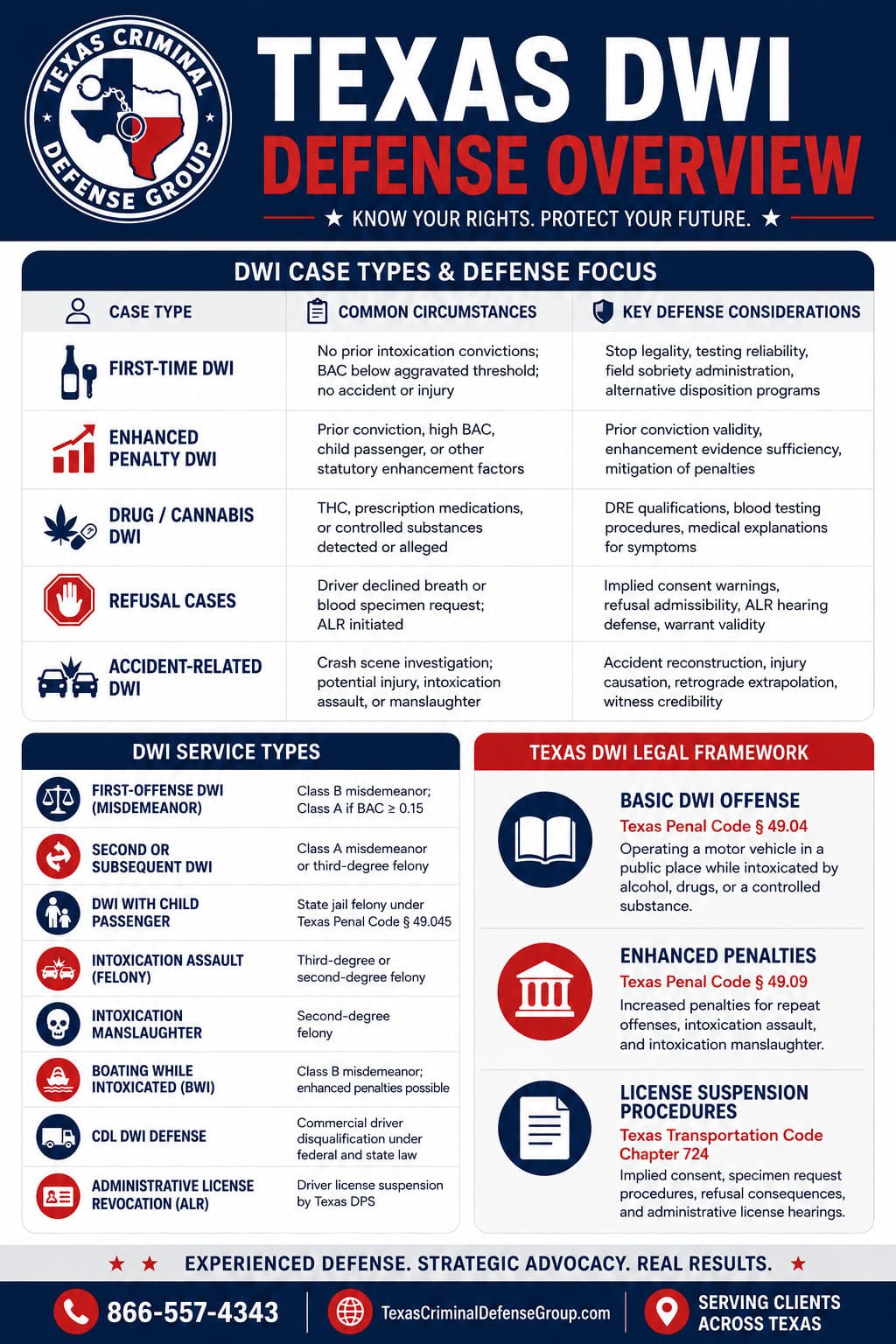
| DWI Service Type | Legal Scope | Key Defense Focus | Where It’s Heard in Lubbock |
|---|---|---|---|
First-Offense DWI (Misdemeanor) | Class B misdemeanor; Class A if BAC ≥0.15 | Probable cause for stop, SFST validity, breath/blood accuracy | Lubbock County Court at Law |
Second or Subsequent DWI | Class A misdemeanor or third-degree felony | Prior conviction admissibility, enhancement proof, jail alternatives | County Court at Law; District Court if a felony |
DWI with Child Passenger | State jail felony under Texas Penal Code § 49.045 | Presence and age of child, CPS involvement, sentencing mitigation | Lubbock County District Court |
Intoxication Assault (Felony) | Third-degree or second-degree felony | Causation, serious bodily injury definition, accident reconstruction | 137th, 140th, or 364th District Court |
Intoxication Manslaughter | Second-degree felony | Causation analysis, toxicology disputes, trial defense | 137th, 140th, or 364th District Court |
Boating While Intoxicated (BWI) | Class B misdemeanor; enhanced penalties possible | Watercraft operation, officer jurisdiction, field sobriety on water | Lubbock County Court at Law |
CDL DWI Defense | Commercial driver disqualification under federal and state law | Preventing CDL suspension, administrative hearing representation | County Court at Law or District Court |
Administrative License Revocation (ALR) | Driver license suspension by Texas DPS | Requesting hearing within 15 days, challenging suspension, securing occupational license | Texas DPS / SOAH hearing (not a criminal court) |
Helping Good People Through Tough Times
Texas Transportation Code Chapter 724 covers implied consent. By operating a motor vehicle in Texas, you impliedly consent to provide a breath or blood specimen if arrested for DWI. If you refuse testing, your license may face automatic suspension for 180 days for a first refusal or two years for a prior refusal or suspension within ten years. If you provide a specimen and the result shows an alcohol concentration of 0.08 or more, your license may face suspension for 90 days for a first offense or one year for a prior suspension.
You have only 15 days from the date of arrest to request an administrative license revocation hearing with the Texas Department of Public Safety to keep driving while your case is pending. A DWI conviction in Texas can also carry serious financial consequences, including fines, court costs, state-imposed assessments, ignition interlock expenses, increased insurance premiums, and possible SR-22 filing requirements.
Most DWI offenders may be required to install an ignition interlock device on every vehicle they operate, at their own expense, for months or longer depending on the facts of the case. Licensed professionals, nurses, real estate agents, attorneys, teachers, commercial drivers, pilots, and security personnel may also face board discipline or employment consequences. Employers may see the criminal record on background checks, non-citizens may face immigration consequences, students may lose financial aid, and a DWI record can weigh against a parent in a custody dispute, especially when the case involves a child passenger or repeat offenses.
| Texas DWI Statute | Legal Standard or Requirement | Impact on Your Case |
|---|---|---|
| Texas Penal Code § 49.04 | Defines DWI as operating a motor vehicle in a public place while intoxicated, including loss of normal use or BAC ≥0.08 | Establishes dual basis for prosecution: impairment or per se BAC |
| Texas Penal Code § 49.09 | Sets enhanced penalties for repeat offenses and elevated BAC | Prior convictions or BAC ≥0.15 increase classification and punishment range |
With Over 500 5-Star Reviews TCGD Have a Track Record of Client
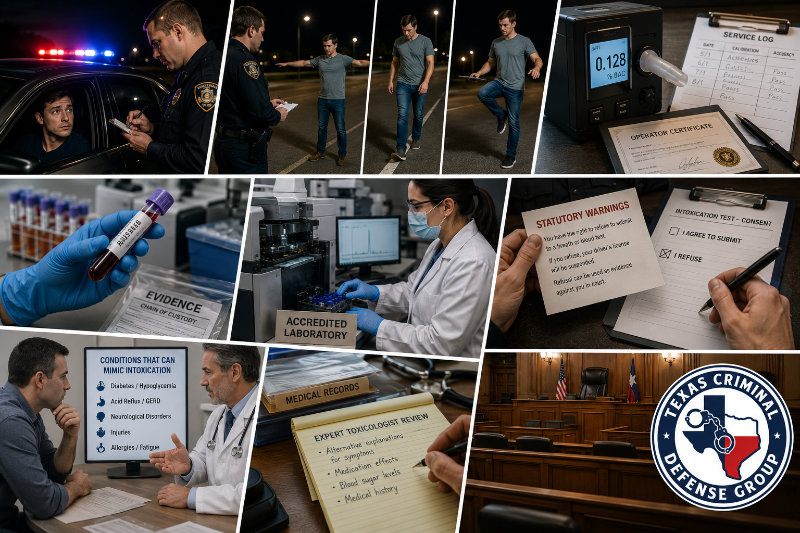
Our Lubbock drunk driving attorney team works each DWI case through a structured investigation. We pull every piece of discoverable evidence the State has, the arrest report, officer narrative, dash-cam and body-cam video, in-car audio, field sobriety worksheets, portable breath results, Intoxilyzer or blood-draw records, calibration and maintenance logs, officer training and certification files, and 911 or dispatch recordings, then map the timeline for gaps, inconsistencies, and violations of your constitutional rights or Texas procedure.
We start with the stop itself. An officer must have reasonable suspicion of a traffic offense or criminal activity to justify a stop; if that’s missing, a violation that didn’t happen, an uncorroborated anonymous tip, or a misreading of traffic law, we move to suppress everything that flowed from it, which often ends the case.
Our DWI representation leans hard on pre-trial motion practice to exclude unreliable or unlawfully obtained evidence, motions to suppress the stop, the field sobriety tests, the breath or blood results, and statements made without Miranda warnings, plus challenges to expert testimony that fails the Texas Rules of Evidence. When suppression succeeds, the State often can’t meet its burden of proof, and the case is dismissed or the charge reduced.
When it serves you, we negotiate with Lubbock County prosecutors to avoid jail time, reduce a charge to a non-DWI offense such as obstruction of a highway or reckless driving, or divert first-time offenders into pretrial intervention. We also pursue deferred adjudication probation, which lets eligible defendants avoid a final conviction if they complete the terms, always aiming to protect your driving privileges, employment, and professional standing.
If the case proceeds to trial in Lubbock County criminal court, we prepare a full defense for the judge or jury: cross-examining the arresting officer, exposing weaknesses in the State’s scientific evidence, calling experts to challenge breath or blood reliability, and arguing reasonable doubt on the facts and the law. We have tried DWI cases to verdict in Lubbock County and surrounding jurisdictions, securing not guilty verdicts and case dismissals through skilled courtroom advocacy.
Where your case lands depends on the charge. A first or second misdemeanor DWI is handled in the Lubbock County Courts at Law, while felony DWI, a third offense, intoxication assault, or intoxication manslaughter, is prosecuted in the district courts, with the 137th, 140th, and 364th District Courts hearing felony criminal matters at the Lubbock County Courthouse on Broadway. The license side of your case runs on a separate track: the ALR hearing is an administrative proceeding held by the State Office of Administrative Hearings at the request of the Texas Department of Public Safety, not a criminal court, which is why you can fight the suspension and the criminal charge at the same time.
Local context matters, too. Many Lubbock DWI stops begin on I-27, Loop 289, or the Marsha Sharp Freeway, and the Texas Tech University community drives a steady share of first-offense DWI, minor-in-possession, and related cases each year. Knowing how the local judges and prosecutors handle these files, and which diversion and deferred-adjudication options they actually offer, shapes the strategy from the very first court setting.
First-time DWI offenders in Lubbock County often qualify for programs and dispositions that limit the long-term damage. Our Lubbock DUI lawyer team evaluates eligibility for pretrial diversion, deferred adjudication probation, and reduction to a lesser charge. First-offense defendants with no prior criminal history, no accident, no child passenger, and a BAC below 0.15 are the strongest candidates for a favorable outcome.
We put mitigation in front of prosecutors and the court, your employment record, family responsibilities, community ties, completed alcohol-education classes, and any counseling or treatment, and back it with character references and documented steps you’ve taken to address underlying issues. That work increases the odds of a charge reduction, probation instead of jail, and a deferred adjudication that keeps a final conviction off your record.
| First-Offense DWI Disposition | Requirements and Conditions | Record Impact |
|---|---|---|
| Pretrial Diversion | Complete education classes, community service, supervision period; typically 6–12 months | Case dismissed upon successful completion; no conviction |
| Deferred Adjudication Probation | Plead guilty/no contest; court defers finding of guilt; complete probation terms (typically 12–24 months) | No final conviction if probation completed successfully; record subject to nondisclosure petition |
| Straight Probation | Final conviction entered; probation in lieu of jail; conditions include fines, classes, community service | Conviction on record; cannot be sealed or expunged |
| Reduction to Reckless Driving or Obstruction | Negotiate plea to non-DWI offense; fines and court costs | No DWI conviction; reduced insurance and license consequences |
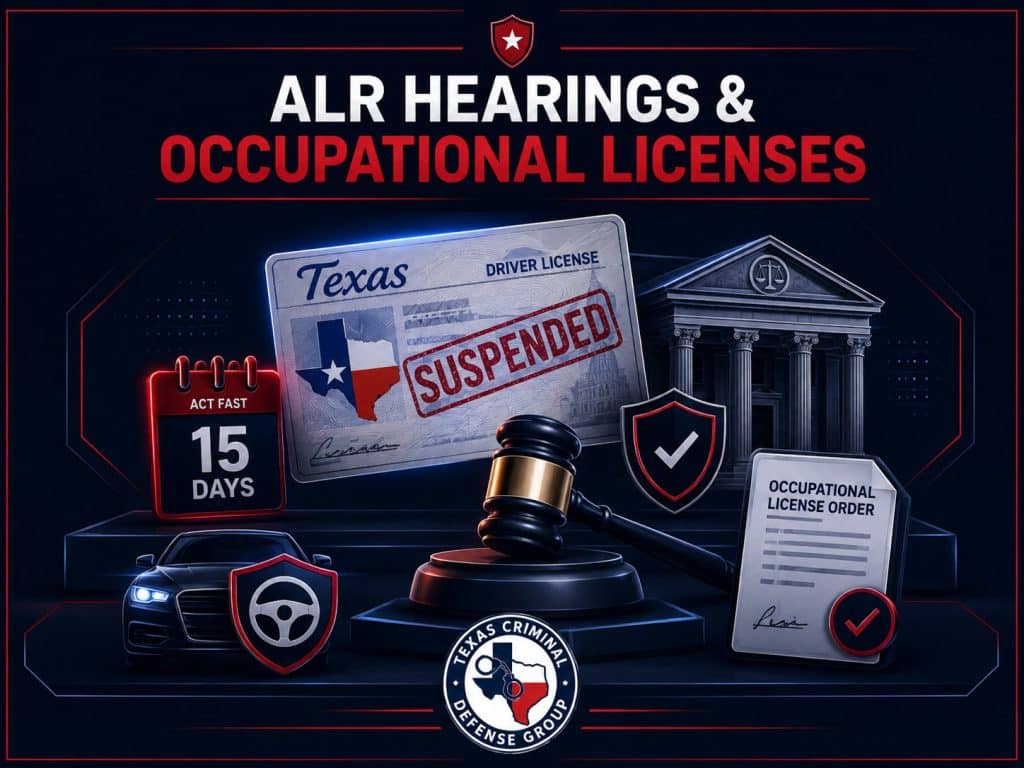
A DWI arrest in Lubbock triggers an automatic administrative license suspension by the Texas Department of Public Safety, separate from the criminal case. This administrative license revocation (ALR) process lets the State suspend your driver’s license on a chemical-test failure or refusal alone, whether or not you are ultimately convicted of the criminal offense. You must request an ALR hearing within 15 days of your arrest to contest the suspension and keep your driving privileges while the case is pending.
Our DWI defense attorney practice includes representation at ALR hearings before administrative law judges. We subpoena the arresting officer, cross-examine witnesses, challenge the legality of the stop and arrest, dispute the breath or blood test, and show where the officer failed to follow the statutory procedures under Texas Transportation Code Chapter 724. A win at the ALR hearing stops the license suspension entirely, even with the criminal case still open.
When license suspension can’t be avoided, we move quickly on an occupational driver’s license so you can still drive for essential purposes: work, school, medical appointments, and household duties. An occupational license requires court approval, proof of financial responsibility (SR-22 insurance), and fees, we prepare and file the petition, represent you at the hearing, and secure a court order authorizing restricted driving.
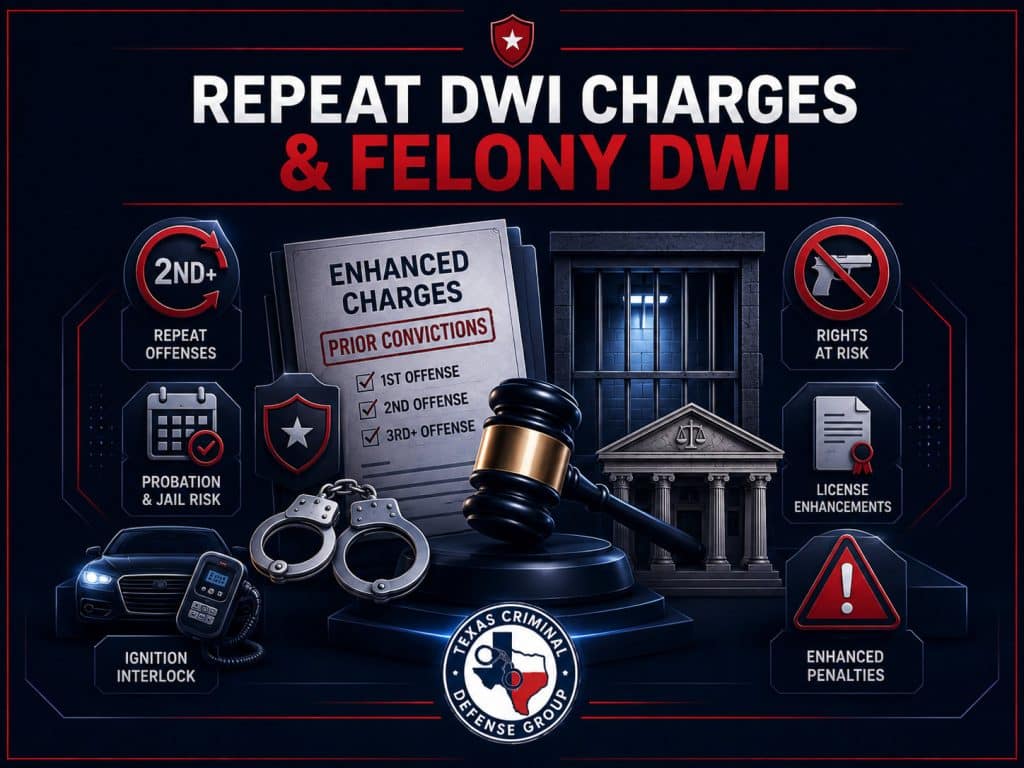
A second or subsequent DWI charge in Lubbock exposes you to significantly harsher penalties, mandatory minimum jail time, longer probation periods, higher fines, extended license suspension, and lifetime ignition-interlock requirements, and prosecutors and judges are far less inclined to offer diversion or deferred adjudication. A third DWI becomes a third-degree felony, punishable by two to ten years in prison and a $10, 000 fine, and a felony conviction costs you firearm-possession rights and creates collateral consequences for employment, housing, and professional licensing. Felony DWI charges are heard in Lubbock’s district courts, the 137th, 140th, and 364th District Courts at the Lubbock County Courthouse on Broadway.
Our Lubbock DWI defense practice represents clients with prior convictions who face enhanced charges. We attack the prior convictions used for enhancement by scrutinizing whether you were properly admonished during the earlier plea, whether you were represented by counsel, and whether the prior judgments meet the legal requirements for enhancement under Texas Penal Code Section 49.09. If a prior conviction is legally defective, we move to strike the enhancement paragraph, dropping the charge classification and available punishment range.
When intoxicated driving results in serious bodily injury or death, prosecutors file the most serious intoxication-related offenses: intoxication assault (a third-degree or second-degree felony) and intoxication manslaughter (a second-degree felony). These cases carry prison sentences ranging from two to twenty years and turn on causation, accident reconstruction, medical evidence, and expert testimony, the State must prove not only that you were intoxicated, but that your intoxication caused the injury or death.
Our DWI defense lawyer team has experience defending serious intoxication felony cases in Lubbock County, Texas, where these charges are prosecuted in the district courts at the Lubbock County Courthouse. We retain accident-reconstruction experts, toxicologists, and medical specialists to challenge the State’s causation theory and present alternative explanations for the collision and the injuries. We examine road conditions, vehicle defects, the actions of other drivers, and victim conduct to build defenses based on comparative responsibility or intervening causes.
Commercial driver’s license holders face uniquely severe consequences from a DWI arrest in Lubbock. Federal Motor Carrier Safety Administration regulations and Texas Transportation Code provisions set a lower BAC threshold, 0.04 for commercial vehicle operators, and mandate automatic disqualification for certain intoxication-related offenses. A single DWI conviction, even in a personal vehicle, triggers a one-year CDL disqualification for a first offense and a lifetime disqualification for a second conviction. Refusing chemical testing in a commercial vehicle means immediate disqualification. For drivers whose livelihood depends on a valid CDL, these penalties are career-ending.
Our CDL DWI attorney practice works to preserve commercial driving privileges through aggressive defense in both criminal court and administrative proceedings. We push for dismissals, acquittals, or reductions to non-disqualifying offenses that let you keep your CDL and keep earning a living. When disqualification can’t be avoided, we help with hardship applications, restricted license petitions, and eventual reinstatement to shorten the interruption to your career.
A CDL DWI case requires specialized knowledge of the interplay between state criminal law, federal commercial-driving regulations, and Texas Department of Public Safety administrative procedure. Our CDL DUI defense challenges the traffic stop, questions the validity of the portable breath-test results used for roadside screening, disputes the accuracy of the evidentiary breath or blood tests, and demonstrates compliance with commercial-vehicle regulations at the time of arrest.
We represent truck drivers, bus operators, delivery drivers, and other commercial vehicle operators in Lubbock, TX facing DWI charges. Our representation includes criminal defense in Lubbock County court, administrative license revocation hearings, and CDL disqualification appeals, and we coordinate with your employer when appropriate during the case.