- Start Your Free Consultation
- (866) 557-4343
An assault charge in Fort Worth can reach into every part of your life. A conviction may bring jail time, heavy fines, a permanent criminal record, and lasting harm to your name at work and at home. Whether the accusation is simple assault, aggravated assault with a deadly weapon, family violence, or assault and battery, you want a Fort Worth assault lawyer who understands the Texas Penal Code, the Tarrant County court system, and the defenses that actually protect you.
Our Fort Worth criminal defense attorneys represent clients across Fort Worth, the DFW metroplex, and the surrounding Tarrant County communities. We take on misdemeanor and felony assault cases, domestic violence allegations, sexual assault accusations, and other violent crime charges. We combine hard courtroom advocacy with a careful review of the evidence: witness statements, police reports, body-camera footage, and affidavits, so every client walks in with the strongest possible defense.
If you or someone close to you has been arrested for assault in Fort Worth, the clock is already running. Getting an experienced criminal defense lawyer involved early can be the line between a dismissal, a reduced charge, or a conviction that follows you for years. Contact our firm today for a confidential consultation and a clear look at how we can protect your future.


Board Certified
Only 1% of Attorney's in TX are Board Certified in Criminal Law

Phones Answered 24/7

5-Star
Google Ratings
over 500
11,500+ Cases Handled

We Fight for Dismissals and Never Back Down from Trial

Elite Assault Crime Defense
Top-rated attorneys in Texas
Texas defines assault under the Texas Penal Code in several overlapping ways. In its most basic form, assault happens when a person intentionally, knowingly, or recklessly causes bodily injury to someone else, threatens another with imminent bodily injury, or makes physical contact that the other person reasonably finds offensive or provocative. That definition stretches from a single spoken threat all the way to a physical fight that leaves a person seriously hurt.
Simple assault is usually filed as a Class A misdemeanor, punishable by up to one year in jail and fines up to $4,000. Once aggravating facts enter the picture, though, such as a weapon, a serious injury, or a victim who is a family member, public servant, or security officer, the charge can climb to a felony. In Tarrant County, misdemeanor assault cases are prosecuted in the county criminal courts, while felony cases move to the district-level courts at the Tim Curry Criminal Justice Center.
Aggravated assault with a deadly weapon is a second-degree felony in Texas, carrying a potential prison sentence of two to twenty years and fines up to $10,000.
Knowing exactly what you are charged with is the first real step in building a defense. Our assault attorney in Fort Worth studies the facts of your case, the evidence the state plans to use, and the controlling law to find weak points in the prosecution and openings for a dismissal or a reduced charge.
Class A misdemeanor assault covers causing bodily injury to another person or threatening imminent bodily injury. Bodily injury means physical pain, illness, or any impairment of a person’s physical condition. Even minor injuries can support a Class A misdemeanor charge when the prosecutor can show intent or recklessness. A conviction can bring up to one year in county jail, fines, probation, and a permanent criminal record that reaches into employment, housing, and professional licenses. These cases are heard in the Tarrant County Criminal Courts in Fort Worth.
Aggravated assault lifts the offense to a felony when the accused causes serious bodily injury or uses or exhibits a deadly weapon during the assault. Serious bodily injury takes in wounds that create a substantial risk of death, cause permanent disfigurement, or lead to protracted loss or impairment of a bodily organ. A deadly weapon can be a firearm, a knife, a vehicle, or any object used in a way capable of causing death or serious injury. Felony convictions carry prison sentences, heavy fines, and long-term collateral consequences, and they are handled in the Criminal District Courts at the Tim Curry Criminal Justice Center.
Assault charges tied to family violence carry their own set of legal consequences in Tarrant County. Family violence assault includes assaults against current or former spouses, dating partners, family members, household members, or co-parents of a child. Even a first-time family violence conviction can cost you your gun rights under federal law, expose you to protective orders, and trigger enhanced penalties for later offenses. Repeat family violence charges can be filed as third-degree felonies, even when the underlying act would otherwise be a misdemeanor.
| Defense Strategy | When It Applies | Key Evidence |
|---|---|---|
| Self-Defense | Use of force to protect against unlawful attack | Witness testimony, injury photos, police reports, 911 calls |
| Defense of Others | Protection of third party from imminent harm | Statements from protected party, video evidence, scene investigation |
| Insufficient Evidence | State cannot prove injury, intent, or identity beyond reasonable doubt | Medical records, expert testimony, alibi evidence |
| Consent | Contact was mutually agreed upon (e.g., sporting event) | Event records, participant agreements, context evidence |
| False Accusation | Motive to fabricate (custody, divorce, revenge) | Text messages, emails, prior inconsistent statements, witness impeachment |
| Accident | Contact was unintentional and not reckless | Scene reconstruction, witness accounts, lack of motive |
No two assault cases are the same, so the defense has to be built around the specific facts, the evidence, and the legal questions in front of the court. Our criminal defense lawyers in Fort Worth draw on a range of strategies to protect clients facing assault charges. Depending on the case, that can mean attacking the sufficiency of the evidence, raising self-defense or defense of others, showing a lack of intent, or establishing that the alleged victim consented to the contact.
Self-defense is one of the most common and most effective defenses in an assault case. Texas law allows the use of force when a person reasonably believes it is immediately necessary to protect against another’s use or attempted use of unlawful force. Deadly force can be justified in narrow situations, such as facing imminent serious bodily injury, sexual assault, or robbery. Our attorneys dig into the circumstances of the incident, gather witness statements, and put forward the evidence that supports a claim of self-defense.
Another approach is to challenge the credibility of the accuser or the reliability of the witness testimony. In many assault cases there are no neutral witnesses, and the result turns on competing accounts from the people involved. Our lawyers run thorough cross-examinations, surface prior inconsistent statements, and look hard at motives for a false accusation, whether that is a custody fight, a divorce, or plain personal animosity.
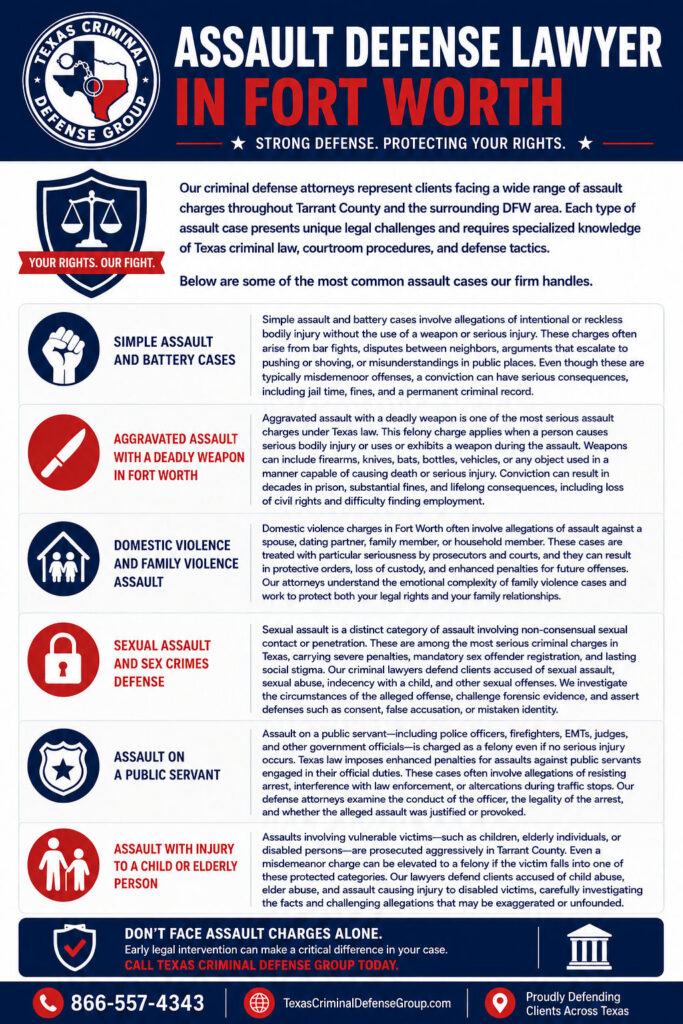
Our criminal defense attorneys represent clients facing a broad range of assault charges across Fort Worth and the wider Tarrant County area. Each kind of assault case brings its own legal challenges and calls for real command of Texas criminal law, courtroom procedure, and defense tactics. Below are some of the assault cases our firm handles most often.
Simple assault and battery cases involve allegations of intentional or reckless bodily injury without a weapon or a serious injury. These charges tend to grow out of bar fights, neighbor disputes, arguments that turn into pushing or shoving, or misunderstandings in public. Even though they usually start as misdemeanor offenses in the Tarrant County Criminal Courts, a conviction can still carry serious weight: jail time, fines, and a permanent criminal record.
Aggravated assault with a deadly weapon is one of the most serious assault charges under Texas law. This felony charge applies when a person causes serious bodily injury or uses or exhibits a weapon during the assault. Weapons here can include firearms, knives, bats, bottles, vehicles, or any object used in a way capable of causing death or serious injury. A conviction can bring decades in prison, heavy fines, and lifelong consequences, including loss of civil rights and real difficulty finding work.
Domestic violence charges in Fort Worth often involve allegations of assault against a spouse, dating partner, family member, or household member. Tarrant County prosecutors and judges treat these cases with particular seriousness, and they can lead to protective orders, loss of custody, and enhanced penalties for any future offense. Our attorneys understand how emotionally tangled family violence cases can be, and we work to protect both your legal rights and your family relationships.
Sexual assault is a separate category of assault built on non-consensual sexual contact or penetration. These are among the most serious criminal charges in Texas, carrying severe penalties, mandatory sex offender registration, and lasting social stigma. Our criminal lawyers defend clients accused of sexual assault, sexual abuse, indecency with a child, and other sexual offenses. We investigate the circumstances of the alleged offense, challenge the forensic evidence, and raise defenses such as consent, false accusation, or mistaken identity.
Assault on a public servant, including police officers, firefighters, EMTs, judges, and other government officials, is charged as a felony even when no serious injury occurs. Texas law imposes enhanced penalties for assaults against public servants acting in their official duties. These cases often involve allegations of resisting arrest, interference with law enforcement, or altercations during traffic stops. Our defense attorneys examine the officer’s conduct, the legality of the arrest, and whether the alleged assault was justified or provoked.
Assaults involving vulnerable victims, such as children, elderly individuals, or disabled persons, are prosecuted aggressively in Fort Worth, TX. Even a misdemeanor charge can be pushed up to a felony when the victim falls into one of these protected groups. Our lawyers defend clients accused of child abuse, elder abuse, and assault causing injury to disabled victims, working through the facts and pushing back on allegations that may be exaggerated or unfounded.
Helping Good People Through Tough Times
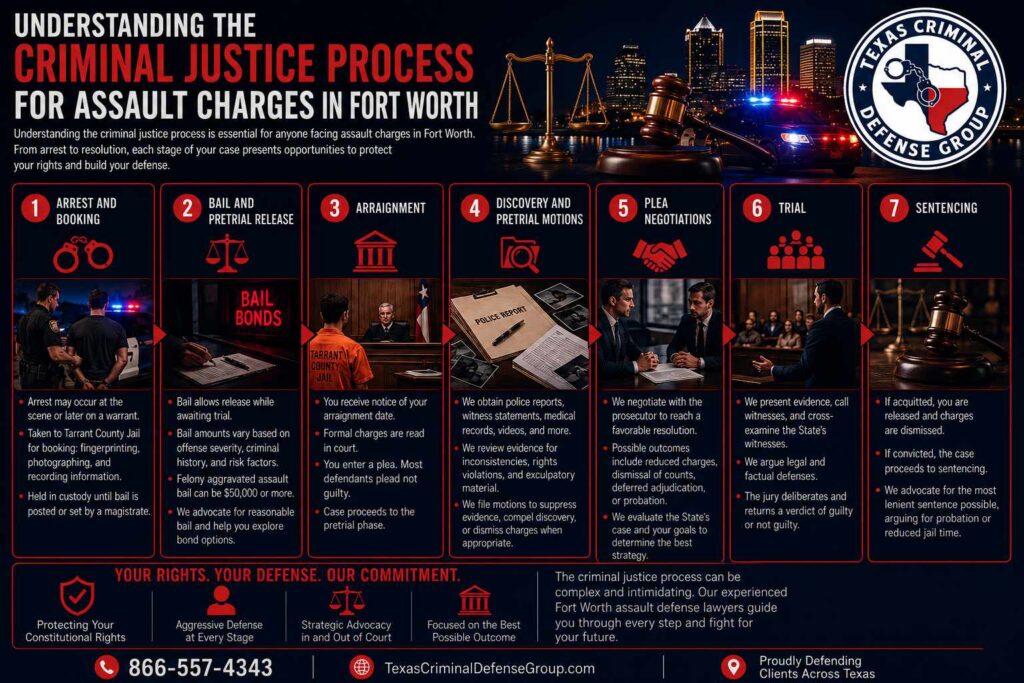
Understanding how the criminal justice process works matters for anyone facing assault charges in Fort Worth. It starts with an arrest, which may happen at the scene of the alleged offense or later on a warrant. After the arrest, the defendant is booked into the Tarrant County Jail, where bail is set. Depending on how serious the charge is, bail can run from a few hundred dollars to tens of thousands of dollars or more.
Once released on bail, the defendant receives notice of an arraignment, where the formal charges are read and a plea is entered. Most defendants plead not guilty at arraignment, and the case moves into the pretrial phase. During pretrial, the defense attorney works through discovery, reviews the state’s evidence, files motions to suppress evidence or dismiss charges, and negotiates with the prosecutor from the Tarrant County Criminal District Attorney’s Office.
If the case cannot be resolved through a dismissal or a favorable plea, it heads to trial. At trial, the prosecution has to prove every element of the assault charge beyond a reasonable doubt. The defense puts on evidence, cross-examines witnesses, and argues the legal defenses. If the jury finds the defendant not guilty, the case ends in an acquittal. If the jury convicts, the case moves to sentencing, where the judge or jury sets the punishment.
Arrests for assault in Fort Worth can come right after an alleged incident or weeks or months later on an arrest warrant. Officers investigate the complaint, interview witnesses, and review whatever evidence is available before making an arrest. Once arrested, the defendant is taken to the Tarrant County Jail (Lon Evans Corrections Center) for booking, which includes fingerprinting, photographing, and recording personal information. The defendant stays in custody until bail is posted or a magistrate sets bail conditions.
Bail lets a defendant get out of custody while the case is pending. In Fort Worth, bail amounts for assault charges depend on the severity of the offense, the defendant’s criminal history, and any danger the defendant may pose to the community or the alleged victim. Misdemeanor assault cases usually carry lower bail, while felony aggravated assault cases can see bail set at $50,000 or more. Our assault lawyer in Fort Worth can push for reasonable bail conditions and walk you through your options for posting bond.
In the discovery phase, the defense attorney obtains the police report, witness statements, medical records, photographs, videos, and any other evidence the prosecution plans to use at trial. Our lawyers go through that material closely, looking for inconsistencies, violations of constitutional rights, and exculpatory evidence that helps the defense. We file pretrial motions to suppress evidence taken through illegal searches or seizures, to force the state to hand over additional evidence, and to dismiss charges where the law supports it.
In many assault cases, the defense attorney negotiates with the prosecutor to reach a plea agreement that resolves the case without a trial. A favorable agreement might include reduced charges, dismissal of certain counts, deferred adjudication, or probation instead of jail time. Our lawyers weigh the strength of the state’s case, the penalties you would face if convicted at trial, and your own goals to decide whether a plea agreement is truly in your interest.
If the case goes to trial, the defense attorney presents evidence, calls witnesses, cross-examines the state’s witnesses, and argues the legal and factual defenses to the jury. The jury deliberates and returns a verdict of guilty or not guilty. On an acquittal, the defendant is released and the charges are dismissed. On a conviction, the case moves to sentencing, where the judge or jury sets the punishment. Our Fort Worth defense lawyer argues for the most lenient sentence available, presenting mitigating evidence and pressing for probation or reduced jail time.

The penalties for an assault conviction in Fort Worth turn on how the offense is classified, the defendant’s criminal history, and any aggravating or mitigating circumstances. Misdemeanor assault convictions can bring up to one year in county jail and fines up to $4,000. Felony convictions carry far heavier penalties, including long prison sentences, substantial fines, and collateral consequences that reach employment, housing, professional licenses, and civil rights.
Beyond the immediate jail time and fines, an assault conviction leaves a permanent criminal record that can follow you for the rest of your life. That record can shut you out of certain jobs, limit educational opportunities, weigh on child custody decisions, and block professional licenses. For non-citizens, an assault conviction can also lead to deportation or denial of naturalization.
Misdemeanor assault convictions can bring up to one year in the Tarrant County Jail. Felony assault convictions carry sentences ranging from two to twenty years or more in state prison, depending on the degree of the felony and the aggravating factors involved. Repeat offenders face enhanced penalties, and certain felony assault charges carry mandatory minimum sentences.
Assault convictions often include fines set by the court. Misdemeanor fines can run as high as $4,000, while felony fines can reach $10,000. On top of fines, the court may order the defendant to pay restitution to the victim for medical expenses, property damage, lost wages, and other economic losses caused by the assault.
In some cases, the court imposes probation or community supervision instead of jail time. Probation conditions commonly include regular reporting to a probation officer, payment of fines and restitution, community service, anger management classes, drug and alcohol testing, and a bar on contact with the victim. Violating those conditions can lead to revocation and imposition of the original jail or prison sentence.
An assault conviction carries collateral consequences that stretch well past the courtroom. They can include loss of gun rights, difficulty finding work, eviction from public housing, ineligibility for student loans and financial aid, loss of professional licenses, and immigration consequences for non-citizens. Our criminal defense lawyer in Fort Worth works to soften these consequences by seeking dismissals, reduced charges, deferred adjudication, or expunction wherever it is possible.

Hiring an experienced assault attorney in Fort Worth is one of the most important decisions you can make when you are facing criminal charges. A skilled lawyer brings command of Texas criminal law, real familiarity with the Tarrant County court system, working relationships with prosecutors and judges, and defense strategies that can be the difference between conviction and acquittal, jail time and probation, or a permanent record and a clean slate.
Our criminal defense attorneys handle every stage of your case from start to finish. We open with a careful review of the facts, the evidence, and the charges against you. We investigate the circumstances of the alleged assault, interview witnesses, pull surveillance video, and gather the evidence that supports your defense. We file motions to suppress illegally obtained evidence, attack the sufficiency of the state’s case, and negotiate with prosecutors to seek dismissals or reduced charges.
If your case goes to trial, our lawyers bring hard courtroom advocacy. We cross-examine the state’s witnesses, call defense witnesses, put in evidence, and argue your case to the jury. Our aim is the best result available to you, whether that is an acquittal, a dismissal, a favorable plea agreement, or reduced penalties.
Our attorneys run independent investigations to build the evidence that supports your defense. That can mean interviewing witnesses, obtaining surveillance video from businesses or homes near the scene, reviewing medical records, consulting expert witnesses, and reconstructing the events that led up to the alleged assault. We also comb police reports and witness statements for the inconsistencies and errors that can undercut the prosecution.
Sharp pretrial motions are a core part of assault defense. Our Fort Worth lawyer team files motions to suppress evidence obtained in violation of your Fourth Amendment rights, motions to dismiss charges when the state lacks probable cause or fails to meet the legal requirements, and motions to compel discovery when the prosecution holds back exculpatory evidence. A successful pretrial motion can lead to a dismissal or the exclusion of key evidence that weakens the state’s case.
Our attorneys know the prosecutors at the Tarrant County Criminal District Attorney’s Office and understand how to negotiate effectively for a favorable outcome. We present mitigating evidence, point out the weaknesses in the state’s case, and press for reduced charges, deferred adjudication, or dismissal. In the right cases, we negotiate plea agreements that let you avoid jail time, keep fines down, and protect your criminal record.
When a case cannot be resolved through dismissal or negotiation, our lawyers bring hard trial representation. We prepare thoroughly, build a persuasive trial strategy, and present your defense with skill and confidence. Our trial lawyers cross-examine the state’s witnesses, challenge the forensic evidence, and put on the testimony and exhibits that support your innocence or justify your actions. We stand with you at every stage, from jury selection through closing arguments.
With Over 500 5-Star Reviews TCGD Have a Track Record of Client
Texas Penal Code Section 22.01 defines assault and sets out the elements the state must prove to win a conviction. Under the statute, a person commits assault by intentionally, knowingly, or recklessly causing bodily injury to another, by intentionally or knowingly threatening another with imminent bodily injury, or by intentionally or knowingly making physical contact with another when the person knows or should reasonably believe the other will find the contact offensive or provocative. Section 22.02 of the Texas Penal Code governs aggravated assault. A person commits aggravated assault by committing assault and either causing serious bodily injury to another or using or exhibiting a deadly weapon during the commission of the assault. Serious bodily injury is defined as injury that creates a substantial risk of death or that causes death, serious permanent disfigurement, or protracted loss or impairment of the function of any bodily member or organ. Texas law also recognizes several affirmative defenses to assault charges, including self-defense, defense of others, defense of property, and consent. To raise self-defense, the defendant has to show that the use of force was immediately necessary to protect against another’s use or attempted use of unlawful force. The force used has to be proportionate to the threat, and deadly force is justified only in limited circumstances, such as protection against murder, sexual assault, aggravated kidnapping, or robbery.
To convict a defendant of assault, the prosecution has to prove each element of the offense beyond a reasonable doubt. For simple assault, the state must show that the defendant caused bodily injury, that the injury was intentional or reckless, and that no legal justification existed. For aggravated assault, the state must also show that the defendant caused serious bodily injury or used or exhibited a deadly weapon
Texas law allows the use of force in self-defense when a person reasonably believes force is immediately necessary to protect against another’s use or attempted use of unlawful force. The force used has to be proportionate to the threat.
Deadly force is justified when a person reasonably believes it is immediately necessary to protect against the other’s use or attempted use of deadly force, or to prevent murder, sexual assault, aggravated kidnapping, or robbery.
A person is justified in using force or deadly force to protect a third person when the person reasonably believes the intervention is immediately necessary to protect that third person from unlawful force or deadly force. The same standards that govern self-defense apply to defense of others. Our assault attorney in Fort Worth presents evidence of the circumstances, the threat to the third party, and the reasonableness of the defendant’s actions to establish this defense.
The cost of hiring a criminal defense attorney in Fort Worth depends on several factors: the complexity of the case, the severity of the charges, the attorney’s experience and reputation, and whether the case goes to trial. Understanding these cost factors helps you make an informed decision when you choose legal representation.
Misdemeanor assault cases are generally less expensive to defend than felony cases. Simple assault charges with no aggravating factors, weapons, or serious injury can often be resolved more quickly, with fewer court appearances and less investigation. Felony aggravated assault cases, by contrast, tend to require extensive pretrial preparation, expert witnesses, forensic analysis, and longer trials, all of which drive up legal fees.
Most criminal defense attorneys charge either a flat fee or an hourly rate. Flat fees give you certainty and let you budget for your defense, while hourly billing tracks the actual time spent on your case. Our firm keeps its fee structure transparent and will talk through costs with you during the initial consultation. We believe quality legal representation should be within reach, and we work with clients on payment plans when it makes sense.
Additional costs can include expert witness fees, investigator fees, court costs, and fees for obtaining records and evidence. Our attorneys give you a clear breakdown of expected costs and keep you posted on any added expenses as the case moves forward. Investing in experienced legal representation is one of the most important decisions you can make when facing assault charges, and the cost of a conviction, including jail time, fines, lost employment, and a criminal record, far outweighs the cost of a strong defense.
An assault arrest or charge can shadow you for years, weighing on employment, housing, and other opportunities. Texas law provides ways to expunge or seal certain criminal records so that people can move forward with a clean slate.
Expunction is available when charges are dismissed, when a defendant is acquitted, or when a defendant successfully completes deferred adjudication for certain offenses. An expunction removes the arrest and the charge from public records and lets the defendant legally deny the arrest in most situations.
Sealing, also called an order of nondisclosure, is available to defendants who successfully complete deferred adjudication for certain offenses. Sealing limits public access to the record without erasing it entirely. Our criminal defense lawyers can help you figure out whether you qualify for expunction or sealing and guide you through the process.
Expunction is available when the defendant was acquitted, when charges were dismissed, when the defendant completed a pretrial diversion program, or when the statute of limitations has run. Expunction is not available for most convictions, but it is a powerful tool for clearing your record after a dismissal or an acquittal.
An order of nondisclosure restricts access to your criminal record, keeping most employers, landlords, and private entities from viewing it. Nondisclosure is available for certain offenses after successful completion of deferred adjudication or community supervision. Some offenses, including assault with certain aggravating factors, are not eligible for nondisclosure.
Beyond the criminal charges, assault allegations in Fort Worth can trigger civil protective orders and lawsuits. A protective order is a civil court order that bars the defendant from contacting or coming near the alleged victim. Violating a protective order is a separate criminal offense that can lead to arrest and additional charges.
People who say they were assaulted may also file civil lawsuits seeking money damages for medical expenses, lost wages, pain and suffering, and emotional distress. Our Fort Worth assault lawyer team can represent you in both the criminal and the civil proceedings, protecting your rights and your financial interests at the same time.
After an arrest for family violence or assault, the alleged victim may seek a temporary protective order. Temporary orders can be issued on an emergency basis and usually stay in effect until a hearing is held. At that hearing, the court decides whether to issue a permanent protective order, which can last up to two years or longer. Protective orders can prohibit contact, require the defendant to move out of a shared residence, and restrict possession of firearms.
Assault victims can file civil lawsuits seeking compensation for their injuries and damages. Unlike criminal cases, where the state must prove guilt beyond a reasonable doubt, civil cases require proof by a preponderance of the evidence, a lower standard. A defendant in an assault case may face both criminal prosecution and civil liability, and a conviction in criminal court can be used as evidence in the civil lawsuit.
Certain aggravating factors can push assault charges to a higher level and raise the penalties on conviction. Those factors include the use of a deadly weapon, the infliction of serious bodily injury, the victim’s status as a protected person (such as a public servant, family member, child, or elderly person), and the defendant’s prior criminal history.
Using or exhibiting a deadly weapon during an assault elevates the charge to aggravated assault, a second-degree felony. A deadly weapon includes firearms, knives, clubs, and any object capable of causing death or serious injury when used in a particular way. Even displaying a weapon during an assault can support a felony charge, whether or not the weapon is ever used.
Causing serious bodily injury elevates an assault charge to aggravated assault. Serious bodily injury takes in wounds that create a substantial risk of death, cause permanent disfigurement, or lead to protracted impairment of a bodily organ. Medical records, expert testimony, and photographs are often used to prove serious bodily injury.
Assaults against certain protected victims carry enhanced penalties. Those victims include public servants (police officers, firefighters, judges), family members, household members, dating partners, children, elderly persons, and disabled persons. Even a misdemeanor assault can be elevated to a felony when the victim falls into one of these protected groups.
Defendants with prior convictions for assault, family violence, or other violent crimes face enhanced penalties for later offenses. Repeat offenders can be charged with felonies even for conduct that would otherwise be a misdemeanor, and the sentencing ranges are increased for defendants with prior convictions.