- Start Your Free Consultation
- (866) 557-4343
A driving while intoxicated charge in Tarrant County reaches into every corner of your life: your drivers license, your job, your freedom, and your future. A DWI conviction carries penalties that go well past fines and jail time. Across Fort Worth, Texas law enforcement and prosecutors push these cases hard, so skilled dwi legal assistance matters from the first minutes of the arrest through the final ruling.
Our firm concentrates on criminal defense, with a heavy focus on intoxication offenses here in Fort Worth, Texas. We take on cases built on alcohol, controlled substance impairment, cannabis-related DWI allegations, prescription drug intoxication, and other layered situations where chemical testing, field sobriety tests, and officer observations become the foundation of criminal charges. Facing a first-time offense, or staring down enhanced penalties from prior convictions, you get an approach that pairs a working command of Texas Penal Code provisions with real courtroom experience in the Tarrant County courts.
A DWI attorney who reads both the science and the procedure in these cases can find the soft spots in the state’s evidence, push back on flawed testing, and put a persuasive defense in front of the court. We walk through every step, from the first traffic stop to the blood or breath specimen, to guard your rights and chase the strongest result the facts allow.


Board Certified
Only 1% of Attorney's in TX are Board Certified in Criminal Law

Phones Answered 24/7

5-Star
Google Ratings
over 500
11,500+ Cases Handled

We Fight for Dismissals and Never Back Down from Trial
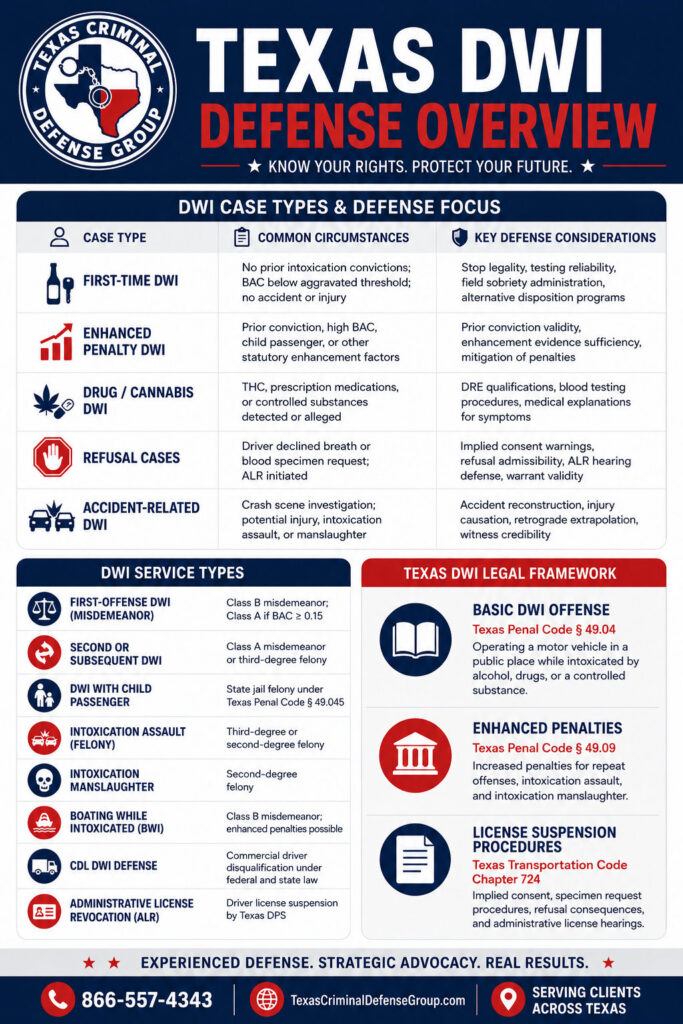
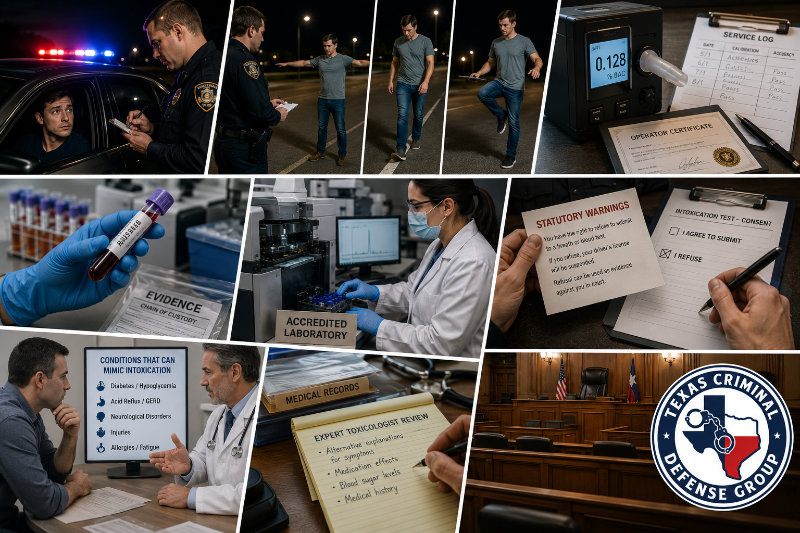
Our criminal defense attorney practice covers the full range of intoxication-related charges filed in Tarrant County and the courts around it. We handle misdemeanor and felony DWI cases, administrative license revocation hearings, occupational license applications, and post-conviction relief. Every matter gets a close review: dash-cam and body-cam footage, calibration records for breath-testing instruments, blood-draw chain-of-custody paperwork, and the arresting officer’s training file.
We defend clients charged with standard driving while intoxicated offenses along with enhanced and specialized intoxication crimes. Our DWI attorney team studies the exact facts of your arrest: the time of the stop, the reason for the detention, how the standardized field sobriety tests were run, whether officers followed Texas Transportation Code Chapter 724
specimen-request rules, and how accurate the chemical testing really was. From there we build targeted motions to suppress evidence and press the State’s proof at trial.
Our Fort Worth criminal defense attorney practice also steps in on the charges that often ride along with a DWI arrest: possession of marijuana, possession of a controlled substance, unlawful carrying of a weapon
, open-container violations, and any outstanding warrant that surfaces during booking at the Tarrant County Jail. We line up the defense across every charge to hold down cumulative penalties and keep your record from stacking consequences.
| DWI Service Type | Legal Scope | Key Defense Focus | Where It’s Heard in Fort Worth |
|---|---|---|---|
First-Offense DWI (Misdemeanor) | Class B misdemeanor; Class A if BAC ≥0.15 | Probable cause for stop, SFST validity, breath/blood accuracy | Tarrant County Criminal Court |
Second or Subsequent DWI | Class A misdemeanor or third-degree felony | Prior conviction admissibility, enhancement proof, jail alternatives | Tarrant County Criminal Court or Criminal District Court (Tim Curry Justice Center) |
DWI with Child Passenger | State jail felony under Texas Penal Code § 49.045 | Presence and age of child, CPS involvement, sentencing mitigation | Criminal District Court (Tim Curry Justice Center) |
Intoxication Assault (Felony) | Third-degree or second-degree felony | Causation, serious bodily injury definition, accident reconstruction | Criminal District Court (Tim Curry Justice Center) |
Intoxication Manslaughter | Second-degree felony | Causation analysis, toxicology disputes, trial defense | Criminal District Court (Tim Curry Justice Center) |
Boating While Intoxicated (BWI) | Class B misdemeanor; enhanced penalties possible | Watercraft operation, officer jurisdiction, field sobriety on water | Tarrant County Criminal Court |
CDL DWI Defense | Commercial driver disqualification under federal and state law | Preventing CDL suspension, administrative hearing representation | Tarrant County Criminal Court |
Administrative License Revocation (ALR) | Driver license suspension by Texas DPS | Requesting hearing within 15 days, challenging suspension, securing occupational license | Texas DPS administrative hearing (State Office of Administrative Hearings) |
Helping Good People Through Tough Times
Texas Penal Code Section 49.04
sets out driving while intoxicated as operating a motor vehicle in a public place while intoxicated. Intoxication means losing the normal use of your mental or physical faculties because of alcohol, a drug, a dangerous drug, a mix of substances, or any other substance, or registering an alcohol concentration of 0.08 or more. That two-part definition lets prosecutors build a DWI case on observed impairment even when a breath or blood result comes in under the per se limit, or lean only on the chemical result no matter how you looked or acted.
Texas Penal Code Section 49.09
controls enhanced penalties and higher offense classifications. A first-offense DWI usually lands as a Class B misdemeanor, punishable by up to 180 days in jail and a fine up to $2,000. When your blood alcohol concentration reads 0.15 or higher, the charge climbs to a Class A misdemeanor with up to one year in jail and a $4,000 fine. A second DWI becomes a Class A misdemeanor no matter the BAC. A third or later conviction jumps to a third-degree felony, carrying two to ten years in prison and up to a $10,000 fine. More enhancements apply when a child passenger under 15 years of age was in the vehicle, which triggers state jail felony charges under Section 49.045, or when the intoxicated driving caused serious bodily injury or death.
| Texas DWI Statute | Legal Standard or Requirement | Impact on Your Case |
|---|---|---|
Texas Penal Code § 49.04 | Defines DWI as operating a motor vehicle in a public place while intoxicated, including loss of normal use or BAC ≥0.08 | Establishes dual basis for prosecution: impairment or per se BAC |
Texas Penal Code § 49.09 | Sets enhanced penalties for repeat offenses and elevated BAC | Prior convictions or BAC ≥0.15 increase classification and punishment range |
Texas Transportation Code Chapter 724 | Governs implied consent, specimen requests, refusal consequences, and ALR procedures | Refusal triggers automatic license suspension; compliance provides breath/blood evidence |
Texas Transportation Code Chapter 724
handles implied consent and the administrative license side. By driving in Texas, you have already consented to give a breath or blood specimen once arrested for DWI. Refuse the test and your license faces an automatic suspension of 180 days for a first refusal or two years for a prior refusal or suspension within ten years. Give a specimen that reads an alcohol concentration of 0.08 or more and your license faces a suspension of 90 days for a first offense or one year with a prior suspension. You have just 15 days from the arrest date to request an administrative license revocation hearing with the Texas Department of Public Safety and keep your driving privileges alive while the court case runs.
A DWI conviction in Fort Worth can bring heavy financial fallout. On top of court costs and other penalties, a misdemeanor DWI conviction in Texas can produce total fines and state-imposed assessments in the range of roughly $6,000 to $10,000 or more. A felony DWI conviction can push financial penalties to $16,000 or higher, depending on the facts, prior convictions, and alcohol concentration. Most DWI offenders can be ordered to install an ignition interlock device on every vehicle they drive, at their own cost, for six months up to several years. Auto insurance premiums can spike or your coverage can be dropped entirely, pushing you into a high-risk SR-22 filing.
Professional license holders, including nurses, real estate agents, attorneys, teachers, commercial drivers, pilots, and security personnel, face discipline and possible suspension or revocation of their credentials after a DWI conviction. Employers running background checks will see the criminal record, which shapes hiring, promotions, and whether you keep the job. Immigration fallout can mean denial of naturalization, inadmissibility findings, and removal proceedings for non-citizens. College students can lose financial aid and face school discipline. Child custody and visitation can be put at risk when a parent picks up a DWI record, and the risk grows in cases with a child passenger or repeat offenses.
With Over 500 5-Star Reviews TCGD Have a Track Record of Client
Our Fort Worth drunk driving attorney team runs each DWI case through a structured investigation and defense build. We start by pulling every discoverable piece from the State: the arrest report, the officer narrative, dash-cam and body-cam video, in-car audio, field sobriety test worksheets, portable breath test results, Intoxilyzer or blood-draw records, calibration and maintenance logs, officer training and certification files, and 911 or dispatch recordings. Then we walk the timeline of events to surface gaps, contradictions, and any violation of your constitutional rights or Texas procedure.
We test the legality of the first traffic stop or vehicle detention. An officer needs reasonable suspicion of a traffic offense or criminal activity to justify the stop. If that legal footing was missing, say, an alleged traffic violation that never happened, an anonymous tip with no corroboration, or a mistaken read of the traffic law, we file a motion to suppress everything gathered from the unlawful stop. Suppressing the stop usually collapses the entire case.
Our DWI representation leans on aggressive pre-trial motion practice to keep unreliable or unlawfully obtained evidence out. We file motions to suppress the traffic stop, the field sobriety tests, the breath or blood results, any statements taken without Miranda warnings, and expert testimony that fails Texas Rules of Evidence standards. When a suppression motion lands, it often forces a dismissal or a real charge reduction because the State cannot carry its burden without that evidence.
Where it fits, we negotiate with Tarrant County prosecutors for plea agreements that avoid jail time, reduce charges to non-DWI offenses such as obstruction of a highway or reckless driving, or route first-time offenders into pretrial intervention. We also pursue deferred adjudication probation, which lets eligible defendants avoid a final conviction if they finish the probation terms. The aim in every negotiation is to hold down criminal and administrative penalties while protecting your driving privileges, your job, and your professional standing.
If your case goes to trial in Tarrant County criminal court at the Tim Curry Criminal Justice Center on West Belknap Street, we build a full defense for the judge or jury. Our DWI attorney in Fort Worth cross-examines the arresting officer, opens up the weak points in the State’s scientific evidence, calls expert witnesses to challenge breath or blood reliability, and argues reasonable doubt on the facts and the law. We have tried DWI cases to verdict in Tarrant County and nearby courts, winning not guilty verdicts and dismissals through hard courtroom work.
First-time DWI offenders in Tarrant County often qualify for programs and outcomes that hold down the long-term damage. Our Fort Worth DUI lawyer team weighs eligibility for pretrial diversion, deferred adjudication probation, and reduction to lesser charges. First-offense defendants with no prior criminal history, no accident, no child passenger, and a BAC below 0.15 are the strongest candidates for a favorable result.
We put mitigating evidence in front of prosecutors and the court: your work record, family responsibilities, community ties, completion of alcohol education classes, and any counseling or treatment. We also line up character reference letters and document the steps you have taken to deal with underlying issues. That work improves the odds of a charge reduction, probation instead of jail, and deferred adjudication that keeps a final conviction off your record.
| First-Offense DWI Disposition | Requirements and Conditions | Record Impact |
|---|---|---|
| Pretrial Diversion | Complete education classes, community service, supervision period; typically 6 to 12 months | Case dismissed upon successful completion; no conviction |
| Deferred Adjudication Probation | Plead guilty/no contest; court defers finding of guilt; complete probation terms (typically 12 to 24 months) | No final conviction if probation completed successfully; record subject to nondisclosure petition |
| Straight Probation | Final conviction entered; probation in lieu of jail; conditions include fines, classes, community service | Conviction on record; cannot be sealed or expunged |
| Reduction to Reckless Driving or Obstruction | Negotiate plea to non-DWI offense; fines and court costs | No DWI conviction; reduced insurance and license consequences |
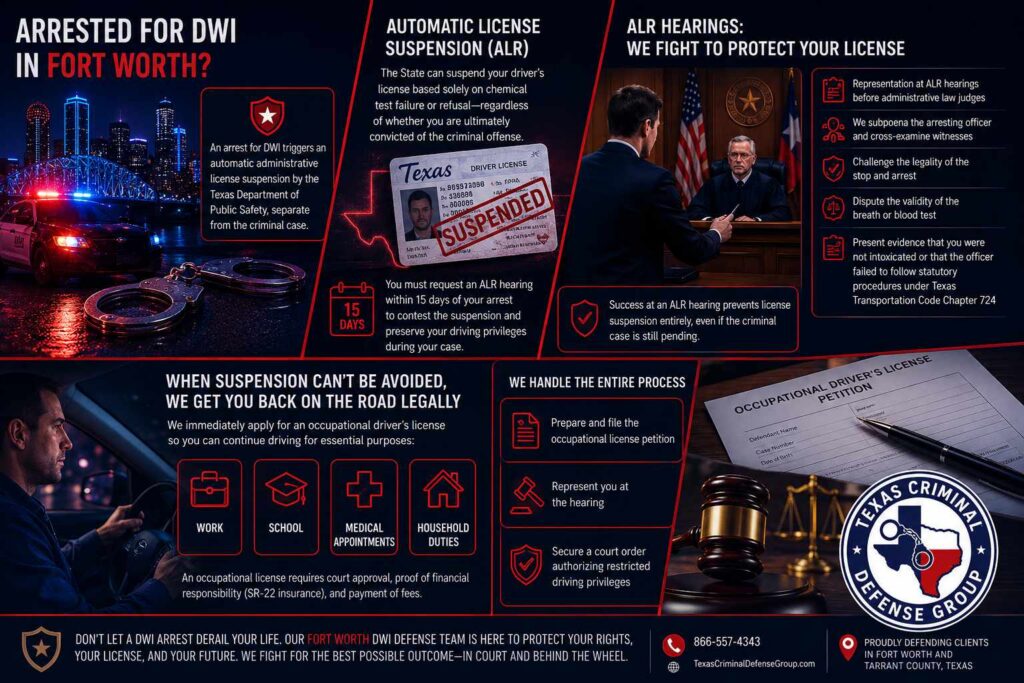
A DWI arrest in Fort Worth sets off an automatic administrative license suspension from the Texas Department of Public Safety, running separately from the criminal case. This administrative license revocation (ALR) track lets the State suspend your driver’s license on chemical test failure or refusal alone, whether or not you are ever convicted of the criminal offense. You have to request an ALR hearing within 15 days of the arrest to fight the suspension and hold onto your driving privileges while the case is pending.
Our DWI defense attorney practice includes appearing at ALR hearings before administrative law judges. We subpoena the arresting officer, cross-examine witnesses, challenge the legality of the stop and arrest, dispute the validity of the breath or blood test, and put forward evidence that you were not intoxicated or that the officer skipped the statutory steps under Texas Transportation Code Chapter 724. A win at the ALR hearing blocks the license suspension outright, even while the criminal case is still open.
When suspension cannot be dodged, we move fast to apply for an occupational driver’s license so you can still drive for the essentials: work, school, medical appointments, and household needs. An occupational license takes court approval, proof of financial responsibility (SR-22 insurance), and fees. We prepare and file the occupational license petition, represent you at the hearing, and secure a court order that authorizes restricted driving and keeps you working and mobile through the suspension.
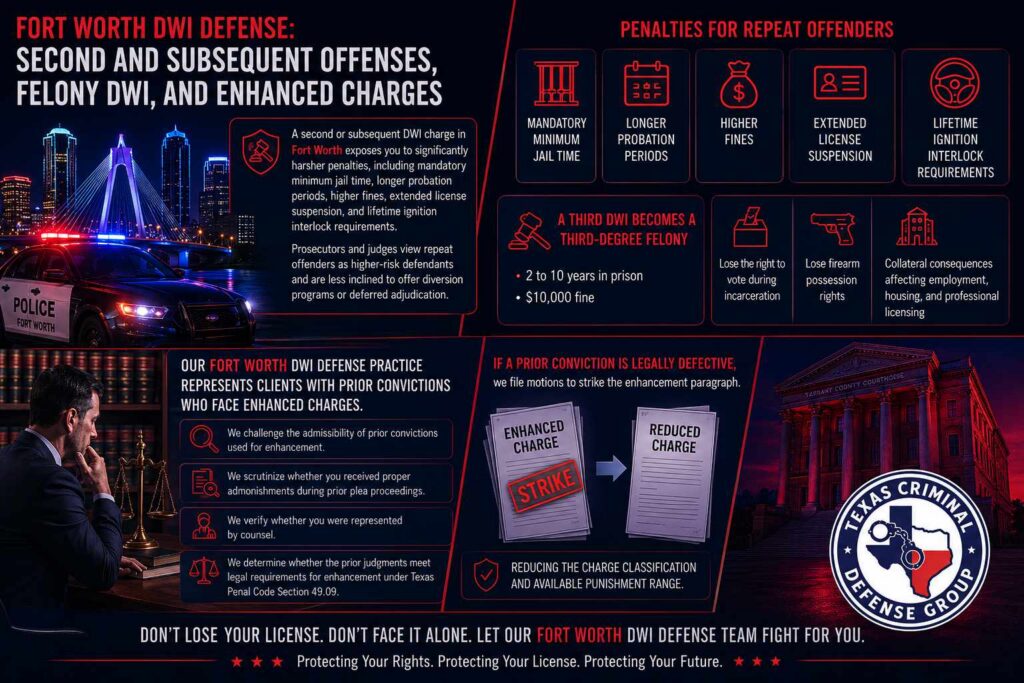
A second or later DWI charge in Fort Worth opens you up to much harsher penalties: mandatory minimum jail time, longer probation, bigger fines, extended license suspension, and lifetime ignition interlock. Prosecutors and judges treat repeat offenders as higher-risk defendants and are slower to offer diversion or deferred adjudication. A third DWI becomes a third-degree felony, punishable by two to ten years in prison and a $10,000 fine. Felony DWI defendants lose the right to vote while incarcerated, lose firearm possession rights, and carry collateral consequences that reach employment, housing, and professional licensing.
Our Fort Worth DWI defense practice represents clients with prior convictions who now face enhanced charges. We challenge whether prior convictions can be used for enhancement at all, checking whether you got proper admonishments in the earlier plea proceedings, whether you had counsel, and whether the prior judgments meet the legal bar for enhancement under Texas Penal Code Section 49.09. If a prior conviction is legally defective, we file motions to strike the enhancement paragraph, which drops the charge classification and the punishment range.
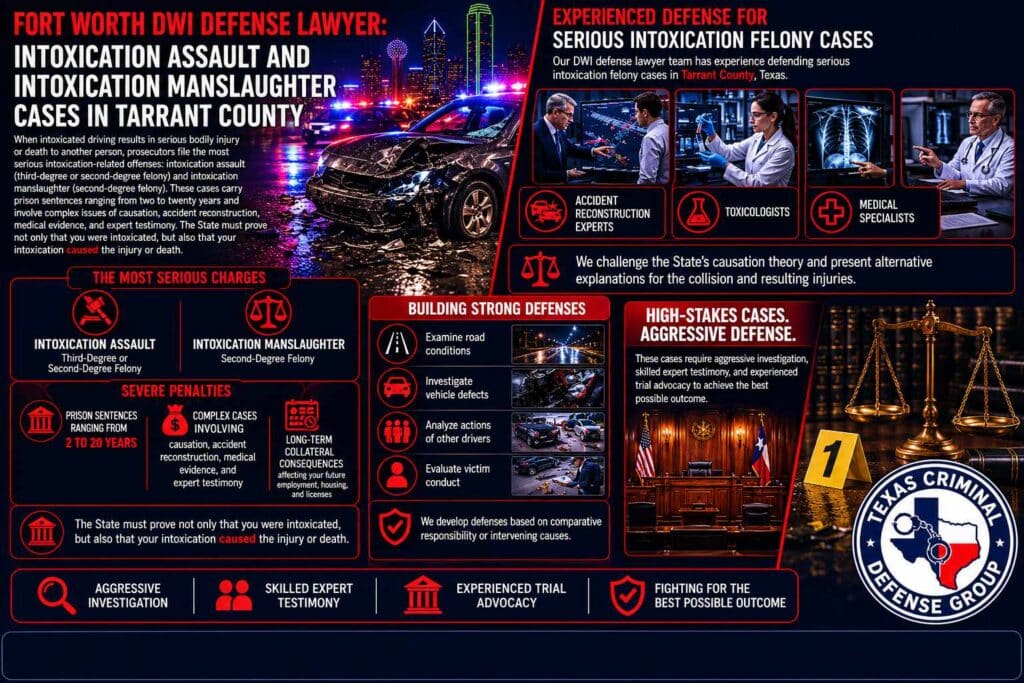
When intoxicated driving leaves someone seriously hurt or dead, prosecutors reach for the most serious intoxication-related offenses: intoxication assault (third-degree or second-degree felony) and intoxication manslaughter (second-degree felony). These cases carry prison ranges of two to twenty years and pull in tough questions of causation, accident reconstruction, medical evidence, and expert testimony. The State has to prove not just that you were intoxicated, but that your intoxication caused the injury or the death.
Our DWI defense lawyer team has experience defending serious intoxication felony cases in Tarrant County, Texas. We bring in accident reconstruction experts, toxicologists, and medical specialists to take apart the State’s causation theory and offer another read of the collision and the injuries. We look at road conditions, vehicle defects, the actions of other drivers, and victim conduct to build defenses grounded in comparative responsibility or intervening causes. High-stakes matters like these demand aggressive investigation, skilled expert testimony, and seasoned trial advocacy to reach the best outcome available.
Commercial driver’s license holders take an unusually hard hit from a DWI arrest in Fort Worth. Federal Motor Carrier Safety Administration regulations and Texas Transportation Code provisions set a lower BAC threshold, 0.04 for commercial vehicle operators, and require automatic disqualification for certain intoxication-related offenses. A single DWI conviction, even behind the wheel of a personal vehicle, triggers a one-year CDL disqualification for a first offense and a lifetime disqualification for a second conviction. Refusing chemical testing in a commercial vehicle brings immediate disqualification. For drivers whose living depends on a valid CDL, these penalties end careers.
Our CDL DWI attorney practice works to preserve commercial driving privileges through hard defense in both criminal court and administrative proceedings. We push for dismissals, acquittals, or reductions to non-disqualifying offenses that let you hold onto your CDL and keep earning. When disqualification cannot be avoided, we help with hardship applications, restricted license petitions, and later reinstatement to shorten the break in your career.
A CDL DWI case calls for specialized command of how state criminal law, federal commercial driving rules, and Texas Department of Public Safety administrative procedure fit together. Our CDL DUI defense work includes challenging the traffic stop, questioning portable breath test results used for roadside screening, disputing the accuracy of evidentiary breath or blood tests, and showing full compliance with commercial vehicle regulations at the time of arrest.
We represent truck drivers, bus operators, delivery drivers, and other commercial vehicle operators in Fort Worth, TX facing DWI charges. That work spans criminal defense in Tarrant County court, administrative license revocation hearings, and CDL disqualification appeals. Where it helps, we coordinate with your employer to supply documentation and legal updates that may bear on your job while the case is pending.