- Start Your Free Consultation
- (866) 557-4343
Prostitution and solicitation charges in Fort Worth put more on the line than a fine or a night in jail. A conviction reaches into your reputation, your job, your professional licenses, and years of collateral fallout that follow the case long after it closes. The Fort Worth prostitution and solicitation lawyer team at Texas Criminal Defense Group defends people arrested for sex-related offenses across Tarrant County, and we build each defense to protect your rights, your freedom, and your future from the first phone call.
Our criminal defense attorneys have spent years handling prostitution, solicitation of prostitution, and related charges in the Fort Worth courts. We pull apart every stage of the arrest, question the police tactics behind it, dig through the digital evidence and witness accounts, and shape a strategy around the specific facts you are facing. Whether the charge grew out of a sting operation, an internet conversation, or a meeting with an undercover officer, you get representation that treats your case as its own, not a template.


Board Certified
Only 1% of Attorney's in TX are Board Certified in Criminal Law

Phones Answered 24/7

5-Star
Google Ratings
over 500
11,500+ Cases Handled

We Fight for Dismissals and Never Back Down from Trial
| Offense Type | Classification | Potential Penalties | Enhanced Factors | Where It’s Heard in Fort Worth |
|---|---|---|---|---|
| First-time prostitution offense | Class B misdemeanor | Up to 180 days jail, fine up to $2,000 | Prior conviction can elevate charge | Tarrant County Criminal Court |
| Second prostitution offense | Class A misdemeanor | Up to 1 year jail, fine up to $4,000 | Multiple arrests increase consequences | Tarrant County Criminal Court |
| Third or subsequent offense | State jail felony | 180 days to 2 years state jail, fine up to $10,000 | Felony record with long-term impact | Criminal District Court (Tim Curry Justice Center) |
| Solicitation involving minor (under 18) | Second-degree felony | 2 to 20 years prison, fine up to $10,000 | Mandatory sex offender registry requirement | Criminal District Court (Tim Curry Justice Center) |
| Promotion/aggravated promotion | Felony (varies by degree) | Significant prison time, substantial fines | Pimping, trafficking, managing prostitution | Criminal District Court (Tim Curry Justice Center) |
Texas Penal Code Section 43.02 defines prostitution as knowingly offering or agreeing to engage in sexual conduct for a fee, or knowingly offering to pay a fee for sexual conduct. Solicitation of prostitution, covered under Texas Penal Code Section 43.021, makes it a crime to knowingly offer or agree to pay a fee to another person for the purpose of engaging in sexual conduct, or to solicit another person in a public place to engage with the actor in sexual conduct for hire. Both crimes sit inside the broader family of sex crimes, and the penalty depends heavily on the facts and on your prior record.
Those distinctions matter more than most people expect. A Fort Worth prostitution lawyer can read the exact charge against you and explain how Texas law lands on your situation. Even a misdemeanor reaches past jail time and money into your employment prospects, professional licenses, immigration status, and personal relationships.
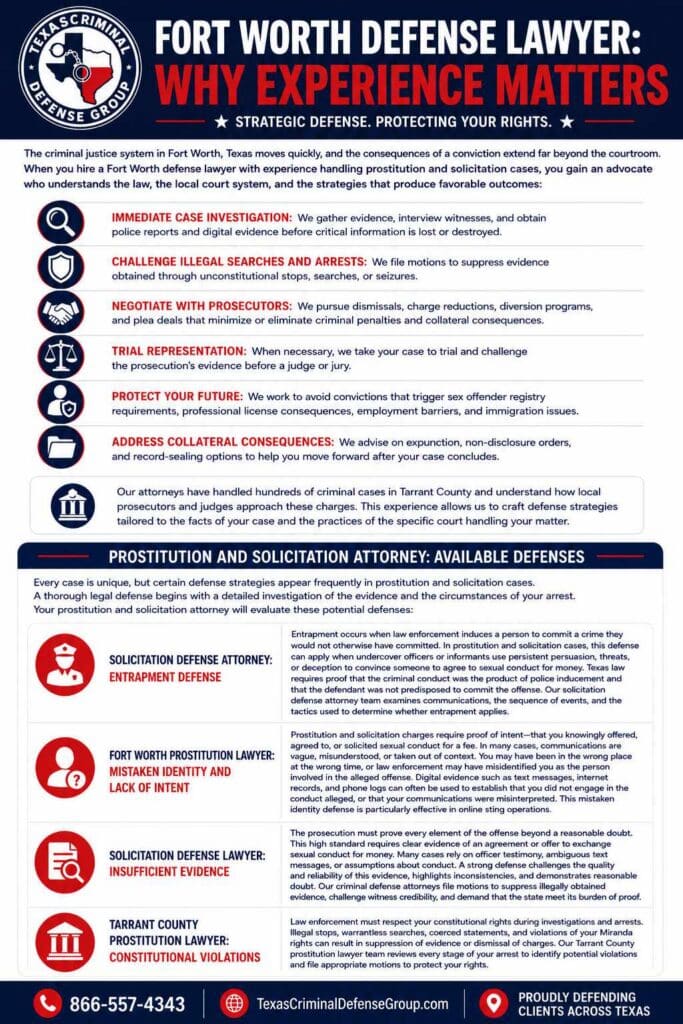
Cases move fast in the Fort Worth criminal courts, and a conviction follows you well past the day you leave the courthouse. Hiring a Fort Worth defense lawyer who has actually worked prostitution and solicitation cases in Tarrant County gives you an advocate who knows the law, knows how the local courts run, and knows which strategies move the needle:
Our attorneys have handled hundreds of criminal cases in Tarrant County and know how the local prosecutors and judges at the Tim Curry Criminal Justice Center approach these charges. That experience lets us tailor the defense to your facts and to the habits of the specific court hearing your matter.
No two cases match, but a handful of defense strategies come up again and again in prostitution and solicitation matters. A real legal defense starts with a close look at the evidence and at how your arrest actually happened. Your prostitution and solicitation attorney will weigh defenses like these:
Entrapment happens when law enforcement pushes a person into a crime they would not have committed on their own. In prostitution and solicitation cases, that can apply when undercover officers or informants lean on persistent persuasion, threats, or deception to get someone to agree to sexual conduct for money. Texas law requires proof that the conduct came from police inducement and that the defendant was not predisposed to commit the offense. Our solicitation defense attorney team combs through the communications, the order of events, and the tactics used to decide whether entrapment fits.
Prostitution and solicitation charges require proof of intent, meaning that you knowingly offered, agreed to, or solicited sexual conduct for a fee. Plenty of the time the communications are vague, misread, or stripped of context. You may have been in the wrong place at the wrong time, or law enforcement may have pinned the alleged offense on the wrong person. Digital evidence like text messages, internet records, and phone logs can often show you never engaged in the conduct claimed, or that your words were misinterpreted. This mistaken identity defense hits especially hard in online sting operations.
The prosecution has to prove every element of the offense beyond a reasonable doubt. That bar demands clear evidence of an agreement or offer to trade sexual conduct for money. A lot of cases lean on officer testimony, ambiguous text messages, or assumptions about what happened. A strong defense goes after the quality and reliability of that evidence, points to the inconsistencies, and builds reasonable doubt. Our criminal defense attorneys file motions to suppress illegally obtained evidence, challenge witness credibility, and hold the state to its burden of proof.
Law enforcement has to honor your constitutional rights through the investigation and the arrest. Illegal stops, warrantless searches, coerced statements, and Miranda violations can lead to suppressed evidence or dismissed charges. Our Tarrant County prostitution lawyer team walks back through every stage of your arrest to find those violations and file the motions that protect your rights.
| Area of Impact | Potential Consequence | Long-Term Effect |
|---|---|---|
| Employment | Difficulty passing background checks, professional license revocation or denial | Reduced earning potential, limited career options |
| Education | Ineligibility for financial aid, scholarship revocation, college admissions barriers | Interrupted academic progress, increased costs |
| Housing | Rejection by landlords and property managers | Difficulty securing rental housing, higher deposits |
| Immigration | Deportation, inadmissibility, denial of naturalization | Permanent exclusion from the United States |
| Child custody | Used as evidence of poor judgment or moral character | Loss of custody or restricted visitation rights |
| Reputation | Public record accessible to employers, family, community | Social stigma, damaged relationships |
Past the jail time and the fines, a conviction for prostitution or solicitation drags collateral consequences into nearly every corner of your life. Weighing those consequences is central to deciding on your defense strategy and to whether you take a plea deal or fight it out at trial:
Our attorneys work to keep those consequences off the table by seeking dismissals, pre-trial diversion, deferred adjudication, or charge reductions that stop short of a final conviction. When a conviction cannot be avoided, we pursue expunction or non-disclosure orders to hold down the long-term hit to your record.
Helping Good People Through Tough Times

When you retain Texas Criminal Defense Group, you get a team that walks you through every stage of the criminal defense process. Here is what working with our Fort Worth solicitation attorney team looks like:
We start with a confidential consultation about the facts of your case, the charges filed, and what you want out of it. We lay out the law, the possible penalties, and the defense options in front of you. That conversation lets you make informed choices about what comes next, and it stays protected by attorney-client privilege with no obligation attached.
Our attorneys get to work on the case right away. We pull police reports, witness statements, video and audio recordings, text messages, internet records, and any other evidence tied to your arrest. We find the soft spots in the prosecution’s case, the contradictions in officer testimony, and the potential constitutional violations. That groundwork becomes the base of your defense strategy.
We file motions to suppress illegally obtained evidence, dismiss charges built on thin probable cause, and call out procedural errors. We also sit down with the Tarrant County Criminal District Attorney’s Office prosecutors to chase favorable outcomes like dismissals, charge reductions, diversion, or deferred adjudication. The goal is always to close your case in a way that guards your record and your future, and to keep you out of trial when that serves you.
When talks do not land an acceptable result, we are ready to try the case. Our criminal defense lawyers bring deep courtroom experience to the Tim Curry Criminal Justice Center, make the arguments, cross-examine the state’s witnesses, attack the evidence, and push for your acquittal. We prepare every case as if it is headed to trial, so your defense is as strong as it can be no matter how the case ends.
If you are convicted or take a plea deal, we walk you through expunction eligibility, non-disclosure orders, and other post-conviction relief. In many cases you can seal or expunge the record after a set time, cutting off public access to your criminal history and easing the long-term collateral consequences of your arrest.
With Over 500 5-Star Reviews TCGD Have a Track Record of Client

One of the heaviest worries for anyone charged with solicitation or prostitution is whether a conviction forces registration as a sex offender. Under Texas law, most misdemeanor prostitution or solicitation offenses do not trigger sex offender registry duties. Certain circumstances can, though, including:
If your charge involves solicitation of a minor or a promotion offense, registration as a sex offender can be mandatory once a conviction lands. That requirement carries brutal long-term weight: limits on where you can live and work, mandatory public disclosure of your personal information, and ongoing reporting duties under Texas Code of Criminal Procedure Chapter 62. Our Tarrant County solicitation lawyer team fights hard to head off convictions that trigger registration and to show the evidence does not back the allegations.
Not every case has to end in a conviction or a trial. Tarrant County and the courts around it run diversion programs and alternative resolutions for certain defendants, first-time offenders in particular. Finish one of these programs and the charges can be dismissed, keeping your record clean. Our Fort Worth legal services for prostitution defense includes pressing for your eligibility and admission into them:
Pre-trial diversion lets eligible defendants complete educational programs, community service, counseling, or similar requirements in exchange for dismissal. These programs usually open up for first-time offenders on misdemeanor charges. Taking part is voluntary, and finishing it leaves no conviction on your record. We work directly with the Tarrant County prosecutors and the program administrators to get you admitted and to keep you in compliance with every condition.
Deferred adjudication is a form of probation that keeps a final conviction off your record if you complete every term and condition. It does involve a guilty plea, but there is no final conviction as long as you finish probation without a violation. Once the probation period ends, you may qualify for a non-disclosure order that seals the record from most public access. It can be a smart route when the evidence is strong but a dismissal is out of reach.
In some cases our attorneys negotiate with the prosecutors to knock prostitution or solicitation charges down to lesser offenses such as disorderly conduct, public lewdness, or other misdemeanors that carry lighter collateral consequences and skip the stigma of a sex-related offense. These plea deals can be an effective way to blunt the impact of your case.