- Start Your Free Consultation
- (866) 557-4343
A theft accusation in Tarrant County puts your freedom, your paycheck, and your reputation on the line at the same time. Shoplifting, credit card fraud, identity theft, or burglary allegations all reach past the courtroom: a theft entry on your record can block an apartment application, cost you a professional license, and shut doors on the jobs you want. Our Fort Worth theft lawyers know exactly what is at stake, and they push back hard to protect your rights from the first hearing at the Tim Curry Criminal Justice Center through final resolution.
Texas grades theft by the value of what was allegedly taken, running from a Class C misdemeanor for property worth under $100 up to a first-degree felony once the property tops $300,000 or certain aggravating factors apply. The Texas Penal Code frames theft in wide terms, covering any situation where a person unlawfully appropriates property meaning to deprive its owner. That reach pulls in shoplifting, employee theft, receiving stolen property, theft of services, and a long list of other scenarios. Every one of them hands an experienced criminal defense attorney its own set of openings to attack.
Our criminal defense lawyers have stood beside clients across Fort Worth, throughout Tarrant County, and around the wider DFW area on every grade of theft charge. We know how the Tarrant County Criminal District Attorney’s Office assembles a theft case, and we know where those cases crack open toward a reduction, a dismissal, or a plea worth taking. When theft allegations land on you, you want a Fort Worth theft attorney who investigates first, challenges the evidence early, and keeps driving for the best outcome the facts allow.


Board Certified
Only 1% of Attorney's in TX are Board Certified in Criminal Law

Phones Answered 24/7

5-Star
Google Ratings
over 500
11,500+ Cases Handled

We Fight for Dismissals and Never Back Down from Trial

Theft is a much bigger category than lifting something off a store shelf. Texas law recognizes numerous forms of theft, and each carries its own elements that prosecutors have to prove. Knowing which version of theft you are actually facing lets your defense lawyer aim strategies straight at the weak points in the allegation. The classification drives the penalties, the defenses that stay on the table, and how much room exists for a favorable plea in Tarrant County.
Shoplifting is still one of the theft charges Fort Worth prosecutors file most often. Theft crimes at retail stores draw heavy scrutiny because chains run layered loss prevention: ceiling cameras, electronic article surveillance tags, and officers trained to build a prosecution file. Plenty of stores insist on pressing charges for every incident no matter how small the value. A criminal lawyer can test whether those loss prevention officers followed their own procedures, whether the footage truly shows intent to steal, and whether the item was ever concealed or carried past the last point of sale.
A first-time offender facing shoplifting allegations may fit a diversion program that keeps a conviction off the record entirely. These tracks usually ask for theft education classes, community service, and payment of court costs. Your Fort Worth theft lawyer works the question of eligibility with the prosecutor and pushes for the least intrusive resolution available in Tarrant County.
Credit card theft and fraud cover using another person’s card or card data without permission. These charges surface constantly: someone uses a relative’s card, keeps using a card after a breakup, or buys online with stolen numbers. Prosecutors lean in hard because the conduct blends deception with a breach of trust. A theft defense lawyer looks at whether you had permission to use the card, whether you reasonably believed you were authorized, and whether the state can actually prove you meant to deprive the owner.
Identity theft charges involve using someone else’s identifying details, a name, Social Security number, or date of birth, to pull goods, services, or other benefits. These files often name several victims and real financial loss, which pushes prosecutors toward enhanced penalties. Federal law enforcement can step in too when the conduct crossed state lines or touched federal benefits. The defense concentrates on whether you actually used the information, whether you knew it belonged to another person, and whether the named victim suffered genuine financial harm.
Auto theft in Texas can mean permanently taking a vehicle or just using it for a while without the owner saying yes. That difference matters, because unauthorized use of a motor vehicle is frequently charged as a separate offense with its own elements and penalties. Many of these cases turn on disputed permission, a borrowed car that never came back, or a repossession gone sideways. Your criminal attorney digs into how you got access to the vehicle, any messages about permission, and whether you ever intended to keep it from the owner for good.
Robbery happens when theft is carried out with force or a threat of force, which converts a property offense into a violent crime carrying far steeper punishment. Aggravated robbery adds a weapon, bodily injury, or a threat against an elderly or disabled victim. A conviction on these charges brings mandatory prison time, so aggressive representation is essential. The defense probes whether force was truly used, whether any weapon was real or merely implied, and whether the identification evidence reliably puts you at the scene.
Burglary charges apply when a person enters a building or habitation without consent intending to commit theft or another crime. Prosecutors do not have to prove a theft ever happened, only that you entered without permission meaning to commit a crime inside. Because so much of that rests on circumstantial proof of intent, an experienced defense lawyer has real room to challenge it. Your attorney can press how the state plans to prove what was in your head at the moment you entered and whether an innocent explanation for your presence exists.
| Theft Classification | Property Value | Offense Level | Maximum Jail/Prison | Maximum Fine | Where It’s Heard in Fort Worth |
|---|---|---|---|---|---|
| Class C Misdemeanor | Less than $100 | Lowest theft offense | No jail time | $500 | Tarrant County Criminal Court |
| Class B Misdemeanor | $100 to $749 | Petty theft level | 180 days in jail | $2,000 | Tarrant County Criminal Court |
| Class A Misdemeanor | $750 to $2,499 | High-level misdemeanor | 1 year in jail | $4,000 | Tarrant County Criminal Court |
| State Jail Felony | $2,500 to $29,999 | Entry-level felony | 2 years in state jail | $10,000 | Criminal District Court (Tim Curry Justice Center) |
| Third-Degree Felony | $30,000 to $149,999 | Mid-level felony | 10 years in prison | $10,000 | Criminal District Court (Tim Curry Justice Center) |
| Second-Degree Felony | $150,000 to $299,999 | Serious felony | 20 years in prison | $10,000 | Criminal District Court (Tim Curry Justice Center) |
| First-Degree Felony | $300,000 or more | Most serious theft | Life in prison | $10,000 | Criminal District Court (Tim Curry Justice Center) |
Texas sorts theft mostly by the value of the property said to be taken. The Texas Penal Code sets clean dollar thresholds that decide whether a theft is charged as a misdemeanor or a felony, and the penalties climb sharply as that value rises. A theft attorney looks past the label to a harder question: can the state actually prove the alleged value beyond a reasonable doubt?
Theft charges grow out of far more than walking merchandise out of a store. You can face a theft allegation for using someone’s credit card without permission, for keeping property you were allowed to borrow but then refused to return, or for holding property you knew or should have known was stolen. In Tarrant County, prosecutors chase these cases hard, and conviction rates stay high for anyone who tries to face the system without seasoned counsel.
Your first sit-down with a Fort Worth criminal defense lawyer is where you finally see your real position and how solid the state’s case actually is. In that meeting your attorney walks through the circumstances of the arrest, looks at any evidence you have, and lays out the charges in plain terms. That early read surfaces potential defenses, procedural mistakes by police, and openings to attack the state’s theory before it hardens.
People routinely underrate how much early legal help changes a theft case. The moment you are charged with theft in Tarrant County, prosecutors start building. Witness accounts settle into place, surveillance footage gets locked down, and the story grows tougher to shake with every passing week. An experienced theft lawyer can start investigating right away, talking to witnesses while memories are still sharp and finding favorable evidence before it slips away.
Helping Good People Through Tough Times
Felony theft charges in Tarrant County carry prison sentences, heavy fines, and permanent felon status. Cases like these demand aggressive representation from attorneys who genuinely handle serious felonies. The stakes are too high to hand your defense to a lawyer who lives in misdemeanor court or has never carried a felony to verdict. Our criminal defense lawyers have tried felony cases before Tarrant County juries at the Tim Curry Criminal Justice Center and know what it takes to win favorable outcomes when everything is on the line.
State jail felonies sit at the entry point of felony theft, covering property valued between $2,500 and $29,999. They rank below the higher-degree felonies, yet a state jail felony conviction still means possible confinement and a permanent record. Judges can hand down sentences ranging from six months to two years in state jail facilities. A first-time offender may earn probation, but that takes convincing the judge you are a fit for community supervision.
Higher-value thefts climb into more serious felony grades with longer exposure. Third-degree felonies involve property worth $30,000 to $149,999 and carry two to ten years in prison. Second-degree felonies involve property worth $150,000 to $299,999 and carry two to twenty years. At those levels, Tarrant County prosecutors seldom agree to probation, and prison time grows likely on conviction. A real defense means attacking the valuation evidence, testing proof of ownership, and probing whether a lesser charge actually fits.
Some aggravating factors bump theft charges to a higher offense level no matter the property value. These include theft of specific items such as firearms or livestock, theft during a declared disaster, theft from elderly victims, and theft tied to government contracting fraud. Texas law spells these enhancements out, and prosecutors reach for them precisely because they drive penalties up fast. Your Fort Worth theft lawyer has to spot any enhancement allegation early and build a plan to knock it down or blunt it.
A theft conviction does its worst damage long after the court is done. The collateral fallout can shadow your life for years, sometimes decades, past the day the case closes. Our theft defense lawyers make sure clients see the whole picture of what a conviction can cost before they weigh any plea offer or defense strategy.
To employers and licensing boards, a theft conviction reads as a mark against your honesty. Many professions require you to disclose criminal history, and a theft conviction can trigger license denial, suspension, or revocation. Healthcare, finance, education, law, real estate, and any role that needs bonding or a security clearance feel it most. Background checks surface theft convictions, and plenty of employers simply will not hire someone carrying a theft-related offense.
For non-citizens, a theft conviction can set off deportation, inadmissibility, or a denied naturalization. Crimes involving moral turpitude, a category that swallows most theft offenses, carry serious immigration stakes. A criminal attorney in Fort Worth teams up with immigration counsel to figure out whether an alternative resolution can keep those consequences from ever triggering for a non-citizen client.
Landlords routinely reject rental applications from people with theft convictions. Credit card companies, banks, and lenders treat a theft conviction as a flag for financial irresponsibility, which can bleed into loan applications and credit terms. Civil restitution judgments can drag down credit scores and sit on credit reports for years.
College applications usually demand disclosure of criminal convictions. Scholarships, financial aid, and admission to competitive programs can all be denied over a theft conviction. Professional schools in law, medicine, nursing, and related fields run character and fitness reviews where a theft conviction raises real red flags.
What you do in the hours right after a theft accusation can steer the entire outcome. Bringing in a Fort Worth theft lawyer before you talk to police or investigators guards your rights and heads off the common missteps that sink a defense.
Police and investigators run practiced interrogation techniques built to draw out incriminating statements, and even an innocent explanation can be twisted or lifted out of context. You hold an absolute right to stay silent and ask for a lawyer. Our criminal lawyers make sure clients invoke those rights cleanly and never hand prosecutors words to use later.
Key evidence vanishes fast. Security footage gets recorded over, witnesses move or go quiet, and physical evidence gets lost or tossed. Defense attorneys move immediately to find and lock down favorable evidence, interview witnesses, photograph scenes, and pin down facts while memories are still fresh.
Fast action lets lawyers attack arrest warrants, search warrants, and probable cause findings before a case builds momentum. When police lack the evidence to establish probable cause, defense attorneys file motions to dismiss or suppress, sometimes ending a prosecution before formal charges are ever filed.
Understanding what to expect during the criminal justice process helps defendants make informed decisions and reduces anxiety about the unknown. A Texas theft attorney guides clients through each stage of proceedings.
| Stage | What Happens | Defense Attorney Role | Timeline |
|---|---|---|---|
| Arrest/Citation | Defendant taken into custody or issued citation | Advise on statement rights, arrange bail | Day 1 |
| Initial Appearance | Magistrate informs defendant of charges and rights | Present bond arguments, enter appearance | Within 48 hours of arrest |
| Discovery | Exchange of evidence between prosecution and defense | Obtain police reports, videos, witness statements | Ongoing throughout case |
| Pretrial Hearings | Motions to suppress, dismiss, or exclude evidence | File and argue motions challenging state’s case | Weeks to months after arraignment |
| Plea Negotiations | Discussions with prosecutor about case resolution | Negotiate for dismissal, reduction, or favorable terms | Throughout pretrial period |
| Trial | Presentation of evidence to judge or jury | Cross-examine witnesses, present defense evidence | Typically 6-12 months after charges filed |
| Sentencing | Court imposes punishment after conviction | Present mitigation evidence, argue for leniency | Immediately after verdict or separate hearing |
Not every theft case proceeds to trial. For first-time offenders or cases involving minimal property values, pretrial diversion programs may offer an alternative path. Tarrant County offers several diversion options where defendants complete community service, pay restitution, and avoid formal conviction. A lawyer for theft charges evaluates whether you qualify for these programs and negotiates with prosecutors to secure admission when appropriate.
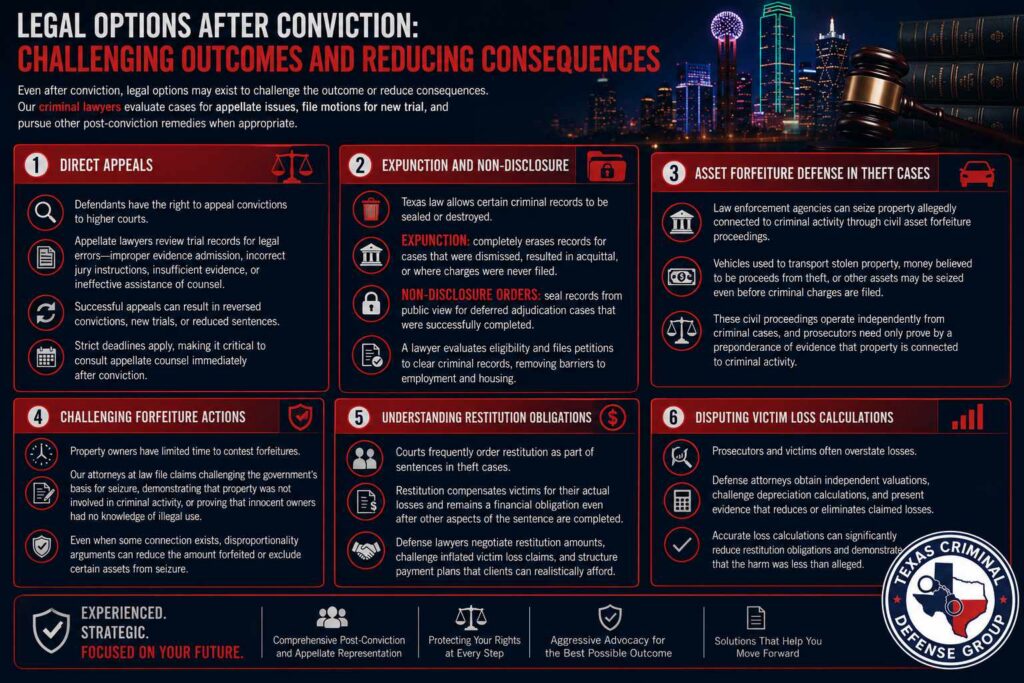
Even after a conviction, options can remain to challenge the result or shrink its consequences. Our criminal lawyers comb cases for appellate issues, file motions for new trial, and pursue other post-conviction remedies whenever the record supports it.
A defendant has the right to appeal a conviction to a higher court. Appellate lawyers read the trial record for legal error: improperly admitted evidence, incorrect jury instructions, insufficient proof, or ineffective assistance of counsel. A winning appeal can reverse a conviction, order a new trial, or cut a sentence. Tight deadlines apply, so consulting appellate counsel right after conviction is critical.
Texas law lets certain criminal records be sealed or destroyed. Expunction wipes out records for cases that were dismissed, ended in acquittal, or where charges were never filed. A non-disclosure order seals records from public view for a deferred adjudication that was completed successfully. A lawyer checks eligibility and files the petitions to clear a record, pulling down barriers to employment and housing.
Law enforcement can seize property said to be tied to criminal activity through civil asset forfeiture. A vehicle used to move stolen property, cash believed to be theft proceeds, or other assets can be taken even before criminal charges are filed. These civil proceedings run separately from the criminal case, and prosecutors only have to show by a preponderance of evidence that the property is connected to crime.
Property owners have only a short window to contest a forfeiture. Our attorneys at law file claims attacking the government’s basis for the seizure, showing the property had no role in criminal activity, or proving an innocent owner knew nothing of any illegal use. Even where some connection exists, disproportionality arguments can shrink the amount forfeited or carve certain assets out of the seizure.
Courts often order restitution as part of a theft sentence. Restitution repays victims for their actual losses and stays a live financial obligation even after the rest of the sentence is finished. Defense lawyers negotiate restitution amounts, challenge inflated victim loss claims, and structure payment plans a client can realistically carry.
With Over 500 5-Star Reviews TCGD Have a Track Record of Client
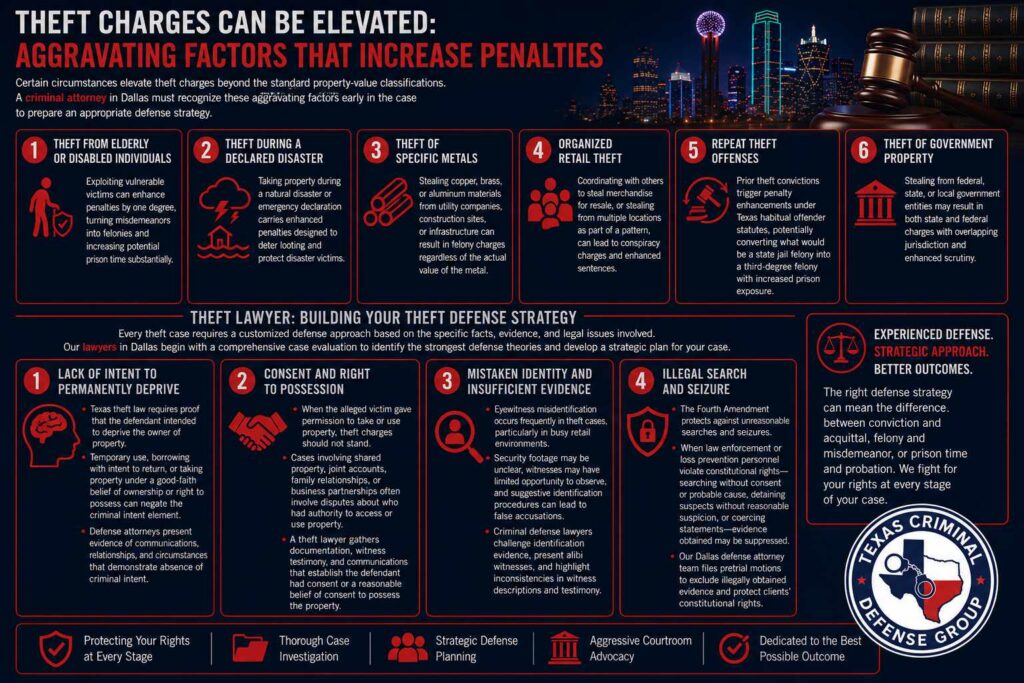
Some circumstances lift theft charges above the plain property-value grades. A criminal attorney in Fort Worth has to catch these aggravating factors early to shape the right defense strategy.
Every theft case calls for a defense built around its own facts, evidence, and legal issues. Our lawyers in Fort Worth open with a full case evaluation to find the strongest defense theories and map a strategic plan for the road ahead.
Texas theft law requires proof that the defendant meant to deprive the owner of property. Temporary use, borrowing with intent to return, or taking property under a good-faith belief of ownership or a right to possess can negate that criminal intent. Defense attorneys put forward the communications, relationships, and circumstances that show criminal intent was never there.
When the alleged victim gave permission to take or use the property, a theft charge should not hold. Cases built on shared property, joint accounts, family ties, or business partnerships often turn on who really had authority to access or use the property. A theft lawyer gathers the documents, testimony, and messages that establish the defendant had consent or a reasonable belief of consent to possess it.
Eyewitness misidentification shows up often in theft cases, especially in crowded retail settings. Footage can be blurry, a witness may have had only a glance, and suggestive identification procedures can seed a false accusation. Criminal defense lawyers attack the identification evidence, present alibi witnesses, and expose the inconsistencies in witness descriptions and testimony.
The Fourth Amendment guards against unreasonable searches and seizures. When police or loss prevention personnel cross constitutional lines, searching without consent or probable cause, detaining a suspect without reasonable suspicion, or coercing a statement, the evidence they gather may be suppressed. Our Fort Worth defense attorney team files pretrial motions to exclude illegally obtained evidence and protect a client’s constitutional rights.