- Start Your Free Consultation
- (866) 557-4343
A drug charge in Lubbock can reach into every part of your life, a conviction can bring jail time, heavy fines, a permanent criminal record, and the loss of a professional license. Whether the allegation is possession, distribution, or manufacturing, the defense you put up early matters. At the Texas Criminal Defense Group, our Lubbock drug attorneys know Texas controlled-substance law, how the local courts run, and how Lubbock County prosecutors build these cases, so we can attack the evidence, negotiate from strength, and shape a defense around the specific facts of your arrest.


Board Certified
Only 1% of Attorney's in TX are Board Certified in Criminal Law

Phones Answered 24/7

5-Star
Google Ratings
over 500
11,500+ Cases Handled

We Fight for Dismissals and Never Back Down from Trial
| Penalty Group | Common Substances | Possession Classification | Key Legal Considerations | Potential Consequences |
|---|---|---|---|---|
| Penalty Group 1 | Cocaine, methamphetamine, heroin, opiates, GHB | State jail felony to first-degree felony | Harshest penalties; less than 1 gram may qualify as state jail felony | 180 days to life in prison, fines up to $250,000 |
| Penalty Group 1-A | LSD and certain hallucinogens | State jail felony to first-degree felony | Measured in abuse units rather than weight | 180 days to life in prison, fines up to $250,000 |
| Penalty Group 2 | Ecstasy (MDMA), PCP, mescaline, mushrooms | State jail felony to first-degree felony | Similar structure to Group 1 with slightly lower penalties | 180 days to life in prison, fines up to $50,000-$250,000 |
| Penalty Group 3 | Valium, Xanax, Ritalin, anabolic steroids | Class A misdemeanor to second-degree felony | Prescription medications with abuse potential | Up to 1 year to 20 years, fines up to $10,000 |
| Penalty Group 4 | Compounds with limited narcotic content | Class B misdemeanor to first-degree felony | Lower penalties; often probation-eligible | Up to 180 days to life in prison, fines vary |
| Marijuana (Cannabis) | Cannabis, hashish, concentrates, edibles, THC | Class B misdemeanor to felony | Separate classification with distinct penalty structure | Up to 180 days to life in prison depending on weight |
Texas sorts controlled substances into penalty groups that drive the severity of the charge and the sentence. The Texas Health and Safety Code divides drugs into Penalty Groups 1, 1-A, 2, 3, and 4, Group 1 covers substances like cocaine, methamphetamine, and heroin, and marijuana sits in its own category with its own weight thresholds. A Lubbock criminal lawyer who concentrates on drug cases knows how prosecutors apply those classifications and how the amount involved decides whether you face a state jail felony or a first-degree felony. Even a small amount of certain drugs can trigger felony prosecution, while larger quantities can push a case toward intent-to-distribute.
Weight is central to sentencing under the Texas Penal Code. Possession of less than one gram of cocaine is a state jail felony, while 400 grams or more can be a first-degree felony carrying a potential life sentence. A lawyer in Lubbock with real drug-case experience knows how to challenge the state’s proof on weight, purity, and usable quantity, scrutinizing the lab reports, the chain-of-custody records, and the testing methods, and holding the state to proving every element beyond a reasonable doubt.

Elite Drug Defense
Top-rated attorneys in Lubbock Texas
Drug cases in Lubbock County are prosecuted by the Lubbock Criminal District Attorney’s Office, which handles a heavy volume of felony drug offenses each year. Misdemeanor drug charges are heard in the Lubbock County Courts at Law, while felony drug charges move through the district courts, the 137th, 140th, and 364th District Courts at the Lubbock County Courthouse on Broadway. Which court you land in, the judge assigned, and the prosecutor on your file all shape the strategy your Lubbock drug attorney uses, and local prosecutors have their own policies on plea negotiations, diversion, and sentencing that differ from other Texas counties.
Lubbock County offers pretrial diversion for eligible defendants, including first-time offenders facing possession, programs built around drug education, community service, and regular testing in exchange for dismissal on successful completion. Eligibility is strict and the prosecutor keeps discretion over who qualifies, so a criminal defense lawyer in Lubbock can push for your admission and present the mitigating facts that support alternative sentencing. Where diversion isn’t on the table, including many cases tied to the Texas Tech community, we prepare to challenge the evidence at trial and pursue acquittal or reduced charges.
Possession is the most common drug charge in Lubbock. Texas law defines it as knowingly or intentionally possessing a controlled substance without a valid prescription, and the state has to prove you knew the substance was there and exercised control over it, which is exactly where a defense opens up. If drugs turned up in a shared car, apartment, or public space, we can argue you lacked knowledge or control, and if the police search was unlawful, the evidence may be inadmissible. We examine the circumstances of the arrest, the police reports, and the witnesses to build a defense aimed squarely at reasonable doubt.
Your constitutional rights are the backbone of the defense. The Fourth Amendment protects you from unreasonable searches and seizures, and the Fifth Amendment protects you from self-incrimination. If police questioned you without Miranda warnings or kept going after you asked for counsel, those statements may be inadmissible. We go through the audio and video, the witness statements, and the police reports to find where law enforcement crossed the constitutional line, because these aren’t technicalities, they’re the limits on government power.
Another line of attack is the chain of custody. From seizure through trial, the controlled substance has to be documented, stored, and tested properly, and any break raises the question of whether what’s in court is what was seized. Crime labs must follow strict protocols, so we subpoena the lab records, request independent testing, and cross-examine the analysts to surface errors or contamination, and even small discrepancies can create reasonable doubt.
Many drug cases lean on confidential informants. We challenge the reliability and credibility of that testimony, look hard at whether the informant had a motive to lie, and review how law enforcement handled them. Courts require police to corroborate an informant before using them to establish probable cause for a warrant or arrest, so if the information is unverified or contradicted, we argue the search or arrest was unlawful.
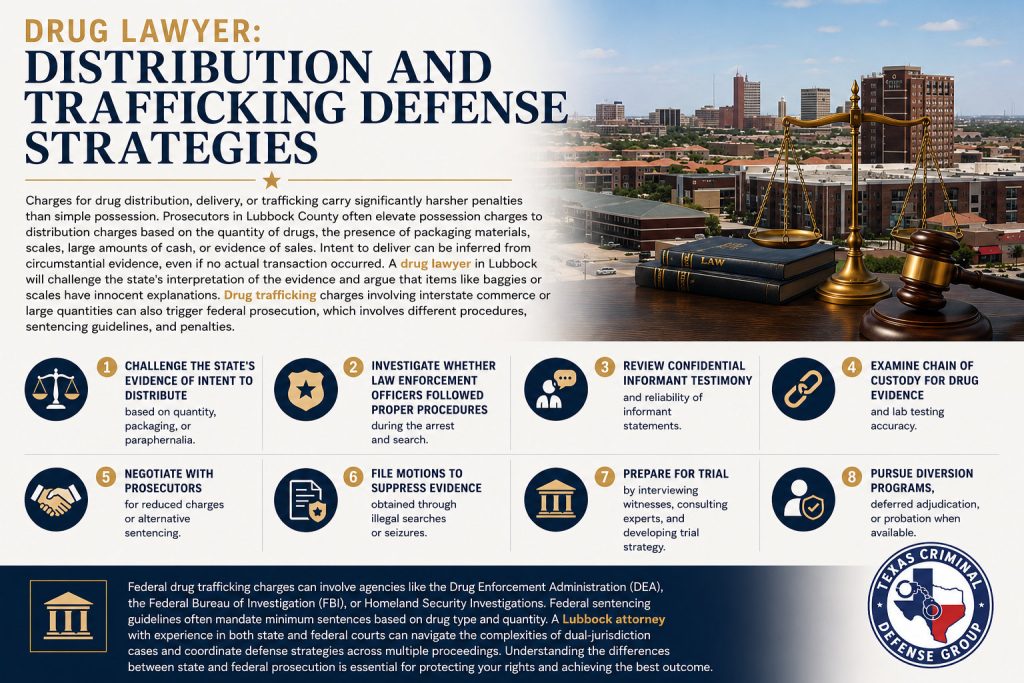
Charges for distribution, delivery, or trafficking carry far harsher penalties than simple possession. Lubbock prosecutors often push a possession charge up to distribution based on the quantity, packaging materials, scales, large amounts of cash, or signs of sales, and intent to deliver can be inferred from circumstantial evidence even with no actual sale. A drug lawyer in Lubbock challenges the state’s read of that evidence and shows that items like baggies or a scale can have innocent explanations. Drug trafficking tied to interstate commerce or large quantities can also draw federal prosecution, which runs on different procedures, sentencing guidelines, and penalties.
Federal drug-trafficking cases can involve the Drug Enforcement Administration (DEA), the Federal Bureau of Investigation (FBI), or Homeland Security Investigations, and federal sentencing guidelines often carry mandatory minimums keyed to drug type and quantity. A Lubbock attorney who works in both state and federal court can manage a dual-jurisdiction case and coordinate the defense across proceedings, and knowing how state and federal prosecution differ is essential to protecting your rights and the outcome.
Helping Good People Through Tough Times
A drug conviction reaches well past jail time and fines. A criminal record can shut you out of jobs, a professional license, student loans, and public housing; for non-citizens it can mean deportation; your right to own a weapon can be permanently restricted; and the conviction can be used to enhance future charges. A law firm in Lubbock focused on criminal defense understands these ripple effects and fights either to avoid the conviction outright or to limit the damage through expunction, nondisclosure, or record sealing where Texas law allows.
Expunction destroys your arrest record as if the arrest never happened. A nondisclosure order seals it from most employers and landlords, though law enforcement and some licensing agencies keep access. Eligibility turns on the outcome of your case and your history, if the charge is dismissed, you’re acquitted, or you complete deferred adjudication, you may qualify. We can walk you through the petition and fight for your clean slate.
Lubbock County has taken part in the broader push for criminal-justice reform in Texas. The Lubbock Criminal District Attorney’s Office has leaned into policies around diversion, treatment, and reduced incarceration for low-level drug offenses like marijuana, but those policies don’t reach every defendant or every charge. Serious cases like trafficking, manufacturing, and distribution are still prosecuted hard, so a criminal defense lawyer in Lubbock has to know the current policies and exactly how they apply to your case. What’s available to one defendant may not be to another, and the strategy has to be built for your circumstances.
Reading the local landscape is part of the job. Shifts in administration, public opinion, and drug policy all move prosecution decisions, even CBD and THC derivatives can be contested territory. A lawyer who’s active in the Lubbock legal community, who knows the players, and who tracks the policy changes brings something beyond black-letter law. The prosecutor on your case, the criminal attorney strategies in play, and the criminal law standards applied all shape the result.
Sentencing for a drug conviction in Lubbock turns on the offense level, your criminal history, and the aggravating or mitigating facts. Texas law allows probation in many drug cases, even some felony offenses, when the defendant is eligible and the judge agrees, with community supervision that can include treatment, counseling, regular testing, community service, and curfews. We put your character, work history, family support, and willingness to get treatment in front of the court to argue probation is the right call, and where incarceration can’t be avoided, we push for the shortest sentence and fight the enhancements.
| Offense Level | Typical Sentence Range | Probation Eligibility | Mitigating Factors | Where It’s Heard in Lubbock |
|---|---|---|---|---|
| Class B Misdemeanor | Up to 180 days in jail, fine up to $2, 000 | Often eligible | First-time offense, small quantity, no prior record | Lubbock County Court at Law |
| Class A Misdemeanor | Up to 1 year in jail, fine up to $4, 000 | Often eligible | Lack of criminal history, employment, family ties | Lubbock County Court at Law |
| State Jail Felony | 180 days to 2 years in state jail | May be eligible | First offense, agreement to treatment, restitution | 137th, 140th, or 364th District Court |
| Third-Degree Felony | 2 to 10 years in prison | Possible with negotiation | Cooperation, lack of violence, successful treatment history | 137th, 140th, or 364th District Court |
| Second-Degree Felony | 2 to 20 years in prison | Difficult but possible | Strong mitigation, exceptional circumstances | 137th, 140th, or 364th District Court |
| First-Degree Felony | 5 to 99 years or life in prison | Rarely available | Substantial assistance to prosecution, extraordinary mitigation | 137th, 140th, or 364th District Court |
Repeat offenders face enhanced penalties under Texas habitual-offender statutes: prior felony convictions let the state seek punishment that raises both the minimum and maximum. A lawyer in Lubbock who knows the enhancement statutes can challenge the use of those priors, argue for concurrent sentences, or negotiate a lower charge that avoids enhancement, and since the gap between a standard and an enhanced sentence can be measured in decades, that work is critical.
With Over 500 5-Star Reviews TCGD Have a Track Record of Client
From the moment of arrest, your constitutional rights are on the line. Officers have to give Miranda warnings before a custodial interrogation, and if they don’t, your statements may be suppressed. You have the right to stay silent and the right to a lawyer, and exercising them can’t be used against you at trial.
A lot of people make the mistake of talking to police without a lawyer, thinking they’ll clear things up, but anything you say can and will be used against you, and even innocent-sounding remarks get bent to fit the state’s theory. A criminal defense lawyer in Lubbock will tell you to invoke your right to silence and counsel the moment you’re arrested, which protects you from self-incrimination and lets your attorney start building the defense.
After arrest, you’re usually taken before a magistrate for a bail hearing, where the court weighs the severity of the charge, your criminal history, community ties, and flight risk. In trafficking cases or those involving large quantities, bail can be set very high or denied, so your attorney can present evidence to argue for a reasonable bond or release on personal recognizance.
If the bond is more than you can afford, your Lubbock drug attorney can file for a bond reduction with proof of your employment, family ties, and roots in the community. In some cases electronic monitoring or other conditions can secure release while ensuring you appear, and getting out matters, because it lets you keep working and help build your defense.
We start by gathering all the evidence, police reports, witness statements, video, lab reports, and any physical evidence, then interview witnesses, visit the scene, and bring in experts where needed, all to find the weak points in the state’s case and build the defense narrative.
Many Lubbock County cases are won or lost on pretrial motions. Where law enforcement ran an illegal search, took a confession without proper Miranda warnings, or violated your rights, we move to suppress that evidence, and without it, the state may have to reduce or dismiss.
Not every case goes to trial. Where the evidence is strong or a deal serves your interests, we negotiate with Lubbock County prosecutors for reduced charges, deferred adjudication, or alternatives, and programs like drug court, veterans court, or mental-health diversion can help you avoid a conviction and address what’s underneath the case.
If the case goes to trial, our criminal lawyers are ready, cross-examining the state’s witnesses, challenging its evidence, calling defense witnesses, and arguing the law to the judge and jury to create reasonable doubt and win an acquittal.